Photo: Wikipedia
Demographics of Nash County
Affluence Level in Nash County
A middle-class area roughly in line with national averages across income, home values, education, and employment.
People of Nash County
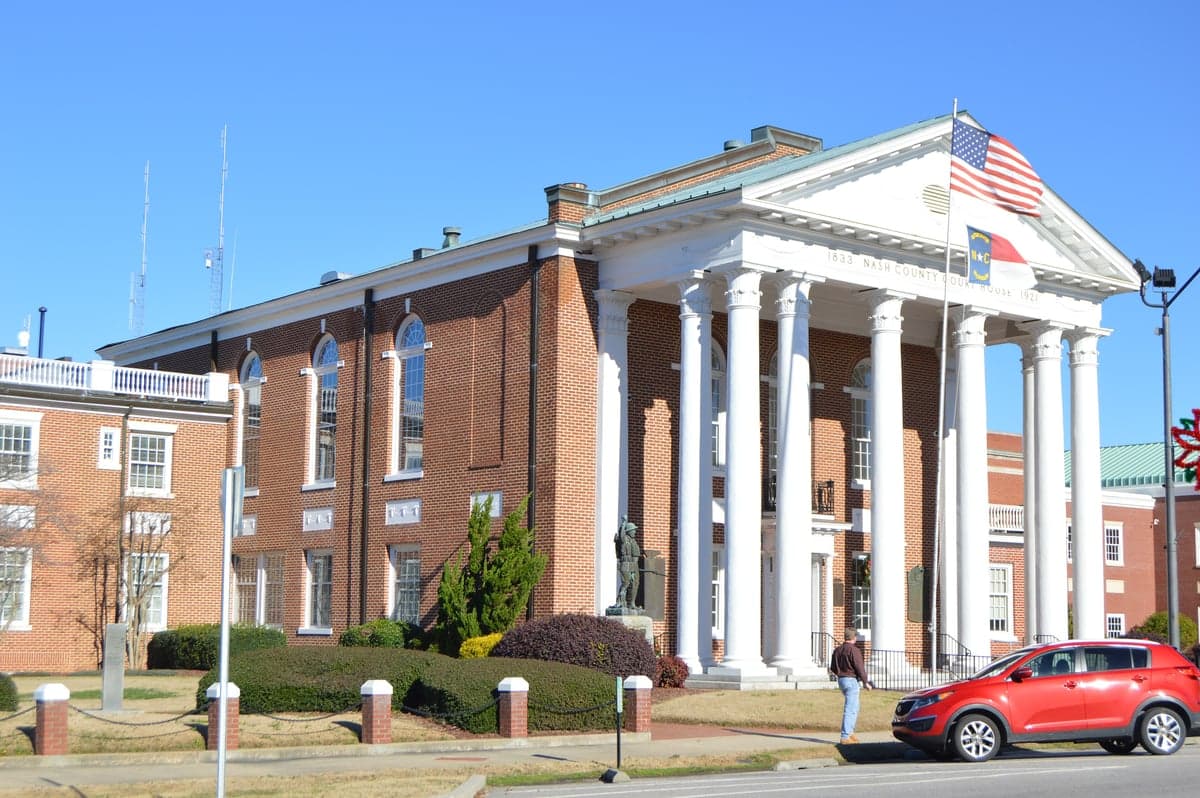
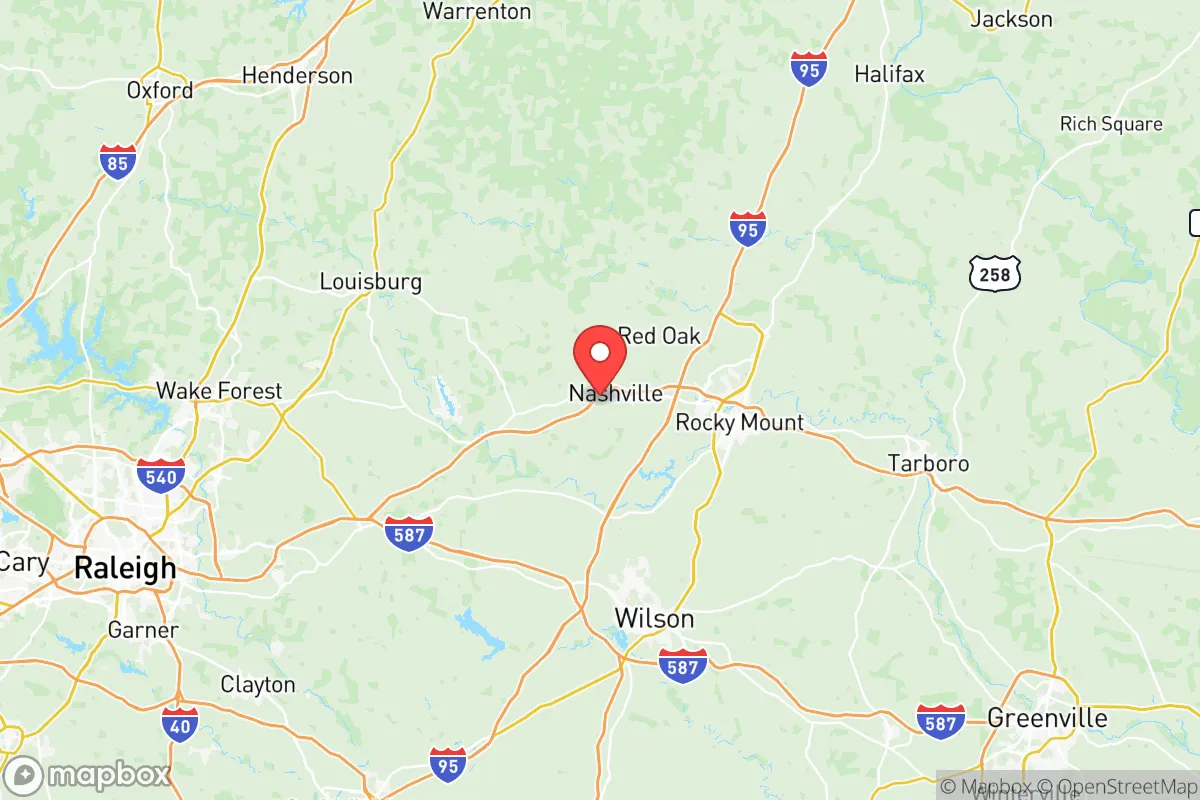
Nash County, North Carolina, is a community of roughly 95,000 residents defined by a nearly even split between White (46.9%) and Black (40.5%) populations, with a growing Hispanic minority (7.9%) and a very small foreign-born share (2.3%). Its people are rooted in a rural, agricultural past, with a strong sense of local identity centered on the twin cities of Rocky Mount (shared with Edgecombe County) and the county seat of Nashville, as well as smaller towns like Spring Hope and Bailey. The county’s character is shaped by a history of plantation agriculture, post-Civil War freedom, and a slow, steady diversification that has only recently begun to accelerate.
Settlement & growth (pre-1960)
Before European settlement, the area now known as Nash County was inhabited by the Tuscarora people, an Iroquoian-speaking tribe who lived in fortified villages along the Tar River. The Tuscarora were largely displaced or killed in the Tuscarora War (1711–1715), after which English and Scots-Irish settlers began moving into the region from the Virginia Tidewater. These early settlers were primarily small farmers, drawn by the promise of fertile, inexpensive land along the river bottoms.
Nash County was officially formed in 1777 from Edgecombe County, named for General Francis Nash, a Revolutionary War hero. The county’s early economy was built on tobacco and cotton, cultivated by enslaved African labor. By 1860, enslaved people made up a majority of the county’s population, a demographic reality that would shape the region for generations. The county’s first incorporated town, Nashville (founded 1780), became the political and commercial hub, while Rocky Mount, straddling the Nash-Edgecombe line, grew as a railroad and cotton-mill town after the Wilmington and Weldon Railroad arrived in the 1840s.
After the Civil War and Emancipation, freed African Americans established independent communities across the county. Many stayed on as sharecroppers and tenant farmers, while others founded all-Black settlements like Momeyer and Castalia. The late 19th and early 20th centuries saw the rise of tobacco warehouses and textile mills in Rocky Mount, which attracted both Black and White workers from the surrounding countryside. The Great Migration (1910–1970) saw tens of thousands of Black residents leave Nash County for Northern industrial cities like Philadelphia and New York, a demographic loss that still echoes in the county’s age structure and family networks.
By 1960, Nash County was still overwhelmingly rural and agricultural, with a population that was roughly 55% White and 45% Black. The county’s small towns—Spring Hope, Bailey, Middlesex, and Sharpsburg—served as market centers for tobacco, cotton, and peanuts. There was virtually no foreign-born population, and the county’s cultural identity was firmly Southern, Baptist, and conservative.
Modern era (post-1965)
The 1965 Hart-Cellar Act had little immediate effect on Nash County, as the region was not a primary destination for post-1965 immigration. The foreign-born population remains very low at 2.3%, far below the national average. However, the county has experienced significant domestic demographic change since the 1970s.
The most notable shift has been the growth of the Hispanic population, which now stands at 7.9%. This wave began in the 1990s, driven by labor demand in agriculture (tobacco, sweet potatoes, and cucumbers) and in construction and poultry processing. Hispanic residents, primarily of Mexican origin, have concentrated in Rocky Mount and in rural areas around Spring Hope and Bailey, where they work on farms and in packing plants. A small but growing number have opened businesses, including tiendas and restaurants, along the U.S. 64 and U.S. 301 corridors.
The Black population share has declined slightly from its 1960 level, now at 40.5%, as some younger Black residents have moved to larger cities like Raleigh and Durham for education and employment. Meanwhile, the White population share has dropped more sharply (46.9%), partly due to an aging demographic and partly due to out-migration. The county’s college-educated share is low at 21.7%, reflecting the area’s historical reliance on manufacturing and agriculture rather than knowledge-economy jobs.
Suburbanization has been modest compared to the explosive growth of the Raleigh-Durham metro area to the west. However, the western edge of Nash County, particularly around Middlesex and Zebulon (in adjacent Wake County), has seen some spillover from the Research Triangle. This has brought a small influx of White and Asian professionals, though the Asian population (East/Southeast Asian) remains tiny at 0.3%, and the Indian-subcontinent population is just 0.5%.
The future
Nash County is projected to become slightly more diverse over the next 10–20 years, but the pace of change will be slow. The Hispanic population is expected to continue growing, potentially reaching 12–15% by 2040, driven by both natural increase and continued labor demand in agriculture and light manufacturing. The Black population share is likely to remain stable or decline slightly, as younger Black residents continue to leave for urban centers. The White population will continue to age and shrink as a share of the total.
New communities are likely to concentrate in the western part of the county, closer to the Research Triangle’s job market, particularly around Middlesex and along the U.S. 64 corridor. Rocky Mount will remain the economic and cultural anchor, but its growth will be constrained by competition from nearby Raleigh and Wilson. The county’s cultural identity is slowly evolving from a strictly biracial Black-White Southern model to a triracial one, with Hispanic residents becoming an increasingly visible part of public life, especially in schools and churches.
The next decade will likely see continued out-migration of young adults, a trend that will keep the population growth rate low (the county grew by only 1.5% between 2010 and 2020). Without a major economic catalyst—such as a large employer or a highway expansion—Nash County will remain a relatively stable, slowly diversifying rural community.
For someone moving in now, Nash County offers a place where the pace of change is manageable, the cost of living is low, and the community is still small enough that personal relationships matter. It is not a destination for those seeking rapid growth or cosmopolitan diversity, but it is a solid, affordable choice for families and individuals who value a slower, more traditional way of life rooted in agriculture and small-town Southern culture.

* Values derived from national, state, county, city and local statistics and may differ in a specific area. Last updated: 2026-07-17T00:19:35.000Z
Narrative content on this page is AI-generated and may contain mistakes. Verify any details that matter before acting on them.
ReloMaps may earn a commission from affiliate links at no extra cost to you.

