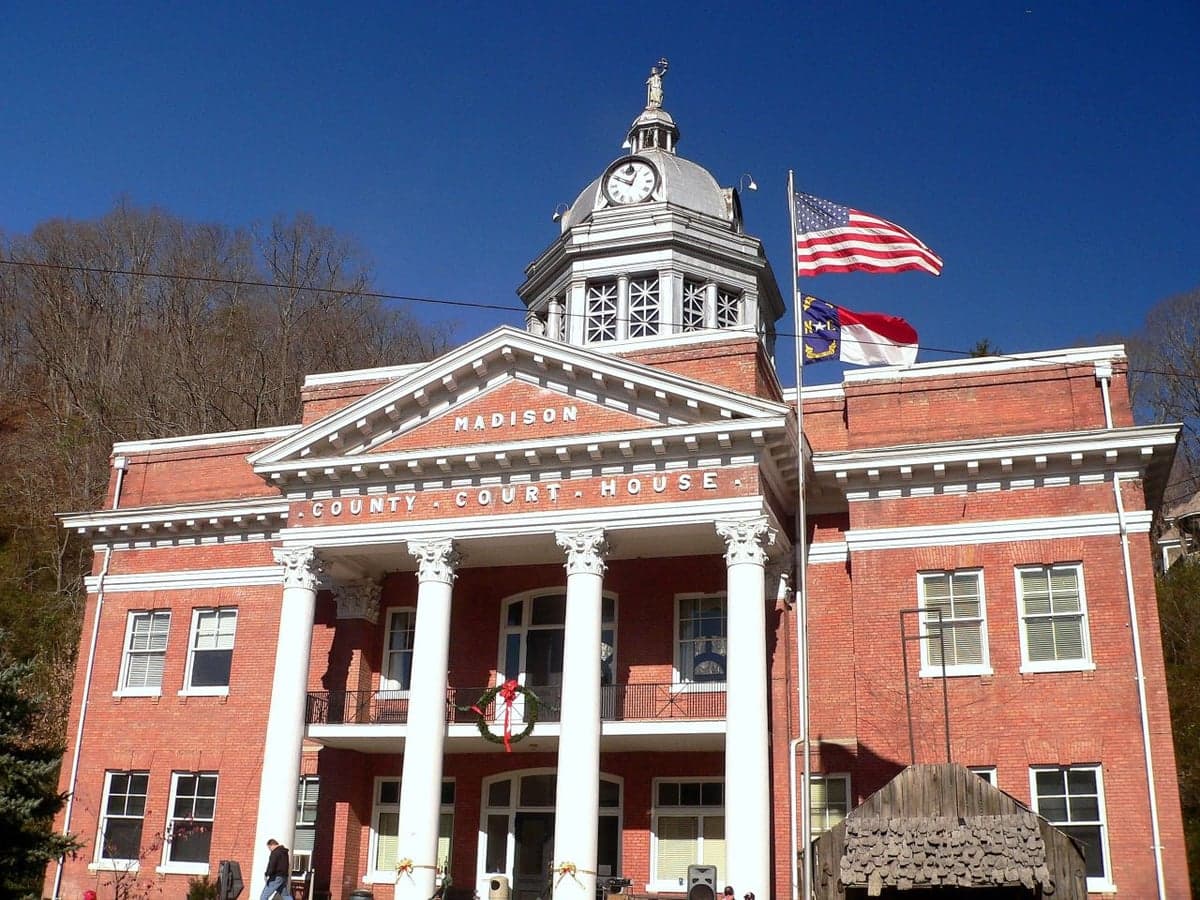
Photo: Wikipedia
Political ClimatePolitical Climate in Madison County
Showing county-level results — no local-only data available.
Lean and PVI are calculated from this county’s 2020 and 2024 presidential results, Cook-style.
Political rankings in North Carolina
- Most Conservative Cities in North Carolina
- Most Liberal Cities in North Carolina
- Best Liberal-Leaning Towns in the South
- Best Liberal-Leaning Towns in Appalachia
- Safest Liberal-Leaning Towns in the South
- Safest Conservative-Leaning Towns in the South
- Safest Conservative-Leaning Towns on the East Coast
- Affordable Small Towns for Conservatives
- Most Conservative Counties in North Carolina
- Most Liberal Counties in North Carolina
Local Political AnalysisPolitical Analysis of Madison County
Madison County sits at R+5 on the Cook Partisan Voting Index, making it a solidly Republican county in a state that’s essentially a coin flip at R+1. But if you’ve lived here as long as I have, you know the sticker on the bumper only tells part of the story. The county has been trending redder over the last decade, but it’s not a monolith—the political geography splits pretty cleanly between the mountain hollows and the river valleys, and that split is getting more pronounced with every election cycle.
How it compares
North Carolina as a whole is a classic swing state—R+1 means statewide races are decided by a point or two, and the state flips between Democratic and Republican control depending on the year. Madison County’s R+5 is a different animal. That’s a comfortable but not overwhelming Republican margin, similar to what you’d see in neighboring Yancey County or parts of Mitchell. The gap matters: in a presidential year, Madison typically goes for the GOP candidate by 8 to 12 points, while the state as a whole might only break that way by 1 or 2. The county’s trajectory is also distinct. While urban centers like Asheville and Charlotte have shifted left, Madison has drifted right, driven largely by in-migration of retirees and remote workers who came for the mountains but brought their politics with them.
What this means for residents
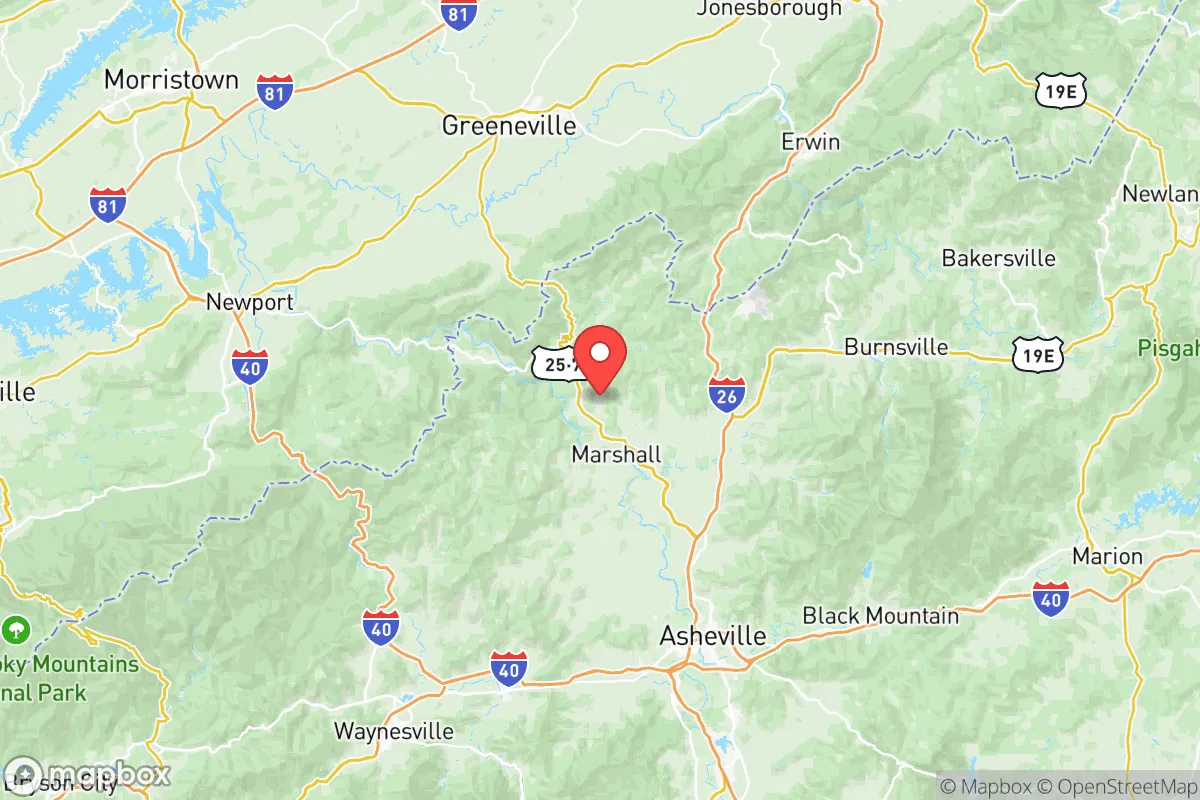
For conservatives, the R+5 lean means local offices—county commission, sheriff, school board—are reliably held by Republicans, and the primary is often the real election. You’ll see that play out in places like Marshall, the county seat, where the courthouse politics are deeply entrenched. For liberals, it means you’re in the minority, but not an invisible one. The town of Hot Springs, with its tourist economy and Appalachian Trail traffic, leans noticeably bluer, and the precincts around Mars Hill—home to Mars Hill University—are the closest thing the county has to swing territory. In the 2024 cycle, those two areas were the only precincts where Democrats cracked 45% of the vote. The practical effect is that progressive residents tend to focus their energy on state and federal races, where their votes actually matter in a competitive state, rather than local contests where the outcome is rarely in doubt.
What this means for residents
If you’re moving here, the political climate shapes daily life in tangible ways. Property taxes are low—the county keeps a tight budget—but so are public services, and that’s a direct reflection of the local majority’s priorities. Gun rights are taken seriously, and you’ll see “Come and Take It” flags flying alongside American flags on porches in places like Walnut and Luck. On the flip side, the county has embraced some non-partisan issues: broadband expansion has been a rare point of unity, and the push to preserve the French Broad River has support across the aisle. The school system in Mars Hill tends to be the most moderate, reflecting the university’s influence, while the rural eastern precincts near the Yancey County line are the most conservative.
Looking ahead, the trajectory is likely to hold. The county is growing—slowly, but steadily—and the new arrivals are split between retirees from Florida and the Northeast (mostly Republican) and younger remote workers drawn to the outdoors (more mixed). That means the R+5 could tighten to R+3 or R+4 over the next decade, but it’s hard to see Madison flipping blue anytime soon. The cultural identity here is rooted in self-reliance and suspicion of distant government, whether that government sits in Raleigh or Washington. That’s a through-line that’s held for generations, and it’s not going anywhere.

State Political ClimatePolitical Climate in North Carolina
State Political AnalysisPolitical Environment in the State
North Carolina is the closest thing the country has to a 50-50 state right now, with a Cook PVI of R+1 that undersells just how tight every statewide race has become. The state has swung from solidly Republican in the 2010s — Mitt Romney won it by 2 points in 2012 — to a genuine toss-up where Donald Trump carried it by just 1.3 points in 2020 and by roughly 3 points in 2024. What makes North Carolina unique is that it's not drifting left like its Southern neighbors; it's a state where the rural-urban split is so evenly balanced that a few thousand votes in the suburbs of Charlotte and Raleigh decide everything.
Urban vs. rural divide
The political map of North Carolina is a tale of two crescents. The urban crescent runs from Charlotte up through the Triad (Greensboro, Winston-Salem, High Point) and over to the Research Triangle (Raleigh, Durham, Chapel Hill). These metros are the Democratic engine — Mecklenburg County (Charlotte) and Wake County (Raleigh) alone account for nearly a quarter of the state's votes, and both have been trending bluer every cycle. Durham is the state's most liberal city, with a heavy university and tech presence, while Chapel Hill is essentially a college town that votes 80% Democratic. The rural crescent — the eastern coastal plain, the Sandhills, and the western mountain counties — is deeply Republican. Counties like Johnston, Cabarrus, and Union, which ring the metros, have become the decisive battlegrounds; they're growing fast with conservative-leaning transplants and reliably deliver 60-65% Republican margins. The 2024 results showed this split perfectly: Trump won 92 of 100 counties, but Harris nearly won the state because the eight counties she carried are so populous. New residents moving to the exurbs of Charlotte or the Raleigh suburbs of Holly Springs and Apex will find themselves in the political center of gravity — these are the places where statewide elections are actually decided.
Policy environment
North Carolina's policy environment is a study in contrasts — fiscally conservative, socially moderate-to-conservative, with a strong streak of local control. The state has a flat income tax that's been ratcheted down from 5.25% in 2019 to 4.25% in 2025, with a scheduled path to 3.99% by 2027. The corporate tax rate is already at 2.5%, among the lowest in the nation, and the state has no estate tax. Sales tax is around 4.75% state-level, but local counties add their own, pushing the effective rate to 6.75-7.5% in most metros. Regulation is generally business-friendly — North Carolina is a right-to-work state, and the General Assembly has consistently resisted minimum wage increases and union-friendly legislation. On education, the state has a robust school choice program: the Opportunity Scholarship program is now universal, meaning any family can use state funds for private school tuition, and there's no income cap. Healthcare is where things get complicated — the state finally expanded Medicaid in 2023 under a Republican legislature, a pragmatic move that covered roughly 600,000 new residents, but it remains one of the stricter states on abortion, banning the procedure after 12 weeks with limited exceptions. Election law is moderately restrictive: voter ID is required, early voting is generous (17 days), and same-day registration is available during early voting. The state does not have a ballot initiative process, which means all policy changes flow through the legislature — a fact that gives the Republican majority significant structural power.
Recent policy direction
The last five years have seen North Carolina's Republican supermajority (which they held from 2022 to 2024, and regained in 2025) push a distinctly conservative agenda. The 2023 session was the most consequential in decades: the legislature overrode Democratic Governor Roy Cooper's veto to pass the 12-week abortion ban (SB 20), enacted universal school choice, and passed a permitless carry law for handguns (SB 41), making North Carolina one of roughly 25 states where concealed carry requires no permit. On gun policy, the state is now solidly in the "constitutional carry" camp, though it still requires a purchase permit for handguns from the sheriff — a vestige of older law that's been a flashpoint. On education, the legislature passed the Parents' Bill of Rights (HB 755) in 2023, requiring schools to notify parents of any changes to a child's health or well-being and banning instruction on gender identity in K-4. On voting, the state passed stricter voter ID rules (SB 824) in 2018, which were upheld by the state Supreme Court in 2023 after years of litigation. The 2024 session added a ban on gender-affirming care for minors (HB 808) and a law requiring sheriffs to cooperate with federal immigration detainer requests (HB 10). Property rights are strong — the state has a "Dillon's Rule" structure that limits local government authority, meaning counties and cities can't pass their own gun, rent control, or sanctuary policies without state approval. For a relocator, the practical takeaway is that North Carolina is moving in a consistently conservative direction on most liberty issues, but it's not a free-for-all — the state still has a sales tax on groceries (though at a reduced 2% rate), and local zoning in the metros remains restrictive.
Civil unrest & political movements
North Carolina has a visible but relatively contained activist scene on both sides. The 2020 George Floyd protests in Charlotte and Raleigh were significant — Charlotte saw several nights of demonstrations and some property damage, and Raleigh's protests led to the toppling of a Confederate statue on the Capitol grounds. The state has a strong progressive organizing infrastructure centered in Durham and Chapel Hill, with groups like the NC NAACP and Down Home NC running active campaigns on voting rights and Medicaid expansion. On the right, the state has seen a surge in county-level GOP activism, particularly around election integrity — the 2020 and 2022 cycles saw numerous county boards of elections flooded with challenges and recounts, though no widespread fraud was ever substantiated. The immigration debate is live but not explosive: the state has no sanctuary cities (state law prohibits them), but the 2024 HB 10 law requiring sheriff cooperation with ICE has been a point of contention, with several urban sheriffs — including in Durham and Wake — publicly resisting. There's also a small but vocal "Mountain State" movement in the far western counties, where some residents have floated secession from North Carolina over cultural and political differences with the urban east — it's mostly rhetorical, but it reflects a real sense of alienation in places like Boone and Asheville. New residents will notice the political energy mostly through yard signs and local Facebook groups; the state doesn't have the kind of visible street-level unrest you'd see in Portland or even Atlanta.
Projection
Over the next 5-10 years, North Carolina is likely to remain a battleground, but the trajectory favors a slow rightward drift on policy even as the electorate stays competitive. The state is growing by roughly 100,000 people a year, and the in-migration is split — retirees and remote workers from the Northeast and California are moving to the mountains and the coast (Asheville, Wilmington, and the Charlotte suburbs), while the Research Triangle continues to attract a younger, more diverse, and more Democratic-leaning workforce. The 2024 election saw the GOP hold the legislature and win the governorship (Josh Stein, a Democrat, won the governor's race, but the legislature remains veto-proof Republican). The demographic math is tricky: the state's Black population (about 22%) is heavily Democratic and growing, but the white working-class vote in the rural east and west is becoming more Republican, and the Hispanic population (about 10%) is split — more conservative than national averages on social issues but leaning Democratic on immigration. The most likely scenario is a continuation of the current pattern: Republican control of the legislature and most statewide offices, with Democratic strength confined to the metros. The flat tax will likely drop to 3.99% by 2027, school choice will expand further, and the state will continue to attract business relocations — it's been the top or near-top state for corporate relocations for a decade, with companies like Apple, Google, and Toyota all announcing major expansions. A new resident moving in now should expect a state that's politically competitive but policy-conservative, with a growing economy and a cost of living that's still below the national average, especially outside the Charlotte and Raleigh metros.
For a new resident, the bottom line is that North Carolina offers a genuinely balanced political environment — you'll find plenty of like-minded neighbors whether you lean left or right, but the state's policy direction is clearly conservative on taxes, guns, education, and social issues. If you're coming from a blue state, expect a lower tax burden, more school choice, and a more permissive gun environment, but also a state that's still figuring out its identity on healthcare and social services. If you're coming from a deep red state, you'll find a more competitive political scene, with real Democratic representation in the cities and a legislature that's conservative but not extreme. The state's biggest political asset is its stability — no one is predicting a dramatic shift in either direction, and the practical effect is that your vote will actually matter here, which is more than you can say for most states in 2026.
* Values derived from national, state, county, city and local statistics and may differ in a specific area. Last updated: 2026-10-28T00:08:22.000Z
Narrative content on this page is AI-generated and may contain mistakes. Verify any details that matter before acting on them.
ReloMaps may earn a commission from affiliate links at no extra cost to you.

