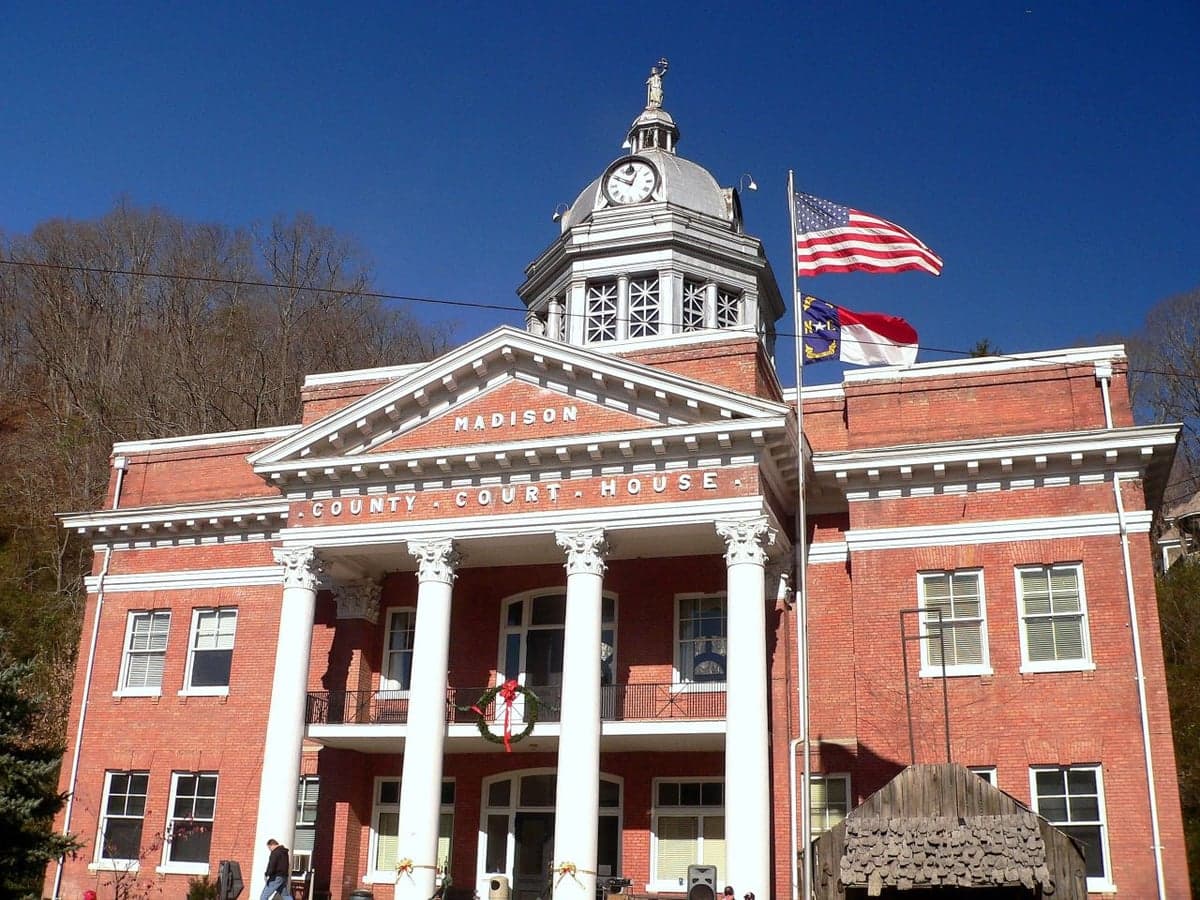
Photo: Wikipedia
Personal Sovereignty in Madison County
Viable for self-reliance. Generally workable, though some barriers may limit total independence.
What does Personal Sovereignty tell us?
Personal Sovereignty measures your capacity for self-reliance and independence with minimal government friction. Higher scores mean fewer barriers between you and the way you want to live... but it assumes you have the space you need and good neighbors.
What does this tell us?
Personal Sovereignty measures your capacity for self-reliance and independence with minimal government friction. Higher scores mean fewer barriers between you and the way you want to live... but it assumes you have the space you need and good neighbors.
State Policy
Energy independence: Importer (24% of energy produced in-state)
Personal Liberty
Homesteading

Personal Liberty Analysis
Madison County, North Carolina, offers one of the strongest personal sovereignty environments in Western North Carolina, combining a light regulatory touch with deep-rooted traditions of self-reliance. The county’s roughly 22,000 residents enjoy a tax burden and land-use climate that are markedly more permissive than what you will find in nearby Buncombe County or the Asheville metro area, yet the region still sits within a state that has moved decisively toward individual liberty on firearms, medical choice, and parental authority. For a single individual or family weighing independence against access to services, Madison County presents a genuine trade-off: maximum autonomy with minimal government interference, purchased at the cost of distance from urban infrastructure.
How the tax burden and regulatory climate compare to surrounding counties
Madison County’s fiscal posture is among the most favorable in the region for those seeking to keep more of their earnings. The county property tax rate sits at approximately 0.57 per $100 of assessed value, which is noticeably lower than Buncombe County’s rate of roughly 0.61 and far below the combined city-county burden inside Asheville city limits. North Carolina’s flat state income tax of 4.75% applies uniformly, but the absence of a separate county income tax and the lack of any municipal property taxes in most unincorporated areas keeps the total effective rate competitive. The county’s regulatory posture is equally restrained: there is no countywide zoning ordinance covering most rural parcels, meaning that in communities like Marshall, Hot Springs, and Mars Hill, landowners generally face fewer hurdles for outbuildings, home-based businesses, and agricultural uses than their counterparts in more urbanized counties. The town of Marshall does maintain its own zoning for the historic downtown corridor, and Hot Springs has limited municipal oversight, but the vast majority of the county’s land area operates under minimal county-level land-use regulation. Building permits are still required for new construction, but the county’s inspection staff is small and the process is generally straightforward compared to the multi-department reviews common in Buncombe or Henderson counties.
Self-defense rights and gun law specifics in Madison County
North Carolina is a shall-issue state for concealed carry permits, and Madison County’s sheriff’s office processes applications without the discretionary denials seen in some urban jurisdictions. The state does not require a permit to purchase a rifle or shotgun, and handgun purchases from private sellers do not require a background check, though licensed dealers still run federal checks. Permitless open carry is legal for anyone who can lawfully possess a firearm, and in 2023 the state enacted permitless concealed carry for adults 18 and older who are not otherwise prohibited, making North Carolina one of the more permissive carry states in the Southeast. Madison County’s culture reflects this legal framework: gun ownership is widespread, and the county has no local ordinances restricting firearm possession in public parks or county buildings beyond state statutory minimums. For those interested in training, the Mars Hill area and the county’s rural shooting ranges offer practical options, and the sheriff’s office historically issues concealed carry permits in a matter of weeks rather than months. Stand-your-ground protections apply statewide, and North Carolina’s Castle Doctrine presumes a reasonable fear of death or great bodily harm when an intruder unlawfully enters a home or occupied vehicle.
Homesteading viability, lot sizes, and off-grid feasibility across the county
Madison County is one of the most homestead-friendly counties in Western North Carolina, largely because of its mountainous terrain and the absence of aggressive subdivision regulations. Minimum lot sizes in the unincorporated areas are generally one acre for parcels with a well and septic system, but many landowners purchase larger tracts of 5 to 20 acres in the more remote sections around Trust, Walnut Creek, and Spring Creek at prices well below the Asheville market. Off-grid living is legally feasible: the county does not mandate connection to a public utility, and solar installations with battery storage are increasingly common in the Laurel Valley and Big Laurel areas. Rainwater collection is not prohibited, and composting toilets are permitted under the state’s on-site wastewater rules, though a licensed septic system is still required for any permanent dwelling. The county’s agricultural extension office actively supports small-scale farming, and the local farmers markets in Marshall and Hot Springs provide outlets for produce, eggs, and meat. One caveat: the mountainous topography means that many parcels have limited buildable area, and driveway construction on steep slopes can be costly. Buyers should verify road maintenance agreements and access easements, as some remote properties rely on private gravel roads that the county does not maintain.
Personal liberties: parental rights, medical autonomy, speech, and property
North Carolina has moved in a distinctly liberty-oriented direction on several fronts that matter to sovereignty-minded residents. The state’s Parents’ Bill of Rights, enacted in 2023, gives parents explicit authority over their children’s education, medical care, and school records, and Madison County’s school board has generally aligned with conservative parental-oversight priorities. Medical autonomy is protected by state law allowing individuals to refuse any medical treatment, and North Carolina does not mandate COVID-19 vaccinations for adults or children. The state also prohibits mask mandates in public schools and has restricted vaccine requirements for employment in most settings. On speech and property, Madison County is a stronghold of traditional First Amendment protections: the county commission does not restrict political signage on private property, and there are no local noise ordinances that would impede a home workshop or farm operation. Property rights are further bolstered by North Carolina’s ag-gag law restrictions and the state’s relatively narrow eminent domain authority, which requires a public purpose and just compensation. The county’s small-town atmosphere in Marshall and Hot Springs means that community norms, rather than formal regulations, often govern behavior, but those norms tend to favor live-and-let-live attitudes toward firearms, homeschooling, and alternative building methods.
Compared to the broader Asheville metro or the more heavily regulated counties of the North Carolina Piedmont, Madison County ranks among the top tiers of personal sovereignty in the state. The combination of a low property tax rate, minimal zoning, permitless carry, and a county culture that prizes self-sufficiency creates an environment where individuals and families can largely set their own terms. The trade-offs are real — fewer services, longer drives to hospitals and major retail, and a reliance on personal infrastructure for water, heat, and access — but for those who prioritize autonomy over convenience, Madison County delivers a level of personal freedom that is increasingly rare in the modern Southeast.

* Values derived from national, state, county, city and local statistics and may differ in a specific area. Last updated: 2026-10-28T00:08:22.000Z
Narrative content on this page is AI-generated and may contain mistakes. Verify any details that matter before acting on them.
ReloMaps may earn a commission from affiliate links at no extra cost to you.

