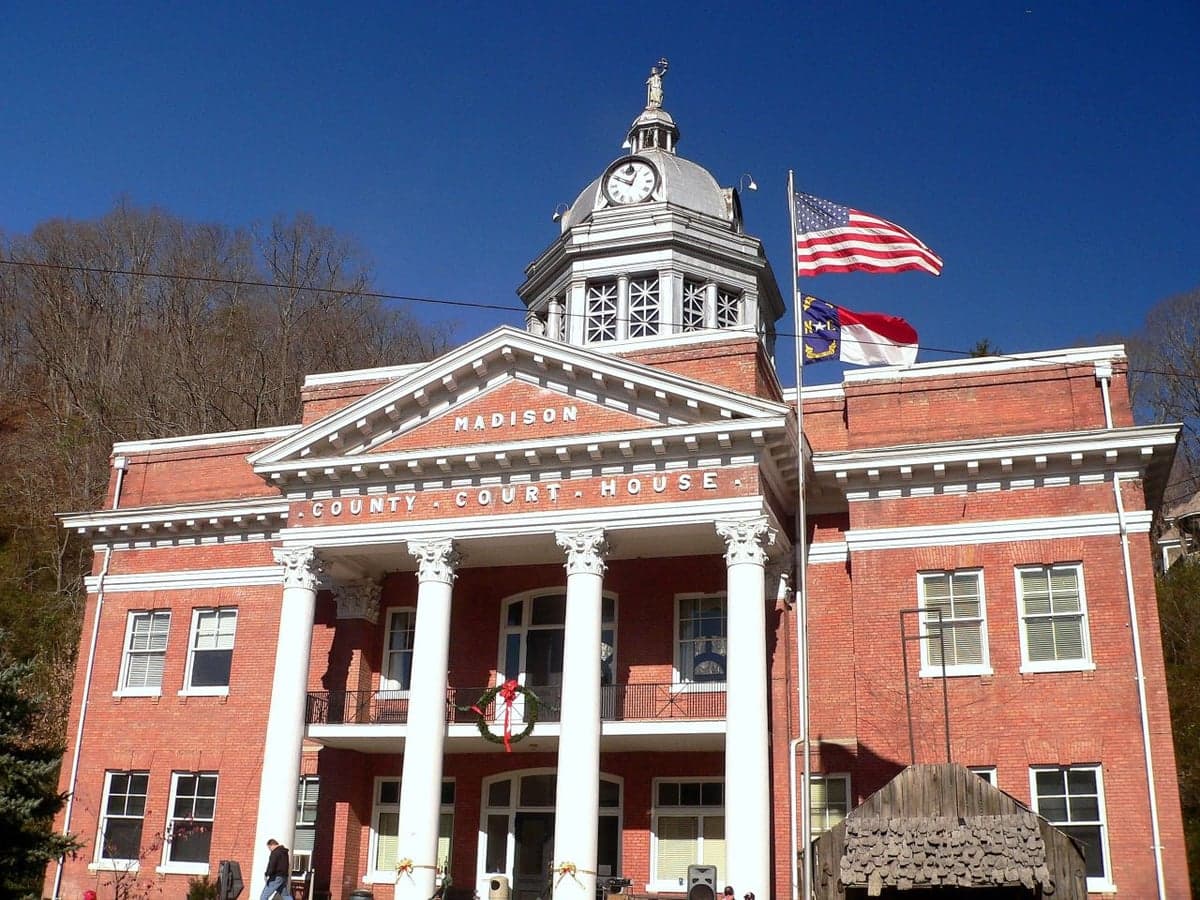
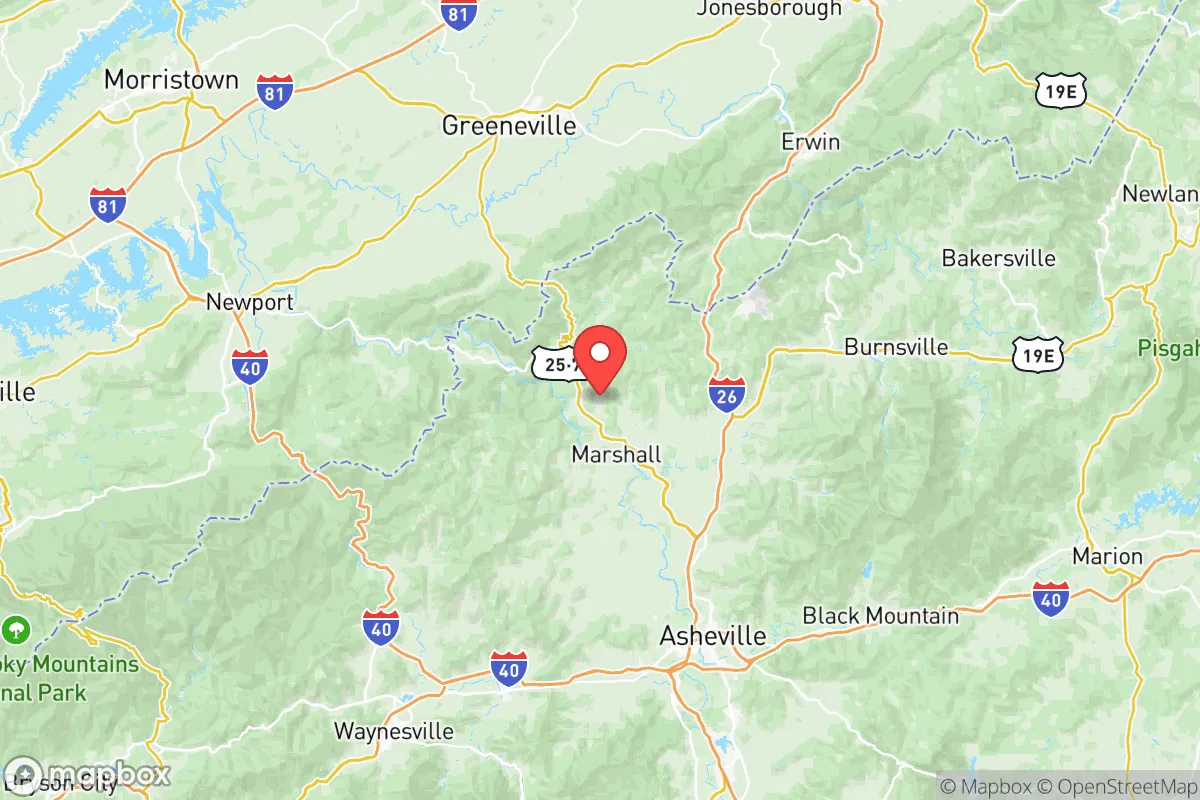
Photo: Wikipedia
Demographics of Madison County
Affluence Level in Madison County
A middle-class area roughly in line with national averages across income, home values, education, and employment.
People of Madison County
Madison County, North Carolina, is one of the most demographically stable and culturally rooted counties in the state, with a population of 21,640 that remains 91.6% white and only 0.6% foreign-born. This is a place where family surnames trace back to the 18th-century frontier, where the Appalachian dialect still colors everyday speech, and where the county seat of Marshall and the tourist hub of Hot Springs anchor a community that has changed less in two centuries than most of the American South. The people of Madison County are overwhelmingly native-born, deeply tied to the land, and increasingly caught between a fading agricultural past and the commuter pull of nearby Asheville.
Settlement & growth (pre-1960)
Long before European settlers arrived, the region that would become Madison County was a hunting and trading ground for the Cherokee, who used the French Broad River valley as a corridor through the Blue Ridge Mountains. The Cherokee called the river the "Tahkeyostee," and their seasonal camps dotted the bottomlands near what is now Hot Springs and Marshall. The first permanent European settlers were not English gentry but Scots-Irish and English frontiersmen who pushed west from Virginia and the Piedmont of North Carolina in the 1780s and 1790s, following the French Broad River southward. These were subsistence farmers and hunters who prized the isolated coves and steep hollows of the Appalachians for their seclusion and abundant game, and they established the first permanent settlements at Shelton Laurel, Big Laurel, and along the meadows that would later become the town of Marshall.
The county was formally carved from Buncombe County in 1851, named after President James Madison, and the new county seat of Marshall was established on the French Broad River as a trading and milling center. The mid-19th century brought a second wave of settlement: German and English families who purchased land along the river bottoms and established the farming communities of Mars Hill and Walnut, while the construction of the Western North Carolina Railroad in the 1880s opened the county to timber extraction and the tourism trade that would define Hot Springs. The railroad brought a small but significant influx of Irish laborers and a handful of Italian and Eastern European stonemasons who worked on the railroad bridges and the grand hotels of Hot Springs, though most moved on after the work was done.
The 20th century up to 1960 was a period of steady out-migration rather than new settlement. The collapse of the timber industry after the 1920s, combined with the exhaustion of the county's steep-slope farmland, pushed thousands of Madison County natives to leave for textile mills in Gastonia and Spartanburg, or to factory jobs in Ohio and Michigan during the Great Migration of Appalachian whites. The county's population peaked at roughly 20,000 in 1910 and then declined for decades, bottoming out near 17,000 in the 1960s. Those who remained were the most land-rooted families, concentrated in the small communities of Marshall, Mars Hill, Hot Springs, and the unincorporated hamlets of Trust, Luck, and Sodom, where subsistence farming, small-scale cattle raising, and seasonal tourism provided a thin living.
Modern era (post-1965)
The 1965 Hart-Cellar Act, which abolished national-origin quotas and reshaped American immigration, had almost no direct effect on Madison County. Unlike the booming Sun Belt metros of Charlotte or Raleigh, Madison County attracted virtually none of the new immigrant waves from Latin America or Asia; the foreign-born share today stands at just 0.6%, and the East/Southeast Asian population is a mere 0.4%, with no measurable Indian-subcontinent community at all. The Hispanic population, at 3.5%, is the county's only notable minority presence, and it arrived not through chain migration from abroad but through domestic movement of Latino workers from Texas, Florida, and central Mexico who came in the 1990s and 2000s to work in the county's poultry processing plants and on the Christmas tree farms that now cover the high ridges around Spring Creek and Jupiter.
The more transformative demographic force of the modern era has been domestic in-migration from the broader American South and, increasingly, from out of state. Beginning in the 1970s, the completion of Interstate 26 made Madison County a viable bedroom community for Asheville, and the county began attracting retirees, artists, and remote workers drawn to the mountain scenery and low property taxes. This wave has concentrated almost entirely in the southern tier of the county — the towns of Marshall, Mars Hill, and the river valleys closest to the Buncombe County line — while the northern and eastern sections around Hot Springs and the remote communities of Allenstand and Paint Rock remain overwhelmingly populated by multi-generational Madison County families. The county's college-educated share has risen to 31.5%, a figure driven almost entirely by this new in-migration, as Mars Hill University faculty, Asheville commuters, and telecommuters have settled alongside a native population whose educational attainment historically lagged the state average.
The future
Madison County is becoming slightly more diverse, but the pace is glacial. The Hispanic population, concentrated among younger families in the Marshall and Mars Hill areas, is the only segment projected to grow meaningfully over the next two decades, driven by second-generation births rather than new immigration. The white population, which includes both the aging native stock and the newer retiree and remote-worker arrivals, is expected to hold steady or decline slightly as the county's birth rate remains below replacement and young natives continue to leave for college and urban jobs. The county's overall population has grown only modestly since 2000 — from roughly 19,600 to 21,640 — and that growth has been almost entirely in the southern commuter belt, while the northern half of the county continues to lose residents.
The cultural identity of Madison County is evolving along a familiar Appalachian fault line. The native population, concentrated in the northern and eastern hollows, remains deeply traditional — evangelical Protestant, gun-owning, and suspicious of outside influence — while the newer arrivals in Marshall and the river valleys are more secular, more educated, and more politically progressive, drawn by the same mountain beauty that the natives have always taken for granted. This is not a conflict that is likely to resolve quickly; it is a slow demographic layering, with the two groups sharing the same post office and grocery stores but living in different social worlds. The county's political character reflects this split, with the rural north voting solidly Republican while the Marshall precincts and the Mars Hill University area have trended Democratic in recent cycles.
For someone moving to Madison County today, the bottom line is this: you are entering one of the last genuinely Anglo-Appalachian counties in the eastern United States, a place where the population is older, whiter, and more native-born than almost anywhere else in North Carolina. The opportunities are in the southern tier — Marshall and Mars Hill offer the best housing stock, the only real jobs outside agriculture, and the closest access to Asheville's economy — while the northern half of the county offers solitude and tradition at the cost of convenience and services. The county is not becoming more diverse in any meaningful way, and it is not likely to in the next generation; what it is becoming is a quieter, more retirement-oriented version of itself, where the old mountain families and the new arrivals will continue to coexist, warily but peacefully, along the banks of the French Broad.

* Values derived from national, state, county, city and local statistics and may differ in a specific area. Last updated: 2026-10-28T00:08:22.000Z
Narrative content on this page is AI-generated and may contain mistakes. Verify any details that matter before acting on them.
ReloMaps may earn a commission from affiliate links at no extra cost to you.

