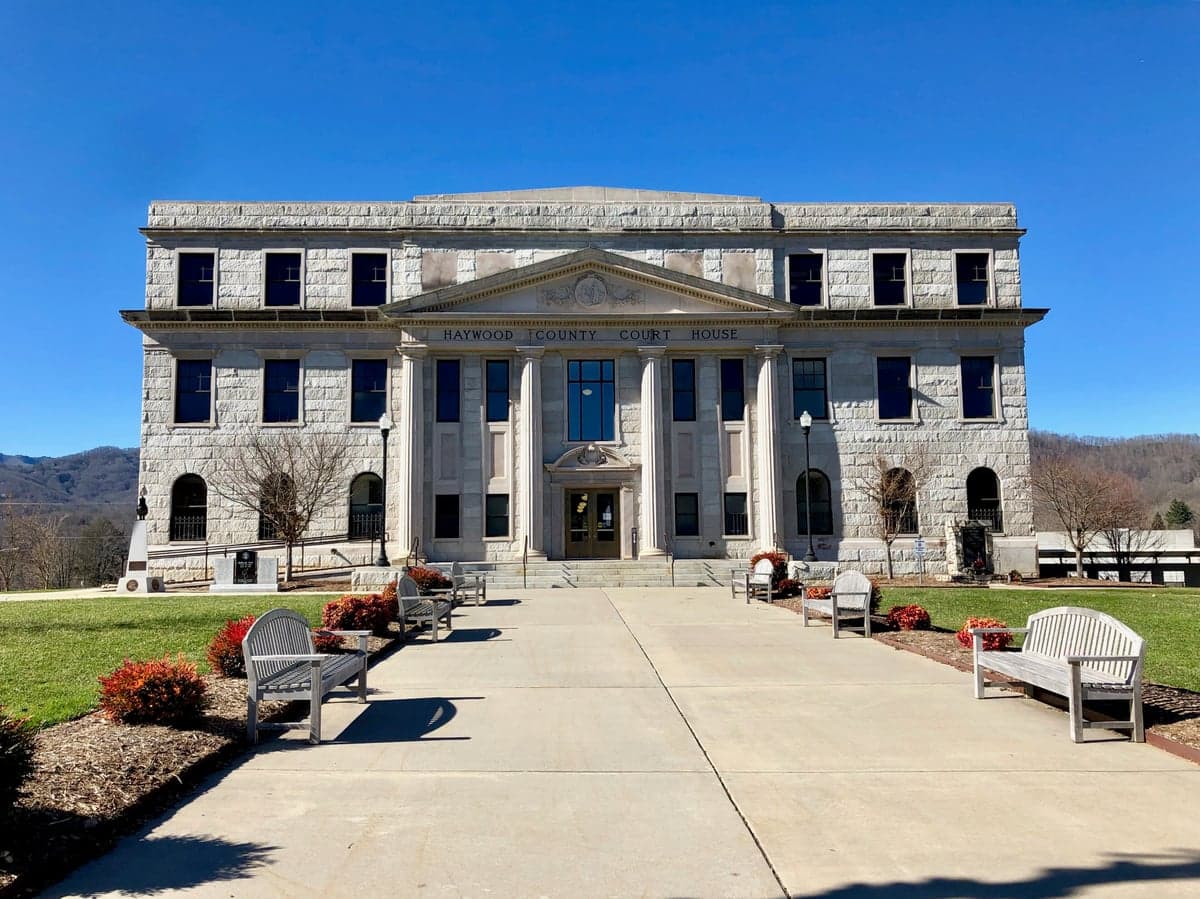
Photo: Wikipedia
Political ClimatePolitical Climate in Haywood County
Showing county-level results — no local-only data available.
Lean and PVI are calculated from this county’s 2020 and 2024 presidential results, Cook-style.
Political rankings in North Carolina
- Most Conservative Cities in North Carolina
- Most Liberal Cities in North Carolina
- Best Liberal-Leaning Towns in the South
- Best Liberal-Leaning Towns in Appalachia
- Safest Liberal-Leaning Towns in the South
- Safest Conservative-Leaning Towns in the South
- Safest Conservative-Leaning Towns on the East Coast
- Affordable Small Towns for Conservatives
- Most Conservative Counties in North Carolina
- Most Liberal Counties in North Carolina
Local Political AnalysisPolitical Analysis of Haywood County
Haywood County, North Carolina, is a reliably Republican area with a Cook Partisan Voting Index of R+5, meaning it votes about five points more conservative than the nation as a whole. That's a significant shift from just a couple of decades ago, when the county was a true swing area, often splitting tickets between conservative Democrats and Republicans. Today, the GOP holds nearly every elected office at the county level, and Republican presidential candidates routinely win the county by 15 to 20 points, though the margins have tightened slightly in recent cycles as the Asheville exurbs push further west.
How it compares to North Carolina
Haywood County's R+5 rating makes it notably more conservative than the state of North Carolina as a whole, which sits at R+1. That one-point statewide lean reflects the intense competition between the fast-growing, diversifying metro areas (Charlotte, Raleigh, the Triad) and the rural, traditionally conservative regions. Haywood, by contrast, is part of the western mountain bloc that has moved rightward as the old Democratic mountain culture faded. The county's politics are closer to those of neighboring rural counties like Jackson or Madison than to the statewide average. However, there is real variation within Haywood itself: the town of Waynesville has a visible Democratic minority, with several precincts near the historic downtown and along the Pigeon River often voting blue in close races. Canton and Clyde lean heavily red, driven by a strong manufacturing and paper-mill heritage. Maggie Valley and Lake Junaluska are more mixed, with tourism and second-home owners creating a small but growing bloc of moderate and liberal voters. The swing precincts tend to be in the unincorporated areas between these towns, where growth from Asheville is beginning to change the electorate.
What this means for residents
For conservative residents, Haywood County's lean means their values are reflected in local governance: the county commission, school board, and sheriff's office are all Republican-controlled, and tax rates are kept relatively low. The local Republican Party is active and well-organized, with strong turnout in primary and general elections. For liberal residents, the political reality is more of a challenge. While they can find community in Waynesville and among the growing number of remote workers and retirees from blue states, they have little influence over county-level decisions. School funding, land-use policy, and public health measures tend to reflect the majority's preferences. That said, the county is not a monolith: the Democratic Party maintains a small but dedicated presence, and local elections are sometimes decided by just a few hundred votes, especially in non-presidential years. The political climate is generally civil, with most residents prioritizing neighborliness over partisanship, but the divide is real and can surface in debates over development, environmental regulation, and public spending.
Culturally, Haywood County's politics are shaped by a mix of mountain independence, evangelical Christianity, and a growing tension between longtime residents and newcomers. The county has resisted some of the more aggressive cultural battles seen elsewhere in the state, but it has also passed resolutions affirming Second Amendment rights and pushed back against state-level mandates on education and health. The biggest policy distinction from the state as a whole is probably on land use: Haywood has no countywide zoning, a stance that reflects a deep-seated libertarian streak and a desire to keep government out of property rights. That's unlikely to change anytime soon, even as development pressures from Asheville continue to mount. For anyone moving here, understanding that political landscape is essential: it's a place where tradition runs deep, change comes slowly, and the best way to get along is to show up, listen, and respect the fact that your neighbor might see the world very differently than you do.

State Political ClimatePolitical Climate in North Carolina
State Political AnalysisPolitical Environment in the State
North Carolina is a classic purple state that has been trending rightward in recent cycles, with a Cook PVI of R+1 that masks a deeply competitive and geographically polarized landscape. The state has not voted for a Democratic presidential candidate since Barack Obama’s narrow 2008 win, and Republicans have held the General Assembly since 2011, often with supermajorities that allow them to override gubernatorial vetoes. Over the past 10-20 years, the dominant story has been the rapid growth of the Charlotte and Raleigh-Durham metros pulling the state left, while rural and exurban areas have hardened their Republican lean, creating a political tug-of-war that makes North Carolina one of the most closely watched battlegrounds in the country.
Urban vs. rural divide
The political map of North Carolina is a textbook example of the urban-rural split that defines American politics in the 2020s. The major population centers—Charlotte (Mecklenburg County), Raleigh and Durham (Wake and Durham Counties), and to a lesser extent Greensboro and Winston-Salem (Guilford and Forsyth Counties)—are solidly Democratic, powered by a mix of college-educated professionals, younger transplants, and diverse populations. Mecklenburg County alone delivered a 30-point margin for Joe Biden in 2020, while Wake County gave him a 25-point win. These metros are the engine of the state’s Democratic coalition, and their continued growth is the main reason the state remains competitive at the presidential level.
Outside these islands of blue, the state is overwhelmingly red. Rural eastern North Carolina, the Sandhills, and the western mountain counties are deeply Republican, with many counties routinely voting 65-75% for GOP candidates. The suburban and exurban counties surrounding the major metros—places like Union County (southeast of Charlotte), Johnston County (southeast of Raleigh), and Cabarrus County (northeast of Charlotte)—have been trending even more Republican as they absorb growth from the cities. Union County, for example, voted +35 for Donald Trump in 2020, up from +28 in 2016. The net effect is a state where Democrats win the cities by huge margins but struggle to compete in the vast rural and suburban expanse, leaving statewide races consistently within a few points.
Policy environment
North Carolina’s policy environment reflects its divided government: a Republican-controlled General Assembly that sets the legislative agenda, and a Democratic governor (Josh Stein, elected in 2024) who can veto bills but is often overridden. The state has a flat income tax rate of 4.5% as of 2025, down from 5.25% in 2022, with a scheduled phase-down to 3.99% by 2027—a clear pro-growth posture that appeals to conservative relocators. There is no state property tax, though local rates vary; the statewide sales tax is 4.75%, with local options pushing it to 7% or higher in some counties. The regulatory environment is generally business-friendly, with right-to-work laws and a low unionization rate (around 3% private sector).
On education, the state has a robust charter school sector and a growing school choice program, including Opportunity Scholarships that provide public funds for private school tuition, expanded significantly in 2024 to cover all income levels. Higher education is anchored by the UNC system, which includes the flagship Chapel Hill campus and NC State in Raleigh, both of which are politically moderate-to-liberal environments. Healthcare policy has been a flashpoint: the state expanded Medicaid in 2023 under a bipartisan deal, covering roughly 600,000 low-income adults, a move that was long resisted by Republican leadership. Election laws have been a perennial battleground, with the GOP passing voter ID requirements (upheld by the state Supreme Court in 2023) and stricter absentee ballot rules, while Democratic challenges have kept some restrictions tied up in court.
Recent policy direction
The last few years have seen North Carolina move decisively in a conservative direction on several fronts, even as the state remains competitive at the ballot box. In 2023, the General Assembly passed a 12-week abortion ban, overriding Governor Roy Cooper’s veto; the law includes exceptions for rape, incest, and fetal anomalies, but represents a significant restriction compared to the previous 20-week standard. On gun policy, the state enacted permitless concealed carry in 2023, allowing any adult who can legally possess a firearm to carry a concealed handgun without a permit—a major win for Second Amendment advocates. The legislature also passed a Parents’ Bill of Rights in 2023, requiring schools to notify parents about instructional materials involving sexuality and to obtain parental consent before changing a student’s name or pronouns, aligning with the broader national movement on parental rights.
On the tax and economic front, the phase-down of the corporate income tax to zero by 2030 (already at 2.5% in 2025) signals a strong pro-business posture. Property rights were strengthened with the passage of a regulatory reform bill in 2024 that limits local governments’ ability to impose certain land-use restrictions. On voting and ballot access, the state has tightened its laws: same-day voter registration was eliminated for most voters in 2023, and the voter ID requirement, while not strictly enforced in all precincts, is now in effect. The overall direction is toward lower taxes, expanded gun rights, restricted abortion access, and greater parental control in education—a package that will appeal to many conservative relocators but may give pause to those on the left.
Civil unrest & political movements
North Carolina has seen its share of political activism and flashpoints, though it has avoided the large-scale civil unrest seen in some other states. The 2020 protests following George Floyd’s murder were significant in Charlotte and Raleigh, with some property damage and curfews, but were smaller and less destructive than in Portland or Seattle. The state has a long history of organized labor activism, particularly in the textile and furniture industries of the Piedmont Triad (Greensboro, High Point, Winston-Salem), though union density has declined sharply since the 1970s. Immigration politics are less heated than in border states, but there have been localized controversies over sanctuary policies: Durham and Orange County have declared themselves sanctuary jurisdictions, while the General Assembly passed a law in 2015 requiring sheriffs to honor ICE detainers, leading to ongoing legal battles.
Election integrity has been a major theme since 2020, with Republican activists and legislators pushing for tighter controls and Democratic groups challenging them in court. The state Supreme Court flipped from a 4-3 Democratic majority to a 5-2 Republican majority in the 2022 elections, and the court has since upheld the voter ID law and a redistricting map that favors Republicans. There is no serious secession or nullification movement in North Carolina, but the rural-urban cultural divide is palpable: a relocator moving to Asheville (a liberal mountain enclave) will encounter a very different political atmosphere than someone settling in Fayetteville (a conservative military town). The most visible flashpoint for a new resident might be the proliferation of political yard signs and bumper stickers, which are ubiquitous in both blue and red areas.
Projection
Over the next 5-10 years, North Carolina is likely to remain a competitive purple state, but the trajectory favors a slow rightward drift if current trends hold. The in-migration pattern is a mixed bag: the Charlotte and Raleigh metros are attracting a mix of out-of-state transplants, many from blue states like New York and California, which could bolster the Democratic coalition. However, the exurban and rural areas are growing faster in raw numbers, and the state’s Hispanic population—while growing—is not yet large enough to shift the balance decisively. The Republican supermajority in the General Assembly, combined with the ability to draw favorable maps, gives the GOP a structural advantage that will be hard for Democrats to overcome without a major national wave.
For a relocator moving in now, the expectation should be that North Carolina will continue to be a state where conservative policies are enacted at the state level, even as the presidential vote remains close. The flat tax will likely drop further, gun laws will stay permissive, and abortion access will remain restricted. The wild card is the state Supreme Court: if Republicans maintain their majority, they will likely uphold future conservative legislation; if Democrats flip it back, some of the recent laws could be challenged. The bottom line is that North Carolina offers a stable, low-tax environment with a growing economy, but the political climate is one of constant tension—a place where both sides feel they are one election away from losing ground.
For a new resident, the practical takeaway is that North Carolina delivers a conservative policy environment at the state level—low taxes, gun rights, school choice, and parental rights—while leaving room for liberal enclaves in the cities. If you lean right, you will find a state government that largely aligns with your values and a growing economy that rewards work. If you lean left, you will find vibrant urban communities where your views are the majority, but you will be living under a state government that is actively pursuing an agenda you likely oppose. The key is to choose your county carefully: the difference between living in Wake County and Johnston County is not just a matter of commute times, but of fundamentally different political and cultural environments.
* Values derived from national, state, county, city and local statistics and may differ in a specific area. Last updated: 2026-10-27T22:13:33.000Z
Narrative content on this page is AI-generated and may contain mistakes. Verify any details that matter before acting on them.
ReloMaps may earn a commission from affiliate links at no extra cost to you.

