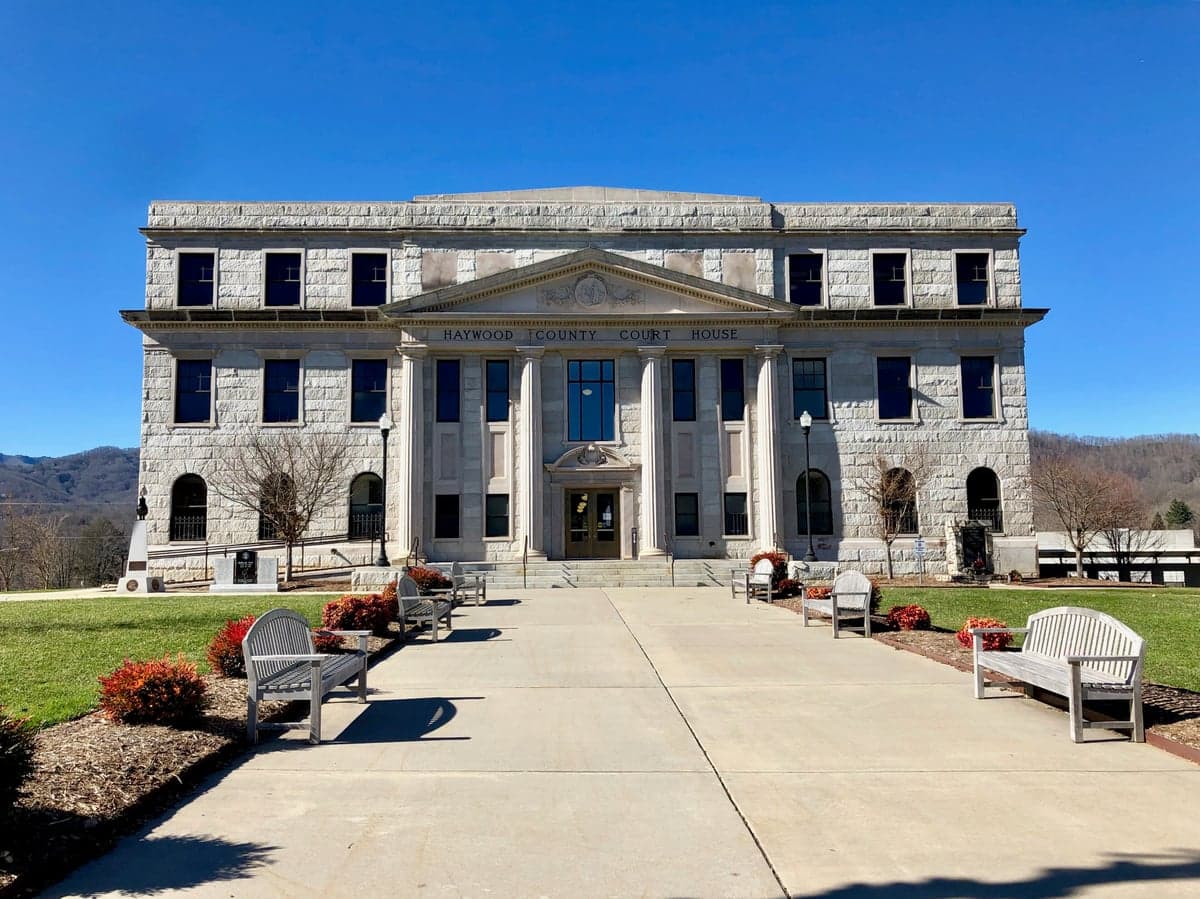
Photo: Wikipedia
Personal Sovereignty in Haywood County
Viable for self-reliance. Generally workable, though some barriers may limit total independence.
What does Personal Sovereignty tell us?
Personal Sovereignty measures your capacity for self-reliance and independence with minimal government friction. Higher scores mean fewer barriers between you and the way you want to live... but it assumes you have the space you need and good neighbors.
What does this tell us?
Personal Sovereignty measures your capacity for self-reliance and independence with minimal government friction. Higher scores mean fewer barriers between you and the way you want to live... but it assumes you have the space you need and good neighbors.
State Policy
Energy independence: Importer (24% of energy produced in-state)
Personal Liberty
Homesteading

Personal Liberty Analysis
Haywood County, North Carolina, offers a notably high degree of personal sovereignty, blending a deeply rooted Appalachian culture of self-reliance with a state-level legal framework that generally favors individual liberty. The county's regulatory environment is lighter than in urban centers like Asheville or Charlotte, but it is not entirely hands-off, with specific local ordinances and zoning rules that vary by municipality. For a relocation-minded individual or family prioritizing autonomy, the key is understanding where in the county—from the more developed town of Waynesville to the rural stretches of Jonathan Creek and Fines Creek—the balance of freedom and regulation best aligns with their goals.
Tax burden and regulatory posture in Haywood County
North Carolina's state-level tax structure is moderately favorable for personal sovereignty. The state levies a flat personal income tax of 4.75% (as of 2025) and a corporate income tax of 2.5%, both of which are competitive nationally. Property taxes in Haywood County are relatively low, with a county-wide rate of approximately $0.58 per $100 of assessed value, though this does not include municipal taxes in towns like Waynesville (additional ~$0.49) or Canton (additional ~$0.55). The regulatory posture is generally light-touch compared to the Northeast or West Coast, but it is not libertarian. The county enforces a uniform development ordinance in unincorporated areas, which includes minimum lot sizes (typically 1 acre for septic systems) and building setbacks. In contrast, the town of Maggie Valley has its own zoning codes that are more restrictive for commercial signage and short-term rentals, while Clyde maintains a more permissive stance on home-based businesses. The absence of a county-wide building permit requirement for owner-occupied single-family homes under 1,000 square feet is a notable nod to self-builders, though state-level septic and well permits are still mandatory.
Self-defense and gun law specifics in Haywood County
North Carolina is a "shall-issue" state for concealed carry permits, and Haywood County's sheriff's office processes applications efficiently, typically within 45-90 days. The state does not require a permit to open carry a handgun, and as of 2023, it became a permitless concealed carry state for individuals 18 and older who are legally allowed to possess a firearm. This means that in unincorporated areas of the county—such as Fines Creek or Bethel—a resident can carry a concealed firearm without any state-issued license. However, local restrictions apply: firearms are prohibited in all county government buildings, including the courthouse in Waynesville, and on school grounds unless stored in a locked vehicle. The county's gun culture is strong and visible; the Haywood County Gun Club near Lake Junaluska offers a public range, and private land ownership is the norm for recreational shooting. Stand-your-ground laws are in effect statewide, with no duty to retreat in any place where the individual is lawfully present. For a reader prioritizing self-defense, Haywood County presents a permissive legal environment, though the practical reality of rural law enforcement response times—often 15-30 minutes in remote areas—places the burden of immediate protection squarely on the individual.
Self-reliance and homesteading viability: lot sizes, zoning, and off-grid feasibility
Haywood County's mountainous terrain and agricultural zoning make it one of the more viable areas in western North Carolina for homesteading and off-grid living. In unincorporated zones, minimum lot sizes for a single-family home with a septic system are generally 1 acre, but parcels of 3-5 acres are common and affordable in areas like Jonathan Creek and Ivy Hill. The county does not require a connection to municipal water or sewer, and many residents rely on private wells and septic systems. Off-grid solar is legal and increasingly common, though the county does enforce the North Carolina State Building Code for electrical work, meaning a licensed electrician must sign off on any grid-tied or battery system. Rainwater collection is unrestricted for outdoor use, but potable rainwater systems must meet state health department standards. Zoning for livestock is permissive: chickens, goats, and up to two cows per acre are allowed without a special permit in agricultural zones. The town of Canton is more restrictive, banning pigs and roosters within town limits, while Waynesville requires a permit for beekeeping. For a serious homesteader, the unincorporated areas of Fines Creek or Bethel offer the greatest freedom, with minimal county oversight and a strong tradition of neighborly self-sufficiency.
Personal liberties: parental rights, medical autonomy, speech, and property
North Carolina law provides a robust framework for parental rights, including the right to direct a child's education, medical care, and religious upbringing. Haywood County has a growing homeschool community, with over 400 registered homeschools as of 2024, and the local school board has not aggressively challenged parental decisions regarding curriculum or vaccination exemptions. Medical autonomy is more nuanced: the state does not have a right-to-try law for terminally ill patients, but it does allow for the use of medical cannabis under the 2021 North Carolina Compassionate Care Act, though the program is not yet operational as of early 2026. Property rights are strongly protected; Haywood County does not have a county-wide rental registration or rent control ordinance, and short-term rental regulations are limited to the towns of Maggie Valley and Waynesville, which require a permit and occupancy tax collection. Free speech is protected under the First Amendment, and the county has not enacted any local ordinances restricting public assembly or protest. The county's conservative-leaning board of commissioners has consistently opposed state-level vaccine mandates and mask requirements, reflecting a broader cultural commitment to individual choice. For a reader concerned about government overreach, Haywood County's local governance is notably deferential to personal decision-making in education, health, and property use.
Overall, Haywood County ranks among the more sovereignty-friendly areas in the Southeast, particularly for those who value self-defense rights, homesteading feasibility, and low regulatory interference. It is not a free-for-all—state building codes, septic regulations, and municipal zoning in Waynesville and Canton impose real constraints—but for a self-reliant individual or family willing to live in the unincorporated areas of Jonathan Creek, Fines Creek, or Bethel, the county offers a level of personal autonomy that is increasingly rare in the modern United States. Compared to the heavily regulated environments of Asheville or the Research Triangle, Haywood County's light-touch governance and cultural respect for independence make it a strong candidate for relocation.

* Values derived from national, state, county, city and local statistics and may differ in a specific area. Last updated: 2026-10-27T22:13:33.000Z
Narrative content on this page is AI-generated and may contain mistakes. Verify any details that matter before acting on them.
ReloMaps may earn a commission from affiliate links at no extra cost to you.

