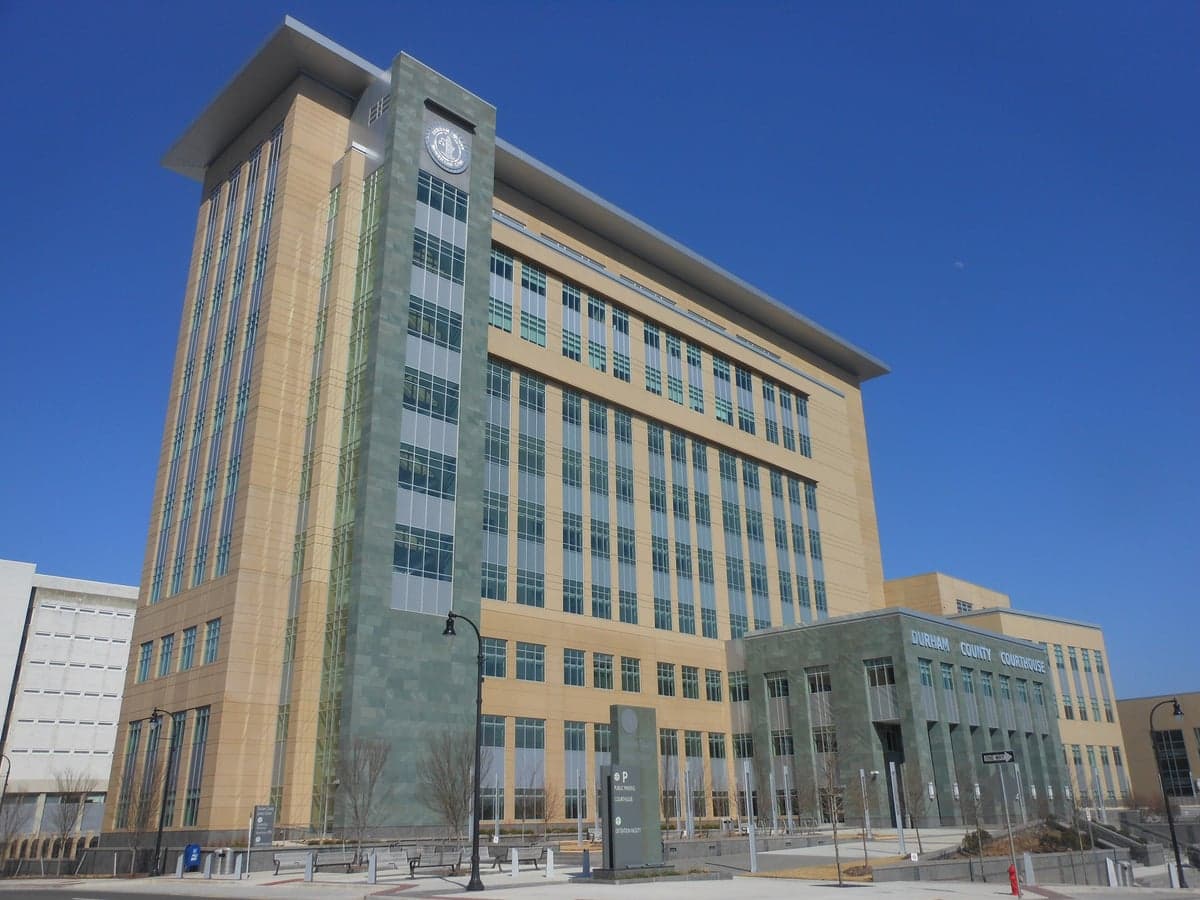
Photo: Wikipedia
Political ClimatePolitical Climate in Durham County
Showing district-level results — no local-only data available.
Local Political AnalysisPolitical Analysis of Durham County
Durham County is one of the most reliably Democratic strongholds in the South, carrying a Cook Partisan Voting Index (PVI) of D+23. That means the county consistently votes about 23 points more Democratic than the national average, a stark contrast to North Carolina as a whole, which sits at a razor-thin R+1. The county hasn't voted for a Republican presidential candidate since 1984, and the margin has only widened since the 2008 Obama wave. The city of Durham itself is the engine of this blue vote, but the political geography isn't uniform—there are real pockets of red, especially as you move toward the rural edges.
How it compares
To understand Durham County's politics, you have to look at it against the state backdrop. North Carolina is a classic swing state—R+1 overall—where statewide races are decided by tens of thousands of votes, not millions. Durham County, by contrast, is a deep blue anchor in the Triangle region. In the 2020 presidential election, Joe Biden won Durham County with roughly 80% of the vote, while Donald Trump carried the state by just over a point. That's a 30-point gap between the county and the state. The political variation within the county is real, though. The urban core—downtown Durham, Duke University's campus, and neighborhoods like Old West Durham and Trinity Park—are overwhelmingly progressive. Head east toward the rural towns of Bahama and Rougemont, or south toward the unincorporated areas near the Chatham County line, and you'll find more conservative precincts that often vote Republican in local races. The swing precincts are mostly in the suburban middle ring—places like the Hope Valley Farms area or parts of southern Durham near I-40—where moderate voters can tip a close county commission race.
What this means for residents
For liberal residents, the D+23 lean means local policy tends to align with progressive priorities. The Durham County Board of Commissioners has been Democratic-controlled for decades, and the city council is similarly left-leaning. That translates into things like a $15 minimum wage for county employees, robust funding for public transit (including the GoDurham bus system and the planned light rail), and a strong focus on affordable housing initiatives. For conservative residents, the political reality is more about feeling out of step with local government. Republican voters in northern Durham County or the rural eastern parts often express frustration that their voices are drowned out by the urban majority. That said, the county's political culture is not aggressively hostile to conservatives in day-to-day life—most people just get along. The real friction shows up in policy debates over land use, school funding, and policing, where the progressive majority tends to push forward without much need for compromise.
One cultural distinction that sets Durham County apart from much of North Carolina is its identity as a historically Black, politically active community. The city of Durham was a center of the Civil Rights movement, and that legacy is still visible in local politics today. The county has a long tradition of Black political leadership—the current mayor, Elaine O'Neal, is Black, and the county commission has often had a Black majority. This gives Durham a different political texture than, say, Wake County (Raleigh) or Mecklenburg County (Charlotte), where the Democratic coalition is more white-collar and suburban. The progressive activism here is also more grassroots and confrontational than in other blue cities in the state. You'll see regular protests downtown, active tenant unions, and a city council that has taken bold stances on issues like police reform and immigrant sanctuary policies. For anyone moving to the area, the political climate is a defining feature—it shapes everything from the local news to the conversations you'll have at a coffee shop on Ninth Street.

State Political ClimatePolitical Climate in North Carolina
State Political AnalysisPolitical Environment in the State
North Carolina is a classic swing state that has drifted from reliably Republican to a true battleground, with a Cook PVI of R+1 reflecting how narrowly divided it is. The state has voted Republican in 10 of the last 13 presidential elections, but Democrats have won it twice since 2008 (Obama in 2008, and a razor-thin margin for Trump in 2024 was actually a GOP hold, though Biden won it in 2020 by just 1.3 points). Over the past 20 years, the dominant story has been the rapid growth of the Charlotte and Raleigh-Durham metros, which have flooded the state with out-of-state transplants and turned once-safe red suburbs into competitive or blue-leaning territory, while rural and small-town counties have hardened their Republican allegiance. The result is a state where control of the governorship, legislature, and courts is perpetually up for grabs, and where policy often lurches between conservative and moderate depending on which party holds the pen.
Urban vs. rural divide
The political map of North Carolina is a textbook case of the urban-rural chasm. The state's three major metros — Charlotte (Mecklenburg County), Raleigh (Wake County), and Durham (Durham County) — are solidly Democratic, with Mecklenburg and Wake each delivering around 60-65% of the vote to Democratic presidential candidates. These counties are growing fast, fueled by finance, tech, and biotech jobs, and they pull the state leftward. In contrast, the vast rural and exurban counties east of I-95 (like Robeson, Columbus, and Duplin) and west of the Piedmont (like Asheville's Buncombe County, which is an island of blue in the mountains) are deeply Republican. The Fayetteville area (Cumberland County), home to Fort Liberty, leans Democratic but is less reliable due to its military and veteran population. The Greensboro and Winston-Salem triad is a mixed bag: Guilford County (Greensboro) is blue-leaning, while Forsyth County (Winston-Salem) is more competitive. The real action is in the suburbs: places like Union County (southeast of Charlotte) and Johnston County (southeast of Raleigh) were once deep red but are now trending purple as new residents arrive. In 2024, Trump still won Union County by 18 points, down from 28 in 2020, a sign of the slow but steady suburban shift.
Policy environment
North Carolina's policy environment is a mix of conservative governance and pragmatic moderation. The state has a flat income tax rate of 4.5% (down from 7% in 2013), with a scheduled phase-down to 3.99% by 2027, making it one of the more tax-friendly states in the Southeast. There is no state tax on Social Security income, and the standard deduction is generous. Sales tax is 4.75% state-level, with local add-ons pushing it to around 7% in most counties. The regulatory posture is generally business-friendly, with right-to-work laws and a low unionization rate (around 3% private sector). On education, the state has a robust charter school system and a voucher program (the Opportunity Scholarship Program) that now serves over 50,000 students, though it has been controversial and subject to legal challenges. Healthcare policy is a flashpoint: the state expanded Medicaid in 2023 under a bipartisan deal, adding 600,000 low-income adults, but the expansion came with work requirements and a sunset clause that keeps it politically fragile. Election laws have been a battleground: the state requires voter ID (photo ID, with limited exceptions), has strict absentee ballot rules, and has seen repeated court fights over gerrymandering and same-day registration. The state also has a 12-week abortion ban (with exceptions for rape, incest, and life of the mother), passed in 2023 after the GOP gained a supermajority in the legislature.
Recent policy direction
Over the past five years, North Carolina has moved decisively to the right on several fronts, driven by a Republican-controlled General Assembly that has been able to override Democratic Governor Roy Cooper's vetoes since 2023. On gun and self-defense law, the state has permitless carry (effective 2023), meaning anyone who can legally own a firearm can carry it concealed without a permit. Stand-your-ground laws are already on the books. On parental and education rights, the legislature passed the Parents' Bill of Rights (2023), which requires schools to notify parents about instructional materials involving gender identity and sexuality, and prohibits classroom instruction on these topics in K-4. On speech and privacy, the state has no broad surveillance law, but it does have a biometric privacy law that is weaker than Illinois's. On medical and bodily autonomy, the 12-week abortion ban is the most significant restriction, but the state also has a 72-hour waiting period and mandatory counseling. On property rights, the state has strong eminent domain protections and no state-level rent control. On taxation, the trajectory is toward lower rates: the flat income tax is scheduled to drop further, and the corporate tax rate is 2.5%, among the lowest in the nation. On voting and ballot access, the state has tightened rules: voter ID is now enforced, absentee ballot drop boxes were restricted, and same-day registration during early voting remains legal but is under constant legislative threat. The overall direction is toward a more conservative, low-tax, limited-government posture, but with enough Democratic resistance to prevent the most extreme proposals from passing.
Civil unrest & political movements
North Carolina has a history of visible political activism on both sides. The Moral Monday movement, which began in 2013, saw thousands of protesters at the state legislature over voting rights, education funding, and Medicaid expansion, and it remains a touchstone for progressive organizing. On the right, the state has a strong gun rights movement, with regular rallies at the legislature and a vocal Second Amendment sanctuary county movement that passed resolutions in over 30 counties in 2020-2021. Immigration politics are less heated than in border states, but there have been flashpoints: Charlotte and Durham have sanctuary city policies (limiting local police cooperation with ICE), which have drawn legislative pushback. The state has no statewide sanctuary law, and the legislature has repeatedly tried to ban such policies. Election integrity has been a major issue since 2020: the state saw a high-profile election fraud investigation in the 9th Congressional District in 2018 (the Bladen County absentee ballot scandal), which led to a new election and a conviction. Since then, the legislature has tightened absentee ballot rules and added voter ID, but no widespread fraud has been documented. The Confederate monument debate has also been active: in 2020, protesters in Raleigh toppled statues, and the legislature passed a law making it harder to remove them. Overall, the state is not a hotbed of civil unrest, but the political temperature is high, and new residents will notice the constant back-and-forth between the Democratic governor and the Republican legislature.
Projection
Over the next 5-10 years, North Carolina is likely to become more competitive, not less. The in-migration from blue states (New York, New Jersey, California) is concentrated in the Charlotte and Raleigh metros, and these newcomers tend to be moderate to liberal, especially on social issues. The rural counties, meanwhile, are losing population and aging, which will slowly erode the GOP's base. However, the Republican legislature has shown a willingness to gerrymander aggressively (the current congressional map gives the GOP a 10-4 advantage in a state that is roughly 50-50), and the state Supreme Court flipped back to a 5-2 Republican majority in 2024. The wild card is the 2026 gubernatorial election, which will determine whether the GOP can hold its supermajority and continue to override vetoes. If Democrats win the governorship, the state will remain a policy stalemate; if Republicans win, expect a sharp right turn on abortion, education, and taxes. The most likely scenario is continued gridlock, with the state slowly trending purple but not flipping blue anytime soon. A new resident moving in now should expect a state where the political climate is always in flux, where local elections matter as much as national ones, and where the culture war is a constant background noise.
For a new resident, the practical takeaway is that North Carolina offers a relatively low-tax, business-friendly environment with a strong economy, but the political climate is polarized and unpredictable. If you lean conservative, you'll find a state that has moved your way on guns, taxes, and education, but you'll also face a growing liberal urban population that is pushing back. If you lean liberal, you'll find a state where your vote matters and where progressive policies are possible in the cities, but you'll be frustrated by a legislature that often overrides the governor. The best advice is to pick your county carefully: Wake and Mecklenburg are blue islands, Union and Johnston are purpleing red, and Buncombe (Asheville) is a liberal mountain enclave. Everywhere else, expect a conservative tilt that is slowly, but not quickly, shifting.
* Values derived from national, state, county, city and local statistics and may differ in a specific area. Last updated: 2026-06-15T22:53:58.000Z
Narrative content on this page is AI-generated and may contain mistakes. Verify any details that matter before acting on them.
ReloMaps may earn a commission from affiliate links at no extra cost to you.

