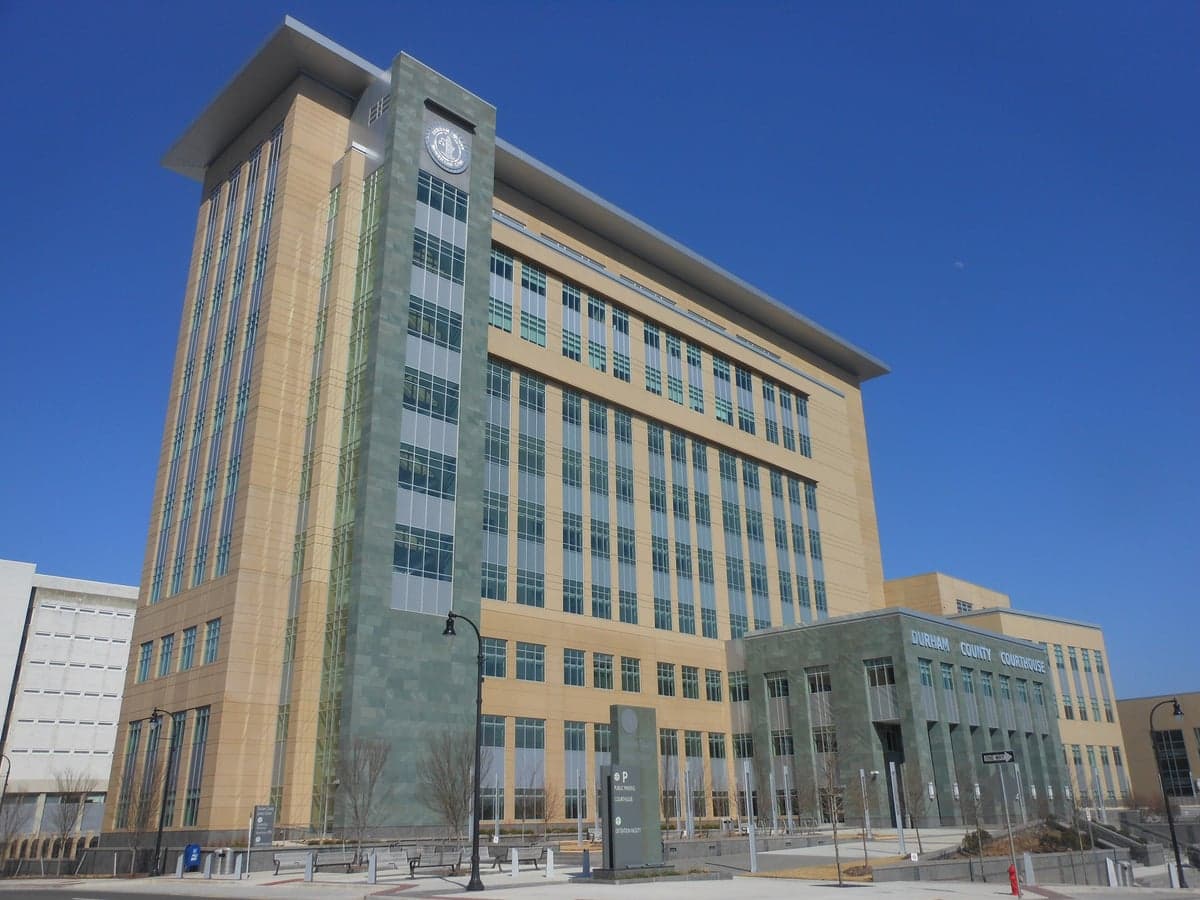
Photo: Wikipedia
Demographics of Durham County
Affluence Level in Durham County
A middle-class area roughly in line with national averages across income, home values, education, and employment.
People of Durham County
Today, Durham County is a densely populated, highly educated, and racially diverse urban hub of 329,405 residents, where a Black plurality (32.8%) and a large White population (41.9%) coexist alongside a rapidly growing Hispanic community (15.3%) and smaller but significant Asian (3.6%) and Indian (1.5%) populations. The county’s identity is shaped by its history as a center of Black entrepreneurship and civil rights activism, its transformation from a tobacco and textile manufacturing powerhouse into a globally recognized hub for medicine and technology, and its current status as a magnet for young professionals and families drawn to the Research Triangle. With over half of adults holding a college degree, Durham County is one of the most educated counties in the South, a trait that drives its progressive politics and knowledge-based economy. The people of Durham County are a product of layered migrations—from enslaved Africans and freedmen to European immigrants, Black migrants from the rural South, and, most recently, a wave of international professionals and Hispanic laborers.
Settlement & growth (pre-1960)
Long before European settlement, the land that is now Durham County was inhabited by the Occaneechi and Eno peoples, Siouan-speaking tribes who lived in small villages along the Eno and Neuse Rivers. European contact in the 17th and 18th centuries brought disease and displacement, and by the mid-1700s, the area was largely depopulated of its Native inhabitants. The first permanent European settlers were primarily of English and Scots-Irish descent, who arrived in the 1740s and 1750s as part of the broader migration into the North Carolina Piedmont. These early settlers established small farms and crossroads communities, including the settlement that would become Hillsborough (in neighboring Orange County) and the tiny hamlet of Durham's Station, named after Dr. Bartlett Durham, who donated land for a railroad depot in the 1850s.
The arrival of the North Carolina Railroad in the 1850s transformed Durham's Station from a rural crossroads into a commercial center. The real catalyst for growth, however, came after the Civil War. In the 1870s and 1880s, the Washington Duke family and other entrepreneurs built a massive tobacco manufacturing industry in Durham, centered on the rolling and marketing of bright-leaf tobacco. This industry drew thousands of workers, both Black and White, from the surrounding rural counties of North Carolina and Virginia. Black families, many of them newly freed from slavery, migrated to Durham in large numbers, settling in neighborhoods like Hayti (pronounced "Hay-tie"), a thriving Black business district south of downtown that became one of the most prosperous African American communities in the Jim Crow South. By 1900, Durham had the largest Black population of any city in North Carolina, and Hayti was home to North Carolina Mutual Life Insurance Company, the largest Black-owned business in the country.
Simultaneously, the textile industry grew in the late 19th and early 20th centuries, drawing White workers from the Appalachian foothills and rural Piedmont into mill villages like West Durham and East Durham. These mill villages were tightly knit, often company-owned communities where families lived in company housing, shopped at company stores, and sent their children to company schools. The tobacco and textile industries together created a biracial working class, but one rigidly segregated by law and custom. The county's population grew steadily, reaching 101,639 by 1950, with the city of Durham absorbing most of the growth.
The Great Migration (roughly 1910–1970) brought additional waves of Black migrants from the Deep South—particularly South Carolina, Georgia, and Alabama—who were fleeing sharecropping, racial violence, and economic stagnation. They settled in established Black neighborhoods like Hayti and also in newer areas such as Walltown and Creedmoor (a small town in the northern part of the county). The establishment of Duke University (expanded from Trinity College in 1924) and North Carolina Central University (founded in 1910 as a normal school for Black teachers) further anchored the county's identity as a center for education and professional opportunity for both races, albeit in strictly separate spheres.
Modern era (post-1965)
The 1965 Hart-Cellar Act fundamentally reshaped Durham County's demographics, though the effects were slower to arrive here than in coastal gateway cities. The most immediate post-1965 change was the acceleration of Black in-migration from the rural South, which continued through the 1970s, and the simultaneous beginning of White flight to suburban areas like Chapel Hill and Morrisville (in neighboring counties). Within Durham County itself, the Black population grew to a majority by the 1980s, peaking at roughly 57% in 1990 before beginning a gradual decline as the county became more diverse.
The creation of the Research Triangle Park (RTP) in 1959, straddling Durham and Wake counties, began to draw highly educated domestic migrants from the Northeast and Midwest in the 1970s and 1980s. These newcomers were predominantly White and Asian professionals working in pharmaceuticals, computing, and biotechnology. They settled in newer subdivisions in southern Durham County, particularly around South Durham and the Hope Valley area, as well as in the town of Parkwood. This influx began to shift the county's racial balance and raised its educational attainment levels dramatically.
The Hispanic population began to grow significantly in the 1990s, driven by demand for labor in construction, landscaping, and the service industries that supported RTP's growth. The first wave was predominantly Mexican, followed by immigrants from Central America (especially El Salvador and Honduras). They concentrated in the East Durham and North Durham neighborhoods, as well as in the unincorporated community of Bahama in the county's northern reaches. By 2020, Hispanics made up 15.3% of the county's population, making them the third-largest racial/ethnic group after Whites and Blacks.
The Asian population, while smaller at 3.6%, grew steadily from the 1980s onward, driven by the recruitment of highly skilled professionals for RTP. Chinese, Indian (1.5%), and Korean immigrants formed the largest subgroups, with many settling in the same South Durham neighborhoods as White professionals. The Indian community, though modest in size, is highly concentrated in the technology sector and has established cultural institutions like the Triangle Hindu Society temple in nearby Cary. The post-1965 period also saw a small but notable influx of immigrants from Africa, particularly Nigeria and Ethiopia, who have settled in Southwest Durham and Lakewood.
Domestic migration has been the dominant driver of population change since 2000. The county has attracted a steady stream of newcomers from the Rust Belt (New York, Ohio, Michigan) and the Northeast corridor, drawn by the region's strong job market, lower cost of living, and milder climate. This migration has been disproportionately young, college-educated, and White, contributing to the county's rising educational attainment (53.5% college-educated) and its shift from a Black-majority to a plurality-Black county. The Black population, while still the largest single group at 32.8%, has declined as a share of the total, partly due to out-migration of middle-class Black families to suburbs like Wake Forest and Garner in Wake County.
The future
Durham County is on track to become even more diverse and more educated over the next 10–20 years. The Hispanic population is projected to continue growing, potentially reaching 20–22% of the county by 2040, driven by both immigration and higher birth rates. This growth will likely be concentrated in East Durham and the northern parts of the county, where housing is more affordable. The Asian and Indian populations are also expected to grow, though more slowly, as RTP continues to attract skilled professionals from Asia. The White population, already the largest group at 41.9%, will likely remain stable or grow slightly, driven by continued domestic in-migration from other parts of the country.
The Black population, which has been declining as a share of the total since 1990, may stabilize or even see a modest rebound as younger Black professionals are drawn to Durham's revitalized downtown and cultural scene. The county's cultural identity is evolving from its historical roots as a Black-majority, tobacco-and-textile town to a more cosmopolitan, multiethnic, and knowledge-driven community. This shift is creating some tension between long-time residents and newcomers, particularly around issues of gentrification, housing affordability, and school district boundaries. The neighborhoods most likely to see the most dramatic change are Downtown Durham and the Ninth Street district, where new apartment towers and condominiums are attracting a mix of young professionals, empty nesters, and students.
Demographically, the county is becoming less segregated than it was in the 20th century, but new patterns of concentration are emerging. Highly educated, affluent newcomers—both White and Asian—are clustering in South Durham and near the RTP border, while lower-income Hispanic and Black families are increasingly concentrated in the eastern and northern parts of the county. The overall trajectory is toward a more diverse, more stratified, and more urban county, where the dividing lines are as much about education and income as about race.
For someone moving to Durham County now, the county offers a dynamic, fast-growing community with a strong economy, excellent schools, and a rich cultural history. The population is becoming more diverse and more educated, but also more expensive and more competitive. The county's identity is no longer defined solely by tobacco and Black entrepreneurship, but by a blend of Southern heritage, global talent, and technological innovation. New residents will find a place that is proud of its progressive values and its history of racial activism, but also grappling with the challenges of rapid growth and demographic change. It is a county in transition, and the next decade will determine whether it becomes a model of inclusive prosperity or a cautionary tale of gentrification and displacement.

* Values derived from national, state, county, city and local statistics and may differ in a specific area. Last updated: 2026-06-15T22:53:58.000Z
Narrative content on this page is AI-generated and may contain mistakes. Verify any details that matter before acting on them.
ReloMaps may earn a commission from affiliate links at no extra cost to you.

