Photo: Wikipedia
Political ClimatePolitical Climate in Schenectady County
Showing district-level results — no local-only data available.
Local Political AnalysisPolitical Analysis of Schenectady County
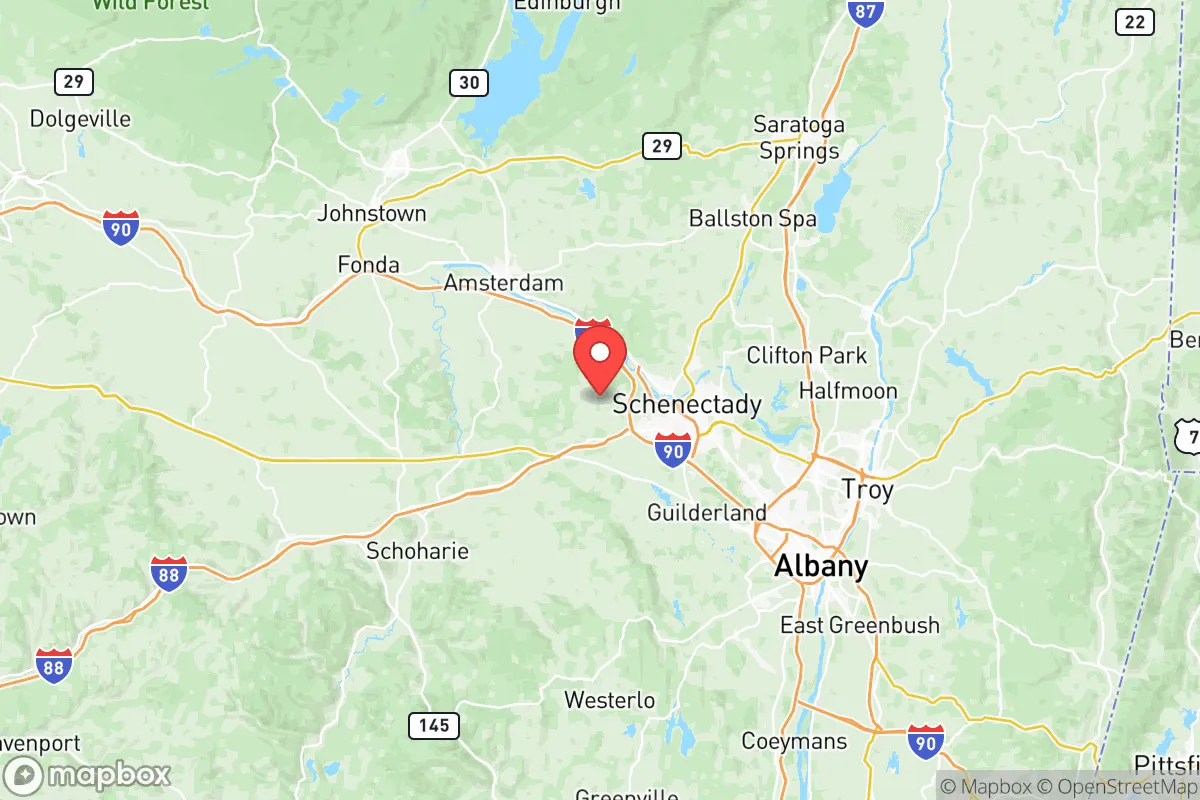
Schenectady County leans reliably Democratic with a Cook PVI of D+8, but the county's politics are far from monolithic. The city of Schenectady itself is a deep blue stronghold, consistently delivering margins of 70% or more for Democratic candidates, driven by its union-heavy manufacturing history and diverse, working-class population. However, the county's political character shifts dramatically as you move outward: the suburban town of Niskayuna, with its educated professional class, also votes comfortably blue, while the more rural, exurban towns of Duanesburg and Princetown lean increasingly red, often favoring Republicans by double digits. The swing precincts that decide county-level races are typically found in the town of Rotterdam, particularly around the Rotterdam Square Mall area, where a mix of older, more conservative homeowners and younger renters creates a genuine toss-up.
How it compares
Comparing Schenectady County to New York, NY is less a comparison of political lean and more a study in scale and intensity. New York City is the engine of the state's Democratic supermajority, with a Cook PVI that is effectively off-the-charts blue, likely D+30 or higher in Manhattan and Brooklyn. Schenectady County's D+8 is a moderate shade of blue by comparison, meaning it is far more representative of the political middle ground of Upstate New York. While a Republican running for office in New York City faces a nearly impossible climb, a Republican candidate in Schenectady County can realistically win countywide office by running strong in Duanesburg, Princetown, and the outer parts of Rotterdam, while keeping losses in the city and Niskayuna within a manageable range. The county's political center of gravity is noticeably to the right of the state's as a whole, which is why local Democrats often run on more moderate, pro-business platforms than their downstate counterparts.
What this means for residents
For a conservative resident living in Duanesburg or Princetown, the political climate is manageable but requires some navigation. You will be in the minority at the county level, but your town government and school board are likely to reflect your values, and you are not far from the reliably red counties of Schoharie and Montgomery to the west. For a liberal resident in the city or Niskayuna, the county feels like a safe and affirming environment, though you may find the local Democratic establishment more pragmatic and less progressive than what you would encounter in New York City. The practical upshot is that Schenectady County avoids the sharpest edges of political polarization. Local issues like property tax rates, school funding, and economic development tend to dominate elections more than national culture war battles, creating a political culture that is competitive but rarely hostile.
A key cultural distinction from New York City is the role of organized labor. The Schenectady political scene is still deeply influenced by unions, particularly the electrical workers (IBEW) tied to the legacy of General Electric, which gives local politics a blue-collar, economically populist flavor that is distinct from the finance-driven, socially liberal politics of Manhattan. You will hear more talk about prevailing wage laws and pension solvency at a county Democratic committee meeting than you would about zoning reform or congestion pricing. This creates a political environment where a pro-union, culturally moderate Democrat can thrive, and where a Republican who focuses on fiscal discipline and avoids social extremism can still find a path to victory, especially in the towns outside the city limits.

State Political ClimatePolitical Climate in New York
State Political AnalysisPolitical Environment in the State
New York State leans solidly Democratic in statewide elections, with Democrats holding every statewide office and commanding supermajorities in both legislative chambers, but this blue veneer masks one of the most politically fractured landscapes in the country. Over the past 20 years, the state has shifted leftward on social and economic policy driven overwhelmingly by New York City and its inner suburbs, while upstate and rural regions have moved sharply in the opposite direction, creating a political chasm that defines nearly every policy debate. For a conservative-leaning relocator, the practical reality is that your vote and your voice will carry very different weight depending on whether you land in Manhattan, Buffalo, or the Finger Lakes.
Urban vs. rural divide
The political map of New York is essentially a battle between the five boroughs of New York City and everything else. New York City alone casts roughly 40% of the state's vote and delivers margins of 70-80% for Democratic candidates, which is enough to override the rest of the state combined. The immediate suburbs — Nassau, Westchester, Suffolk, and Rockland counties — have trended blue over the past decade, with Nassau County flipping from a swing county to reliably Democratic in presidential races. Upstate, the picture is reversed: Erie County (Buffalo) and Monroe County (Rochester) are Democratic-leaning but far less so than the city, while the vast rural stretches of the Southern Tier, North Country, and Central New York vote Republican by margins of 20-30 points. Staten Island remains the only New York City borough that votes Republican in presidential elections, a quirk that makes it a political outlier within the city. The suburban counties of Orange, Putnam, and Dutchess are genuine swing areas where local races often hinge on turnout, and they represent the only realistic battlegrounds for Republican candidates seeking statewide office.
Policy environment
New York's policy environment is defined by high taxes, extensive regulation, and a robust social safety net, all of which have been supercharged under Democratic control. The state has a progressive income tax with rates topping out at 10.9% for the highest earners, plus some of the highest property taxes in the nation — median effective property tax rates hover around 1.7%, with rates in places like Monroe County and Westchester County exceeding 2%. The regulatory posture is business-friendly in name only for many industries; the state has strict rent control laws in New York City and its immediate suburbs, a $15 minimum wage that is indexed to inflation, and a paid family leave program funded by payroll deductions. On education, New York spends more per pupil than almost any other state, but outcomes vary wildly — suburban districts like those in Westchester and Nassau are among the best in the country, while many upstate and rural districts struggle with declining enrollment and aging infrastructure. Healthcare is heavily regulated, with the state operating its own health insurance exchange and expanding Medicaid under the Affordable Care Act. Election laws are among the most accessible in the country: no-excuse absentee voting, early voting, same-day registration, and automatic voter registration are all in place, which Democrats argue increases participation and Republicans argue invites fraud, though evidence of widespread fraud has not materialized.
Recent policy direction
The last five years have seen New York accelerate leftward on nearly every front a relocator might weigh. On gun policy, the state passed the SAFE Act in 2013 and followed it with the 2022 Concealed Carry Improvement Act, which effectively ended permitless carry and created "sensitive location" restrictions so broad that they cover virtually all public spaces — a law currently being challenged in federal court. On parental and education rights, the state has moved in the opposite direction of many red states: it banned for-profit charter schools, expanded funding for public schools, and passed a law requiring all school districts to adopt diversity, equity, and inclusion policies. New York passed the Reproductive Health Act in 2019, codifying abortion rights into state law and removing several restrictions, making it a destination for out-of-state patients seeking care. On property rights, the state's 2019 rent stabilization laws significantly expanded tenant protections in New York City and its suburbs, limiting landlords' ability to raise rents or convert units. The state has also enacted strict data privacy laws, including the SHIELD Act, which imposes security requirements on businesses handling personal data. On voting, the state has moved to expand access at every opportunity, including the 2021 law that allowed no-excuse absentee voting and the 2023 law that automatically restored voting rights to parolees. The overall direction is unmistakably toward a more regulated, higher-tax, socially liberal environment, with the state government actively using its power to preempt local laws that conflict with its priorities.
Civil unrest & political movements
New York has been a flashpoint for political activism on both sides, with the scale and intensity of protest activity far exceeding most states. The 2020 George Floyd protests in New York City were among the largest in the country, with sustained demonstrations for weeks and significant property damage in parts of Manhattan and Brooklyn, leading to ongoing debates about policing and public safety. The state's sanctuary policies — which limit cooperation between local law enforcement and federal immigration authorities — have been a persistent source of tension, with some upstate counties like Rensselaer and Niagara passing resolutions declaring themselves "sanctuary county" opponents, though these resolutions are largely symbolic. The "New York City exodus" narrative of 2020-2022 was real but uneven: Manhattan and Brooklyn saw population declines, while suburbs in Orange, Dutchess, and Ulster counties saw net in-migration, much of it from city residents seeking more space and lower taxes. Election integrity has been a recurring flashpoint, with Republican-led counties like Erie and Monroe challenging the state's mail-in voting expansion and the 2020 election results, though no significant irregularities were found. The state has also seen a rise in local secession movements, with some upstate counties exploring the idea of breaking away to form a new state — the "New York State of Mind" movement in 2021 gained some media attention but little practical traction. For a new resident, the most visible political expression will likely be the constant presence of protest activity in New York City and, to a lesser extent, in Albany and Buffalo, while upstate rural areas tend to be quieter but more politically engaged in local government meetings and school board races.
Projection
Over the next 5-10 years, New York's political trajectory is likely to continue its leftward drift, but with important caveats. The demographic trends are working against the Democratic coalition: New York City's population declined by roughly 5% between 2020 and 2024, while many upstate and suburban areas held steady or grew slightly, meaning the city's political dominance may slowly erode. However, the people leaving New York City are disproportionately moderate and conservative-leaning, while the city's remaining and incoming population tends to be younger and more progressive, so the political character of the city may actually become more uniformly liberal even as its population shrinks. The state's high tax burden and regulatory environment will continue to drive out-migration of higher-income households, which could create fiscal pressure on the state budget and potentially force moderation on tax policy, though the Democratic supermajority shows little appetite for significant tax cuts. The wild card is the state's housing crisis: if the state successfully implements its ambitious housing plan to build 800,000 new units over the next decade, it could slow out-migration and attract new residents, potentially shifting the political balance in some suburban areas. For a conservative-leaning relocator, the realistic expectation is that New York will remain a deeply blue state for the foreseeable future, but the practical experience will vary enormously depending on location — living in Staten Island, Orange County, or the Finger Lakes will feel politically different from living in Manhattan or Brooklyn, even if your vote doesn't change the statewide outcome.
For someone moving to New York, the bottom line is that you are choosing a state where your political influence will be limited if you lean conservative, but where your daily life can still align with your values if you pick your location carefully. The state's high taxes and extensive regulations are real and will affect your finances regardless of where you live, but the quality of life in many upstate and suburban communities remains high, with excellent schools, low crime in most areas, and access to world-class cultural and recreational amenities. If you value political engagement at the local level, you will find plenty of opportunity in school boards, town councils, and county governments where conservative voices can still make a difference. If you are looking for a state where your vote will reliably count toward a conservative majority, New York is not that place — but if you are willing to accept the trade-offs, it offers a quality of life that many find worth the political cost.
* Values derived from national, state, county, city and local statistics and may differ in a specific area. Last updated: 2026-06-22T16:33:10.000Z
Narrative content on this page is AI-generated and may contain mistakes. Verify any details that matter before acting on them.
ReloMaps may earn a commission from affiliate links at no extra cost to you.

