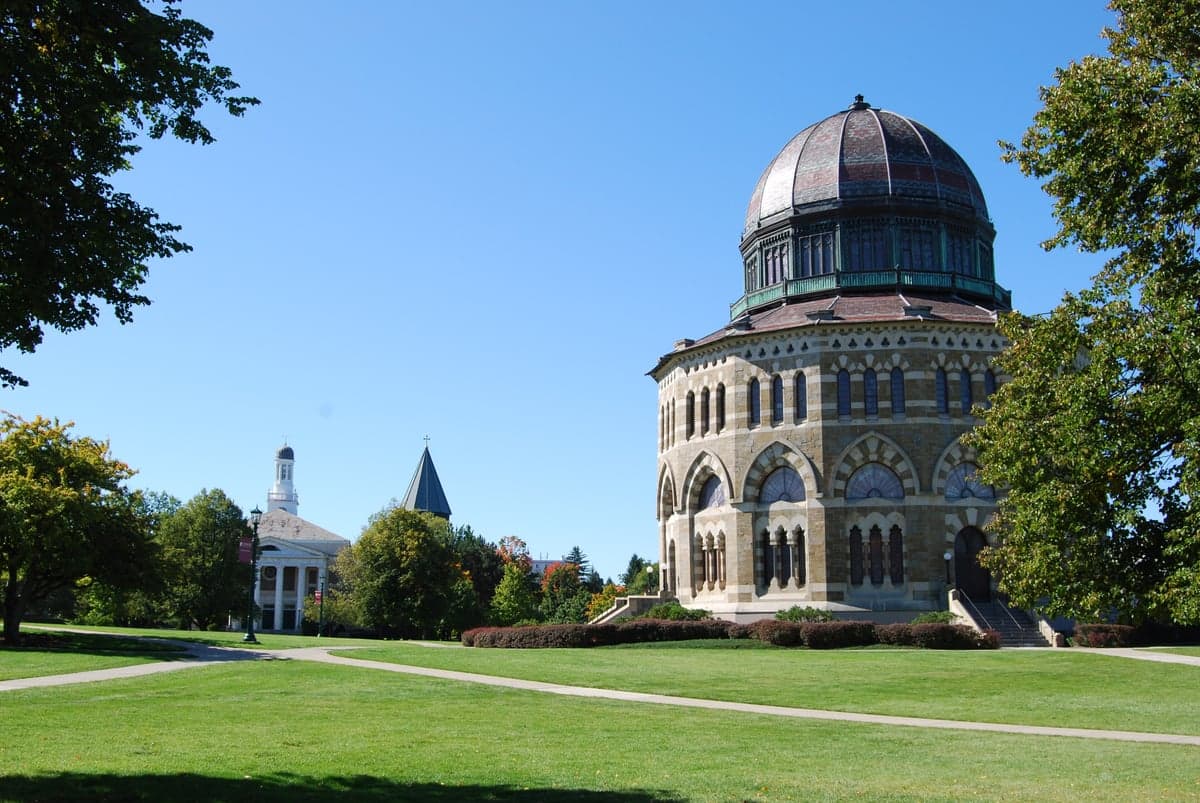
Photo: Wikipedia
Personal Sovereignty in Schenectady County
Moderate friction. Expect trade-offs in some aspect of personal liberty and independence.
What does Personal Sovereignty tell us?
Personal Sovereignty measures your capacity for self-reliance and independence with minimal government friction. Higher scores mean fewer barriers between you and the way you want to live... but it assumes you have the space you need and good neighbors.
What does this tell us?
Personal Sovereignty measures your capacity for self-reliance and independence with minimal government friction. Higher scores mean fewer barriers between you and the way you want to live... but it assumes you have the space you need and good neighbors.
State Policy
Energy independence: Importer (12% of energy produced in-state)
Personal Liberty
Homesteading

Personal Liberty Analysis
Schenectady County presents a mixed picture for those prioritizing personal sovereignty, where the broader constraints of New York State law intersect with local conditions that can either amplify or soften the regulatory hand. While the state’s legal framework imposes significant limitations on self-defense, property rights, and tax burdens, the county itself offers pockets of relative autonomy, particularly in its more rural and suburban towns. For a relocation-minded individual or family weighing personal freedom, the key is understanding where within Schenectady County the balance tips toward greater self-reliance, and where the state’s heavy regulatory posture is most keenly felt.
Tax burden and regulatory posture in Schenectady County
New York State’s tax burden is among the highest in the nation, and Schenectady County residents feel that weight directly. The combined state and local income tax rate can exceed 10% for higher earners, and property taxes in the county are notably high, with effective rates often hovering around 2.5% to 3% of assessed home value. This is a significant factor for anyone seeking to keep more of their earnings. The regulatory environment is similarly dense: state-level building codes, environmental regulations, and land-use rules are extensive, and local municipalities add their own layers. In the city of Schenectady itself, zoning is tight, permitting processes can be slow, and property development is subject to multiple review boards. However, moving outward to towns like Niskayuna or Glenville, the regulatory touch lightens somewhat, though still within the state’s framework. For a conservative-leaning reader, the tax and regulatory climate here is a clear trade-off: you gain proximity to Albany’s job market and some community services, but you pay for it in both taxes and bureaucratic friction.
Self-defense and gun law specifics in the county
New York’s gun laws are among the most restrictive in the country, and Schenectady County is fully subject to them. The state requires a permit to purchase a handgun, a background check for all firearm sales, and a license to carry a concealed firearm, which after the 2022 Bruen decision is now issued on a "shall-issue" basis but still involves a lengthy application process, character references, and a firearms safety course. The county sheriff’s office in Schenectady processes these permits, and while local officials are generally professional, the process is not quick. Magazine capacity is capped at 10 rounds, and the state’s SAFE Act bans certain features commonly found on semi-automatic rifles. For those who prioritize the right to self-defense, this environment is a significant constraint. Within the county, gun culture is more visible in the rural areas around Duanesburg and Princetown, where hunting and sport shooting are common, and local gun shops and ranges serve a community that values the Second Amendment. In the city and more suburban towns like Scotia, the culture is more mixed, but the legal restrictions apply uniformly across the county.
Self-reliance and homesteading viability across the area
Homesteading and off-grid living are possible in Schenectady County, but the feasibility varies sharply by location. The county’s more rural towns, particularly Duanesburg and Princetown, offer larger lot sizes—often one to five acres or more—and a more permissive zoning environment for keeping livestock, building outbuildings, and installing alternative energy systems. In these areas, residents can realistically pursue a degree of self-sufficiency, with gardens, chickens, and even small-scale farming. However, full off-grid living is complicated by state building codes that require connection to utilities in many cases, and by the county health department’s strict regulations on septic systems and well water. In the city of Schenectady and the more densely developed suburbs like Niskayuna, lot sizes are smaller, zoning is restrictive, and homeowners’ associations may impose additional limits on what you can do with your property. For someone serious about self-reliance, the rural townships offer the best opportunity, but even there, the state’s regulatory reach means that true independence from the grid is difficult to achieve legally.
Personal liberties in Schenectady County
On issues of parental rights, medical autonomy, and free speech, Schenectady County largely reflects the broader New York State environment. Parental rights in education have been a point of contention, with the state mandating certain curricula that some families find intrusive, though local school boards in towns like Scotia-Glenville and Duanesburg have shown more responsiveness to parent input than the city district. Medical autonomy is heavily constrained by state law, particularly regarding vaccine mandates and public health orders, which were strictly enforced during the pandemic. Property rights are also limited by the state’s rent stabilization laws in the city and by environmental regulations that can restrict land use in rural areas. Free speech is legally protected, but the cultural climate in the county is politically mixed—more liberal in the city and more conservative in the outlying towns—so the experience of expressing dissenting views can vary. For a reader prioritizing personal liberties, the county offers a spectrum: the rural towns provide more breathing room, while the city and close suburbs are more aligned with the state’s progressive regulatory posture.
Overall, personal sovereignty in Schenectady County is a study in contrasts. The state’s heavy tax burden, restrictive gun laws, and dense regulatory framework create a baseline that limits autonomy compared to states in the South or Midwest. Yet within the county, the rural towns of Duanesburg, Princetown, and parts of Glenville offer a more freedom-friendly environment than the city or close-in suburbs. For a conservative-leaning individual or family, the decision to relocate here hinges on whether the trade-offs—higher taxes and less legal latitude for self-defense and off-grid living—are worth the benefits of the region’s economy, schools, and community. Compared to areas like upstate New York’s more rural counties, Schenectady County is moderate in its autonomy profile; it is not the most restrictive in the state, but it is far from the most permissive.

* Values derived from national, state, county, city and local statistics and may differ in a specific area. Last updated: 2026-06-22T16:33:10.000Z
Narrative content on this page is AI-generated and may contain mistakes. Verify any details that matter before acting on them.
ReloMaps may earn a commission from affiliate links at no extra cost to you.

