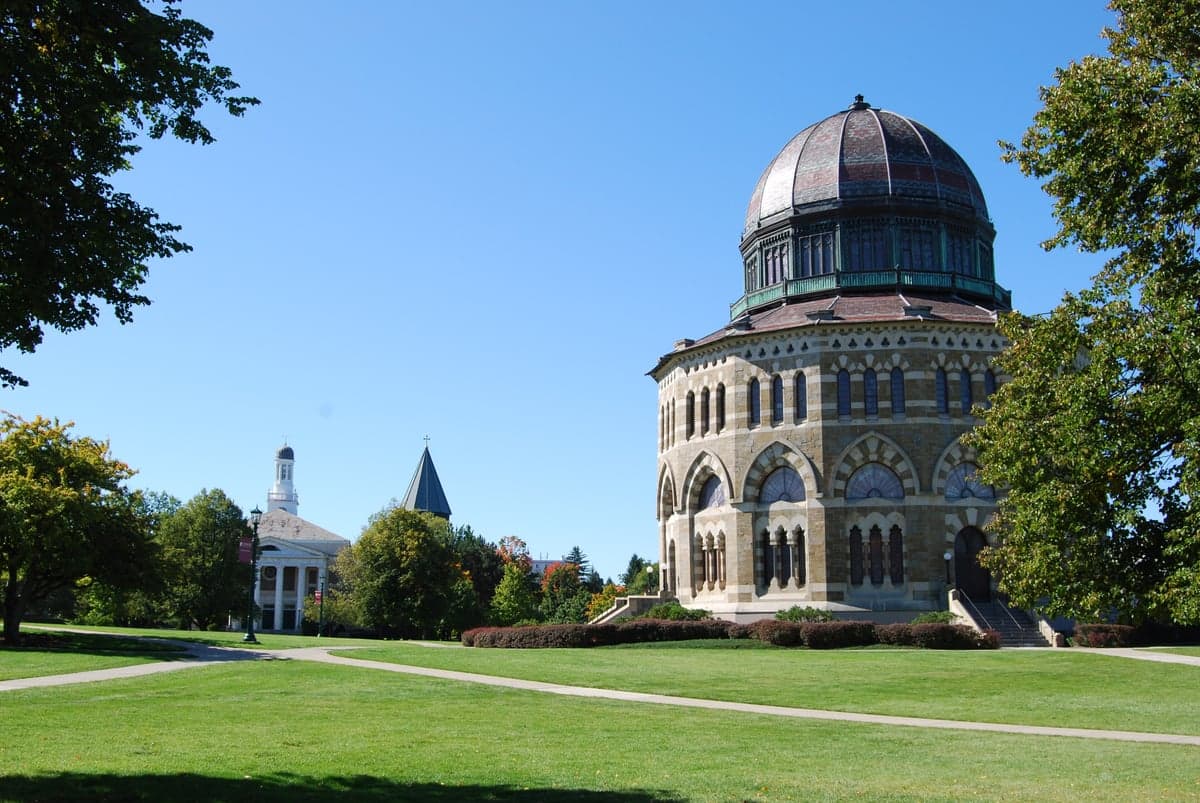
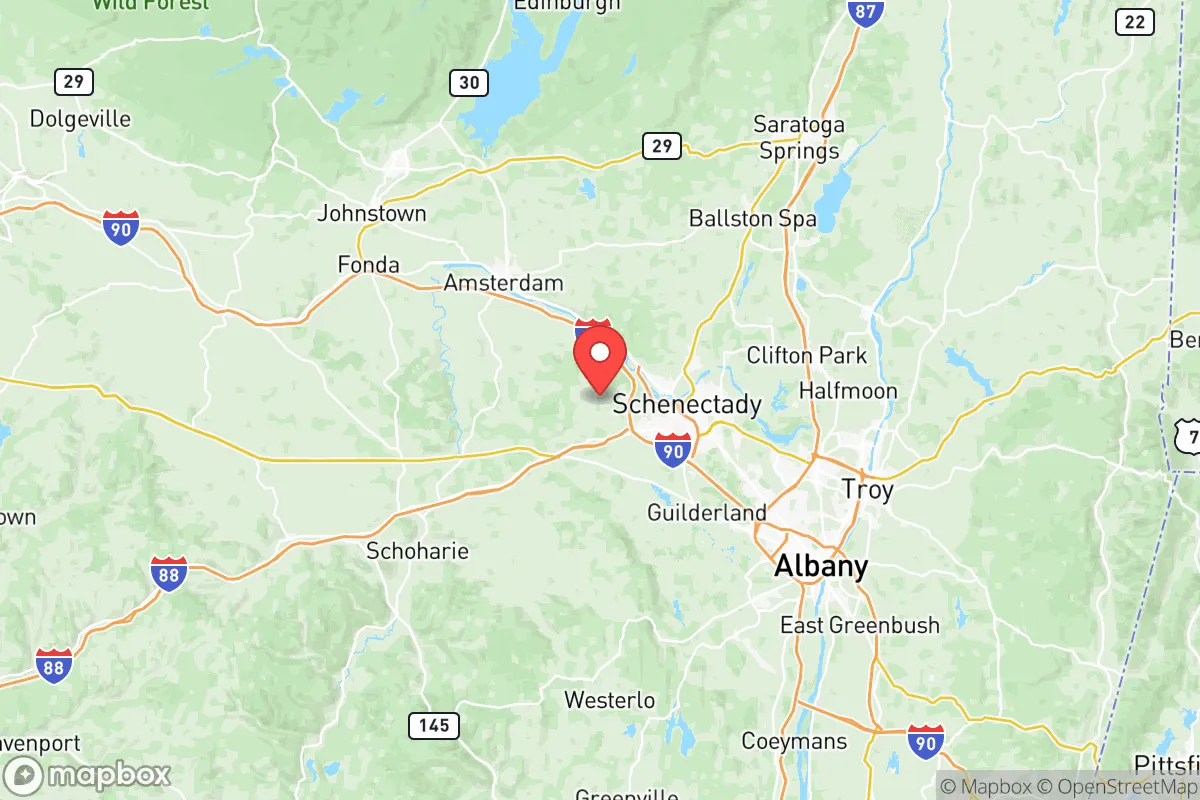
Photo: Wikipedia
Demographics of Schenectady County
Affluence Level in Schenectady County
A middle-class area roughly in line with national averages across income, home values, education, and employment.
People of Schenectady County
Schenectady County, New York, is home to roughly 160,000 residents, a population shaped by centuries of industrial ambition and immigration. Today, the county is a predominantly white (68.7%) community with a notable Black population (10.1%) and growing Hispanic (8.1%) and Asian (East/Southeast Asian at 2.1%, Indian subcontinent at 2.8%) communities. Its character is defined by the legacy of General Electric and the Erie Canal, a history of European ethnic enclaves, and a modern, slow diversification that sets it apart from faster-growing parts of the state.
Settlement & growth (pre-1960)
The original inhabitants of the region were the Mohawk people, part of the Haudenosaunee (Iroquois) Confederacy, who controlled the fertile Mohawk River valley. Dutch colonists from the patroonship of Rensselaerswyck established the first permanent European settlement in the 1660s, founding what is now the city of Schenectady in 1661 as a fur-trading post. The Dutch left a lasting cultural and architectural imprint, though the colony was taken over by the English in 1664.
The American Revolution devastated the Mohawk population, who largely sided with the British and were forced out after the war. The opening of the Erie Canal in 1825 transformed Schenectady County from a quiet agricultural area into a transportation and manufacturing hub. The canal brought an influx of Irish immigrants in the 1830s and 1840s, who dug the waterway and settled in the Stockade neighborhood of Schenectady and the village of Rotterdam. They were followed by German immigrants in the 1840s and 1850s, who established farms and businesses in the town of Glenville and the village of Scotia.
The single most transformative event was the founding of the Thomas Edison Machine Works in Schenectady in 1886, which soon became the General Electric Company (GE). From the 1890s through the 1920s, GE recruited heavily from Europe, creating a massive demand for skilled and semi-skilled labor. This brought a wave of Italian immigrants, who concentrated in the Mont Pleasant and Goose Hill neighborhoods of Schenectady, and Polish immigrants, who settled in the Eastern Avenue corridor and the town of Niskayuna. A smaller but significant community of Russian Jews arrived in the early 1900s, establishing businesses on State Street. By 1920, Schenectady was one of the most foreign-born cities in the United States, with over 30% of its population born abroad.
The Great Depression and World War II saw a slowdown in European immigration, but the war itself brought a new group: Black Americans from the South, part of the Great Migration, who came to work in GE's wartime factories. They settled primarily in the Hamilton Hill neighborhood of Schenectady. The post-war boom of the 1950s saw suburbanization accelerate, with white ethnic families moving from the city to new developments in Niskayuna, Rotterdam, and Glenville, while the city of Schenectady itself began a long period of population decline.
Modern era (post-1965)
The 1965 Hart-Cellar Act opened immigration from Asia and Latin America, but Schenectady County's foreign-born population remains low at just 3.6%, compared to the national average of over 13%. This reflects the region's stagnant industrial economy after GE's peak. The county did not experience the large-scale new immigration that reshaped New York City or other major metros.
The most significant post-1965 demographic shift has been the growth of the Hispanic population, now at 8.1%. This community is largely Puerto Rican and Dominican, with a smaller number of Mexican and Central American immigrants. They have concentrated in the city of Schenectady, particularly in the Hamilton Hill and Mont Pleasant neighborhoods, as well as in the town of Rotterdam. The Black population, at 10.1%, has remained relatively stable, with a continued presence in Hamilton Hill and growing numbers in Niskayuna and Glenville.
The East/Southeast Asian community (2.1%) is a newer addition, driven by professionals and students connected to GE's remaining research operations and to Union College. This group is small but visible in Niskayuna and the city of Schenectady's Upper Union Street area. The Indian subcontinent community (2.8%) is similarly professional and concentrated in Niskayuna, drawn by the tech and engineering sectors. Domestic migration has been modest; the county has not seen the rapid Sun Belt-style growth of other regions, but it has attracted some former New York City residents seeking lower housing costs, particularly in the towns of Clifton Park (which straddles the county line) and Niskayuna.
The future
Schenectady County is projected to see slow, steady diversification over the next 10-20 years. The white population, currently 68.7%, will continue to decline as older residents age and younger, more diverse families move in. The Hispanic and Asian (both East/Southeast Asian and Indian subcontinent) populations are expected to grow, though from a small base. The county's foreign-born share will likely rise but remain below the national average.
The geographic pattern will likely continue: the city of Schenectady will become more Hispanic and Black, while the suburban towns of Niskayuna and Glenville will see growth in Asian and Indian subcontinent populations. The town of Rotterdam is likely to see a continued Hispanic presence. The county's cultural identity is slowly shifting from a white, European-ethnic, union-industrial character to a more multi-ethnic, professional-services and healthcare-based one. The decline of GE as a dominant employer has been replaced by growth in healthcare (Ellis Medicine, St. Peter's Health Partners) and education (Union College, SUNY Schenectady).
For someone moving in now, Schenectady County offers a relatively affordable, historically rich environment with a modest but real diversity. It is not a melting pot in the style of a major city, but it is a place where distinct ethnic neighborhoods and suburban professional enclaves coexist. The county is becoming more diverse, but slowly, and its future character will be shaped more by domestic migration from downstate New York and by the children of existing immigrant families than by a new wave of international arrivals.

* Values derived from national, state, county, city and local statistics and may differ in a specific area. Last updated: 2026-06-22T16:33:10.000Z
Narrative content on this page is AI-generated and may contain mistakes. Verify any details that matter before acting on them.
ReloMaps may earn a commission from affiliate links at no extra cost to you.

