Photo: Wikipedia
Political ClimatePolitical Climate in Jefferson County
Showing district-level results — no local-only data available.
Local Political AnalysisPolitical Analysis of Jefferson County
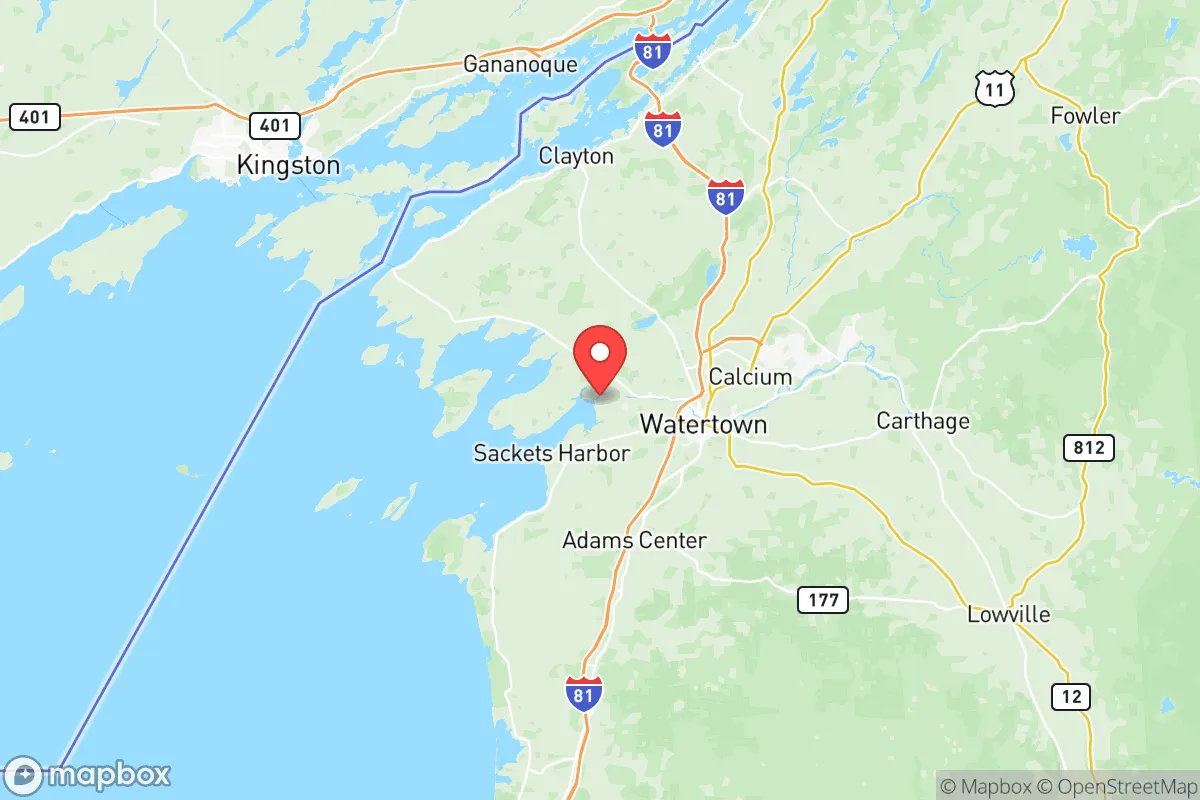
Jefferson County is a solidly Republican stronghold in an otherwise blue state, carrying a Cook Partisan Voting Index of R+11. That means the county votes about 11 points more Republican than the national average, making it one of the most conservative areas in New York outside of the Southern Tier. The political center of gravity here hasn't shifted much in the last decade—Trump won the county by 18 points in 2020 and by 20 in 2024—but there are real pockets of blue, especially in the city of Watertown and the village of Sackets Harbor, where active-duty military families and younger professionals tend to pull the vote closer to the middle. The trajectory is stable red, but not uniformly so; the rural towns like Lyme and Henderson are deep red, while the college-adjacent precincts around Jefferson Community College in Watertown can swing within 5 points of a tie.
How it compares
Compared to New York City, the political gulf is enormous. New York County (Manhattan) votes roughly D+80, meaning the two places exist in entirely different political universes. In Jefferson County, you'll find Republican candidates routinely winning town council seats unopposed, while in New York City, a Republican running for citywide office is a novelty. The contrast is most visible in policy priorities: Jefferson County residents consistently rank property taxes, Second Amendment rights, and agricultural land use as top concerns, whereas New York City voters prioritize transit funding, rent regulation, and public school equity. The county's R+11 lean is actually a bit more conservative than the surrounding North Country region—St. Lawrence County to the east is R+9, and Lewis County to the south is R+14—so Jefferson sits right in the middle of the regional conservative spectrum.
What this means for residents
For conservative residents, the local political climate is comfortable. The county legislature has a strong Republican majority, and the sheriff's office is consistently GOP-aligned, meaning gun laws are enforced with local discretion and tax levies tend to stay low. For liberal residents, it's a different story: they often feel politically isolated, especially in rural towns like Brownville or Cape Vincent where Democratic candidates rarely even file petitions. That said, the county's blue pockets—Watertown's 1st and 4th wards, and the village of Sackets Harbor—do provide community for progressives, and local Democratic committees are active, if outnumbered. The practical effect is that most policy debates here are about local issues—road funding, school budgets, and lakefront development—rather than the national culture wars that dominate NYC politics. The county's conservative lean also means that state-level Democratic policies, like the SAFE Act or bail reform, are often met with local resolutions of non-compliance or symbolic opposition.
Culturally, Jefferson County feels more like upstate Michigan or rural Pennsylvania than the rest of New York. The presence of Fort Drum—home to the 10th Mountain Division—injects a strong military ethos into local politics, with veterans often holding elected office and military families making up a significant voting bloc. This gives the area a pragmatic, service-oriented conservatism that differs from the more ideological strains found in the suburbs of Albany or Rochester. The county's policy distinctions are most visible in land use: agricultural exemptions are generous, and there's little appetite for the kind of zoning density mandates common downstate. For anyone moving here from New York City, the political adjustment is real—but the slower pace, lower cost of living, and direct access to Lake Ontario and the Thousand Islands often outweigh the partisan mismatch for those who make the leap.

State Political ClimatePolitical Climate in New York
State Political AnalysisPolitical Environment in the State
New York State has been a solidly Democratic stronghold for decades, with Democrats holding every statewide office and a supermajority in the State Assembly for most of the last 20 years. The state hasn't voted Republican in a presidential election since 1984, and in 2024, Kamala Harris carried it by roughly 12 points. But that top-line number hides a deeply fractured political landscape: New York City and its inner suburbs drive the blue wave, while vast swaths of upstate—places like Allegany County and Lewis County—routinely vote 2-to-1 or more for Republicans. The 10-to-20-year arc has been one of accelerating polarization, with the city becoming more progressive and upstate rural areas hardening into GOP strongholds, while the moderate suburban middle has shrunk.
Urban vs. rural divide
The political map of New York is essentially a tale of two states. New York City (population 8.3 million) is the engine of the Democratic vote, delivering margins of 75-85% in most elections. Its five boroughs are home to the state's most progressive constituencies, from Manhattan's professional class to the Bronx's working-class communities of color. The immediate suburbs—Nassau County on Long Island and Westchester County north of the city—have trended Democratic over the past decade, driven by college-educated voters and growing minority populations. In 2024, Nassau voted for Harris by about 8 points, a flip from its Republican lean in the 1990s. Meanwhile, upstate metros like Buffalo, Rochester, and Albany are Democratic-leaning but more moderate, while the rural counties between them—the Southern Tier, the North Country, and the Finger Lakes—are deeply red. Otsego County and Steuben County are typical: they vote Republican by 20-30 points, and their politics are shaped by gun rights, opposition to state mandates, and a sense of being ignored by Albany. The divide isn't just electoral; it's cultural. A resident of Chautauqua County in the far west has almost nothing in common politically with someone in Brooklyn.
Policy environment
New York's policy environment is among the most progressive in the nation, and it's felt most acutely in taxes and regulation. The state has a progressive income tax with rates up to 10.9% for top earners, plus some of the highest property taxes in the country—Monroe County (Rochester) and Erie County (Buffalo) have effective rates around 2.5-3% of home value. Sales tax varies by locality but typically runs 8-8.75%. The regulatory posture is heavy: New York has strict rent stabilization laws in NYC and its suburbs, a statewide ban on fracking since 2015, and a climate law (the Climate Leadership and Community Protection Act) mandating 70% renewable electricity by 2030. Education policy is centralized, with the state setting curriculum standards and funding formulas that favor high-needs districts. Healthcare is dominated by large systems like Northwell Health and the University of Rochester Medical Center, and the state expanded Medicaid under the ACA. Election laws are relatively liberal: no-excuse absentee voting was expanded during COVID and made permanent, and early voting is available statewide. But the state also has a closed primary system, which can frustrate independents.
Recent policy direction
The last five years have seen a sharp leftward turn in Albany, driven by the Democratic supermajority and Governor Kathy Hochul. On gun policy, the state passed the SAFE Act in 2013 (expanded in 2022 after the Supreme Court's Bruen decision), which bans assault weapons, limits magazine capacity to 10 rounds, and requires a permit to purchase a semi-automatic rifle. The 2022 Concealed Carry Improvement Act added "sensitive location" restrictions and a "good moral character" requirement for permits, which is being challenged in court. On parental and education rights, the state has moved in the opposite direction from many red states: it passed a law in 2023 prohibiting school districts from banning books based on "partisan or doctrinal" disapproval, and it requires schools to teach LGBTQ+ history. Speech is broadly protected under the state constitution, but a 2022 law (the "hate crime" expansion) increased penalties for bias-motivated speech that incites violence. Privacy and surveillance: the state passed the SHIELD Act in 2019, which requires data breach notifications and security programs, and it has a biometric privacy law (2023) regulating facial recognition. Medical and bodily autonomy: New York has codified abortion rights into law (the Reproductive Health Act of 2019) and expanded access to gender-affirming care for minors, including a 2023 law that shields providers from out-of-state lawsuits. Property rights are constrained by rent control in NYC and strong eminent domain powers for development. On voting, the state passed the John R. Lewis Voting Rights Act in 2022, which requires pre-clearance for local election changes in jurisdictions with a history of discrimination.
Civil unrest & political movements
New York has a long history of political activism, and recent years have been no exception. The 2020 Black Lives Matter protests in NYC were among the largest in the country, with sustained demonstrations for months. The state's sanctuary policies—dating back to the "New York is a Sanctuary State" executive order in 2017 and codified in the 2019 Green Light Law, which allows undocumented immigrants to obtain driver's licenses—have made it a flashpoint in immigration politics. ICE detainers are not honored, and local law enforcement is prohibited from cooperating with federal immigration authorities in most cases. On the right, the "Second Amendment Sanctuary" movement has spread through upstate counties: as of 2025, over 30 counties (including Oneida County and Delaware County) have passed resolutions declaring themselves sanctuaries from state gun laws, though these are symbolic. Election integrity controversies flared after 2020, with some upstate counties (like Rensselaer County) refusing to certify primary results over concerns about ballot security, though courts ultimately forced certification. The "New York City exodus" narrative of 2020-2022—where tens of thousands of residents moved to Florida, Texas, and the Carolinas—was real, but it has slowed as remote work stabilized. A new resident would notice the contrast: in NYC, you'll see activist groups on every corner; in rural areas, you'll see "Don't Tread on Me" flags and signs reading "Keep Albany Out of Our County."
Projection
Over the next 5-10 years, New York's political trajectory points toward continued Democratic dominance at the state level, but with growing internal friction. The demographic trends are clear: New York City and its suburbs are becoming more diverse and more progressive, while upstate rural areas are aging and shrinking. The 2020 Census cost the state a congressional seat, and the trend is likely to continue—population loss in the Southern Tier and North Country will further concentrate political power in the downstate region. However, the suburban shift toward Democrats may slow as housing costs push moderate families out of Westchester and Nassau into more affordable red states. The state's fiscal situation is a wild card: New York has one of the highest debt burdens in the country, and the 2024-2025 budget included significant tax increases on high earners to fund expanded social programs. If the economy slows, expect pressure to cut spending or raise taxes further, which could accelerate out-migration. On cultural issues, the state will likely continue to be a leader on progressive policies—expect further gun restrictions, expanded healthcare access, and stronger tenant protections. But the rural-urban divide will deepen, with more counties passing symbolic resolutions of defiance and more legal challenges to state laws. A conservative moving in now should expect to live in a state where their vote is largely irrelevant at the statewide level, but where local control in upstate counties still matters for schools, zoning, and law enforcement. A liberal moving in will find a state that largely aligns with their values, but with high costs and a growing tension between the city and the rest of the state.
For a new resident, the bottom line is this: New York is a state where your political experience depends almost entirely on where you live. If you're a conservative looking for a place where your vote counts and your values are reflected in state policy, you'll be frustrated—Albany will feel like a distant, hostile force. But if you're willing to live in a rural or exurban county, you can find a community that shares your outlook, even if the state government doesn't. If you're a liberal, you'll find a state that protects your rights on healthcare, education, and civil liberties, but you'll pay for it in taxes and cost of living. The practical takeaway: choose your county carefully, because in New York, the zip code is your politics.
* Values derived from national, state, county, city and local statistics and may differ in a specific area. Last updated: 2026-07-14T06:24:49.000Z
Narrative content on this page is AI-generated and may contain mistakes. Verify any details that matter before acting on them.
ReloMaps may earn a commission from affiliate links at no extra cost to you.

