
Photo: Wikipedia
Demographics of Jefferson County
Affluence Level in Jefferson County
A below-average socioeconomic profile. Incomes, home values, and educational attainment trail the U.S., with higher poverty and unemployment.
People of Jefferson County
Jefferson County, New York, is a predominantly white, rural community of 116,130 residents, shaped by centuries of military presence, agricultural settlement, and a strong connection to the St. Lawrence River and Lake Ontario. The county’s identity is anchored by Fort Drum, the U.S. Army’s largest installation east of the Mississippi, which brings a transient military population and a conservative, patriotic character to the region. With a foreign-born population of just 1.8% and a white share of 80.8%, Jefferson County remains one of the least ethnically diverse counties in New York, though its Hispanic (7.3%) and Black (4.6%) communities are slowly growing. The population is older than the national median, with a college attainment rate of 25.7%, reflecting a workforce rooted in military service, agriculture, and manufacturing rather than high-tech or professional services.
Settlement & growth (pre-1960)
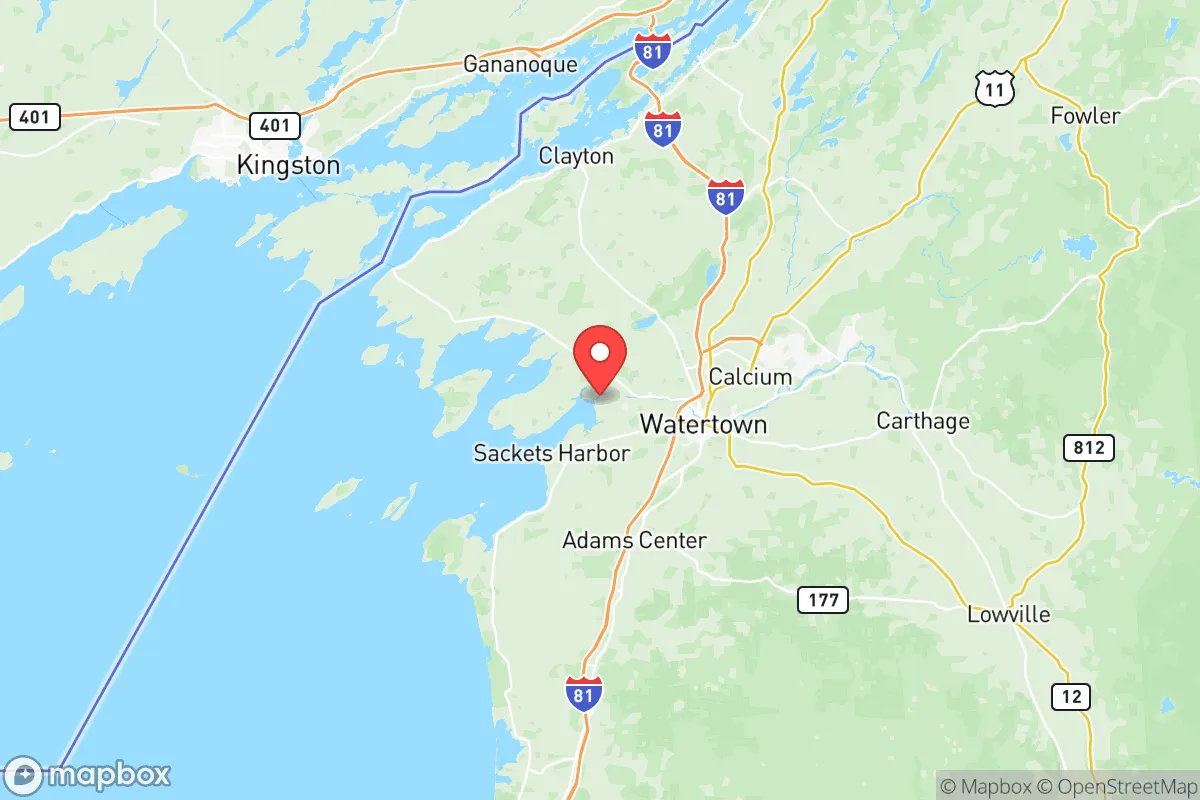
Before European contact, the region now known as Jefferson County was the homeland of the Haudenosaunee (Iroquois) Confederacy, specifically the Oneida and Onondaga nations, who used the area for hunting, fishing, and trade along the Black River and Lake Ontario. French explorers and Jesuit missionaries passed through in the 17th century, but no permanent European settlement occurred until after the American Revolution. The county was formally established in 1805 from part of Oneida County, and the first major wave of settlers were Yankees from New England—primarily from Massachusetts, Connecticut, and Vermont—who arrived between 1790 and 1820, drawn by cheap land grants offered by the state and the promise of fertile soil along the Black River Valley. These early settlers founded the county seat of Watertown in 1800, along with Sackets Harbor (a key naval base during the War of 1812) and Adams, Ellisburg, and Henderson.
The War of 1812 cemented the county’s military character, as Sackets Harbor became a major shipbuilding and supply center for the U.S. Navy. After the war, the construction of the Erie Canal (completed 1825) and later the Black River Canal (completed 1855) spurred a second wave of settlement: Irish immigrants arrived in the 1830s and 1840s to dig the canals and work in the region’s growing limestone quarries and paper mills. Many Irish families settled in Watertown’s Irish Flats neighborhood and in the mill villages of Brownville and Dexter. A smaller wave of German immigrants arrived in the 1850s, establishing farms in the towns of Lorraine and Rodman, and contributing to the county’s dairy industry.
The late 19th and early 20th centuries saw the rise of manufacturing in Watertown—paper mills, foundries, and carriage factories—which attracted Italian immigrants (1890s–1910s) and Polish immigrants (1900s–1920s). Italian families concentrated in Watertown’s north side, while Polish immigrants settled in Glen Park and Black River, working in the paper mills and the New York Air Brake Company. The Great Depression and World War II slowed immigration, but the 1940s brought a new wave: the establishment of Pine Camp (later Fort Drum) in 1908 expanded dramatically during World War II, drawing soldiers and civilian workers from across the U.S. The county’s population peaked at 111,000 in 1950, driven by the military buildup and post-war manufacturing.
Modern era (post-1965)
The 1965 Hart-Cellar Act had a minimal direct impact on Jefferson County, as the region’s foreign-born population remains tiny (1.8%) compared to national averages. However, the act’s broader effects—shifting U.S. immigration toward Asia and Latin America—are visible in the county’s small but growing Hispanic and Asian communities. The Hispanic population (7.3%) is largely of Puerto Rican and Mexican descent, many of whom arrived as military families stationed at Fort Drum or as agricultural workers in the county’s dairy and apple farms. The Black population (4.6%) is also heavily tied to Fort Drum, with many African American soldiers and their families settling in Watertown and the villages of Evans Mills and Philadelphia after service.
Domestic migration has been the dominant demographic force since 1965. The closure of many manufacturing plants in the 1970s and 1980s—including the New York Air Brake Company’s downsizing and the decline of Watertown’s paper mills—led to a population decline from 111,000 in 1970 to 110,000 in 1990. However, the 1990s saw a reversal as Fort Drum expanded under the Base Realignment and Closure (BRAC) process, becoming the home of the 10th Mountain Division. This brought thousands of soldiers and their families from across the U.S., many of whom chose to stay after retirement. The county’s population grew to 116,000 by 2010, with most growth concentrated in the towns of Le Ray (home to Fort Drum’s main gate) and Watertown, as well as the village of Calcium, which grew from a hamlet to a bustling commercial corridor serving the base.
Suburbanization has been modest compared to Sun Belt regions, but new subdivisions have sprouted around Fort Drum and along Route 11 between Watertown and the base. The East/Southeast Asian community (1.3%) is small but visible, with Filipino and Korean families often connected to military service, while the Indian subcontinent community (0.5%) includes a mix of military personnel and medical professionals working at Samaritan Medical Center in Watertown. The county remains overwhelmingly white (80.8%), but the military presence has introduced a degree of racial and ethnic diversity that is higher than in neighboring rural counties like Lewis or St. Lawrence.
The future
Jefferson County’s population is projected to remain stable or decline slightly over the next 20 years, as the region’s low birth rate and aging population (median age 42) offset any growth from Fort Drum. The military base is the county’s economic anchor, and any future BRAC round could dramatically reshape the population—either through a sudden influx of new units or a devastating drawdown. The Hispanic and Black populations are likely to grow slowly, driven by military recruitment and retention, but the county will remain far less diverse than New York State as a whole. New immigrant communities are unlikely to form significant enclaves, as the low foreign-born share and lack of ethnic infrastructure (e.g., ethnic grocery stores, places of worship) limit chain migration.
The county’s cultural identity is evolving from a traditional rural and manufacturing base toward a military-service economy. This shift has brought a more transient, nationally diverse population to Watertown and the Fort Drum corridor, while the outlying towns—Cape Vincent, Chaumont, and Clayton—remain overwhelmingly white and rooted in agriculture and tourism. The next decade will likely see continued suburbanization around Fort Drum, with new housing developments in Le Ray and the village of Dexter, while the county’s rural townships continue to lose young adults to urban areas.
For someone moving in now, Jefferson County offers a stable, family-oriented community with a strong military presence, low crime rates, and affordable housing—but limited economic opportunity outside the base and healthcare sectors. The population is becoming slightly more diverse and suburban, but the county’s character remains deeply tied to its Yankee and Irish roots, its military heritage, and its role as a gateway to the Thousand Islands region. It is a place where newcomers are welcomed, but where the pace of change is slow and the cultural expectations are conservative.

* Values derived from national, state, county, city and local statistics and may differ in a specific area. Last updated: 2026-07-14T06:24:49.000Z
Narrative content on this page is AI-generated and may contain mistakes. Verify any details that matter before acting on them.
ReloMaps may earn a commission from affiliate links at no extra cost to you.

