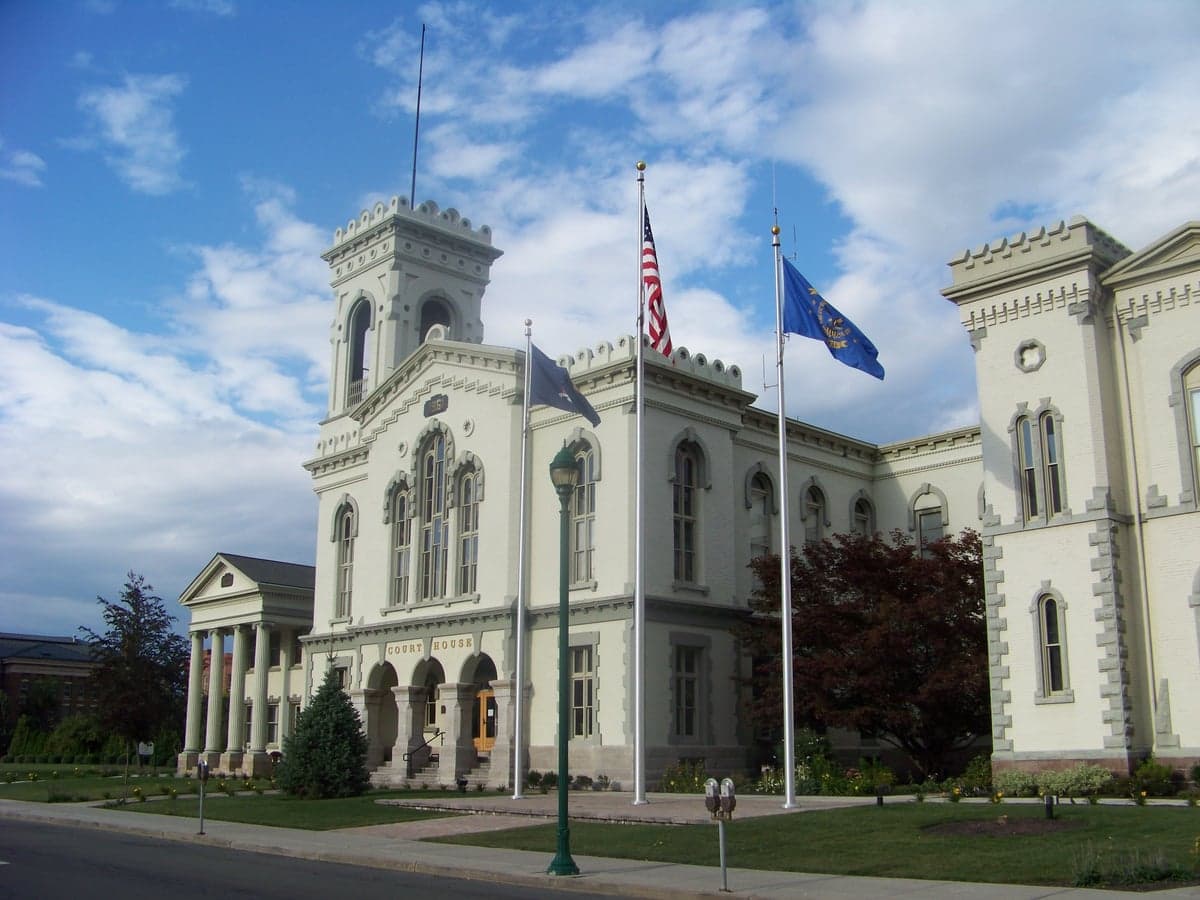
Photo: Wikipedia
Political ClimatePolitical Climate in Chemung County
Showing district-level results — no local-only data available.
Local Political AnalysisPolitical Analysis of Chemung County
Chemung County, anchored by the city of Elmira, has a Cook Partisan Voting Index of R+10, making it one of the more reliably Republican counties in New York's Southern Tier. That R+10 rating means the county votes about 10 points more Republican than the national average, a shift that has become more pronounced over the last decade. In 2020, Donald Trump carried Chemung County with roughly 58% of the vote, while Joe Biden took about 40%, a margin that has widened slightly from 2016. The county's political trajectory is a slow, steady drift rightward, driven largely by the rural and exurban precincts outside Elmira, even as the city itself remains a Democratic stronghold.
How it compares to New York, NY
The contrast with New York City is stark. New York, NY — Manhattan — is one of the most Democratic-leaning places in the country, with a Cook PVI likely in the D+40 range or higher. In 2020, Biden took Manhattan with over 86% of the vote. Chemung County's R+10 rating places it in a completely different political universe. Within Chemung County itself, the political geography is more nuanced. Elmira's 1st and 2nd wards lean reliably Democratic, often voting 60-65% for Biden, reflecting the city's older industrial base and union presence. Meanwhile, towns like Horseheads, Big Flats, and Southport are swing areas that have trended Republican over the past two cycles, with Horseheads precincts often splitting 55-45 Republican. The rural towns — Catlin, Baldwin, Veteran, and Ashland — are deeply red, frequently voting 70% or more for GOP candidates. The swing precincts are in the suburban ring around Elmira, particularly in the Town of Elmira and parts of Horseheads, where economic anxiety and cultural issues have pushed voters rightward.
What this means for residents
For conservative residents, Chemung County offers a comfortable political environment. Local offices — county legislature, sheriff, district attorney — are nearly all held by Republicans, and the county's GOP committee is well-organized. Conservative voters here feel their views are represented in local governance, from tax policy to Second Amendment issues. For liberal residents, the reality is more mixed. While Elmira provides a blue island, the county-level politics can feel isolating. Progressive candidates rarely win countywide races, and issues like zoning reform or environmental regulation often stall. That said, the county's Democratic minority is active, particularly around Elmira College and the city's older neighborhoods, and they have found success in city council races. The practical effect is that liberal residents often focus their energy on city-level politics, while conservative residents dominate county and state legislative races.
Culturally, Chemung County is distinct from New York City in ways that go beyond voting. The county's economy is rooted in manufacturing, logistics, and healthcare — major employers include Elmira Corning Regional Airport, Arnot Health, and the Elmira City School District — rather than finance or tech. Gun ownership is common, church attendance is higher than the state average, and the pace of life is slower. Policy-wise, the county has pushed back on state-level mandates from Albany, particularly around gun laws and energy regulations. The county legislature has passed resolutions opposing New York's SAFE Act and green energy mandates, reflecting a local culture that values autonomy. For anyone moving here from downstate, the political and cultural shift is immediate and tangible — but the county's small size and tight-knit communities mean that even political opponents often know each other by name.

State Political ClimatePolitical Climate in New York
State Political AnalysisPolitical Environment in the State
New York State has been a solidly Democratic stronghold for decades, but the political reality is far more complex than its statewide blue hue suggests. The state hasn't voted Republican in a presidential election since 1984, and Democrats hold supermajorities in both legislative chambers and every statewide office. However, the last 10-20 years have seen a dramatic acceleration of the state's leftward tilt, driven primarily by the massive population and political weight of New York City, while vast swaths of upstate New York have swung hard in the opposite direction, creating one of the most pronounced urban-rural political divides in the entire country.
Urban vs. rural divide
The political map of New York is essentially a tale of two states. New York City's five boroughs — Manhattan, Brooklyn, Queens, the Bronx, and Staten Island — cast roughly 40% of the state's total vote, and they vote overwhelmingly Democratic. In 2024, Manhattan gave Joe Biden over 85% of the vote. This urban core is the engine of the state's Democratic dominance, powered by dense populations of young professionals, minority communities, and union households. The immediate suburbs, particularly in Westchester County and Long Island's Nassau and Suffolk counties, have historically been swing areas but have trended bluer in recent cycles, especially after the Trump era pushed many suburban moderates leftward. Upstate, the picture flips dramatically. Cities like Buffalo, Rochester, Syracuse, and Albany are Democratic islands in a sea of red. The vast rural and exurban counties — think Wyoming County, Orleans County, and the North Country's St. Lawrence County — routinely vote 60-70% Republican. A notable exception is the Finger Lakes region, where Tompkins County (home to Ithaca) is one of the most liberal areas in the state outside of NYC. The political geography is so stark that a resident of rural Allegany County and a resident of Brooklyn live under the same state government but have almost nothing in common politically.
Policy environment
New York's policy environment is shaped by its Democratic supermajority and reflects the priorities of its urban population. The state has one of the highest combined state and local tax burdens in the nation, with a progressive income tax that tops out at 10.9% for the highest earners, plus high property taxes, especially in the downstate suburbs. The regulatory posture is aggressive: New York was the first state to pass a statewide plastic bag ban, has some of the strictest environmental regulations in the country, and maintains a strong labor union presence through prevailing wage laws and project labor agreements. On education, the state funds its public schools generously but also mandates significant administrative overhead, and the Board of Regents sets a statewide curriculum that has become increasingly progressive. Healthcare is a major focus: New York expanded Medicaid under the ACA, and the state has pursued a single-payer-style system through the New York Health Act, though it hasn't passed yet. Election laws are among the most liberal in the country, with no-excuse absentee voting, early voting, automatic voter registration, and same-day registration. The state also has a strict gun control regime, including the SAFE Act of 2013, which bans assault weapons and high-capacity magazines and requires universal background checks.
Recent policy direction
The last five years have seen New York accelerate its progressive agenda in ways that directly affect the calculus for a relocating conservative. On gun and self-defense law, the state passed the Concealed Carry Improvement Act in 2022 in response to the Supreme Court's Bruen decision, which made New York a "sensitive places" state, effectively banning firearms in most public spaces including Times Square, subways, and parks. Parental and education rights have become a flashpoint: the state eliminated gifted and talented programs in New York City, mandated LGBTQ-inclusive curriculum statewide, and passed the "Billionaire's Tax" to fund education, while parental notification policies for gender identity remain a live debate. On speech and privacy, New York passed the nation's strongest online privacy law (the SHIELD Act) and has aggressively pursued hate speech legislation, though First Amendment protections remain robust. Medical and bodily autonomy is fully protected: New York codified abortion rights into state law in 2019 and passed a constitutional amendment in 2024 enshrining reproductive freedom. Property rights have been curtailed by the state's rent stabilization laws, which cover over a million units in NYC, and by the 2019 Housing Stability and Tenant Protection Act, which eliminated vacancy decontrol. Taxation has become more progressive, with the top marginal rate rising from 8.82% to 10.9% in 2021. Voting and ballot access has expanded dramatically, with the state now offering early voting, no-excuse absentee ballots, and automatic voter registration at DMV offices.
Civil unrest & political movements
New York has been a epicenter of both left-wing and right-wing political activism. The Black Lives Matter protests in summer 2020 were among the largest and most sustained in the country, particularly in New York City and Buffalo, leading to the passage of police reform legislation including the repeal of 50-a, which had shielded police disciplinary records. The sanctuary city movement is deeply entrenched: New York City has been a sanctuary city since 2014, and the state passed the "Green Light Law" in 2019, which allows undocumented immigrants to obtain driver's licenses and limits cooperation with federal immigration authorities. On the right, the Second Amendment movement is active, with groups like the New York State Rifle and Pistol Association challenging gun laws in court. The anti-vaccine mandate movement saw large protests in Albany in 2021, and the parental rights movement has gained traction in suburban school board elections, particularly on Long Island and in Westchester. Election integrity controversies have been relatively muted compared to other states, though the 2020 and 2022 elections saw Republican allegations of fraud in absentee ballot processing, particularly in New York City. The secession movement is real but fringe: there have been periodic calls for upstate counties to break away and form a new state, most recently in 2021 when a group of upstate legislators proposed "New York State of Mind," but these efforts have no realistic path to success.
Projection
Over the next 5-10 years, New York's political trajectory points further left, but with significant countervailing forces. The demographic shift is the key variable: New York lost a congressional seat after the 2020 census due to population decline, driven largely by out-migration from upstate and from New York City's outer boroughs. The people leaving tend to be moderate and conservative-leaning, moving to Florida, Texas, and the Carolinas, while the people arriving are overwhelmingly young, urban, and progressive. This self-selection reinforces the state's blue tilt. However, the in-migration of conservative-leaning populations into upstate areas like the Hudson Valley and the Southern Tier, driven by remote work and lower housing costs, could create new swing districts. The suburban shift is the wild card: if the national Democratic brand continues to lose ground with working-class voters, Long Island and the Hudson Valley could flip back to purple. But the state's legislative supermajority is so entrenched that even a Republican governor (unlikely as that seems) would have limited power to reverse the policy direction. A new resident moving in now should expect that in a decade, the state will have even higher taxes, stricter gun laws, more expansive tenant protections, and a more aggressive climate agenda, but also robust public services, strong labor protections, and a vibrant cultural environment.
For a conservative-leaning individual or family considering New York, the bottom line is this: you will be living in a state where your vote for statewide office is effectively meaningless, and your tax dollars will fund policies you likely oppose. However, the state is not a monolith. If you choose a red county like Staten Island, Orange County, or Chautauqua County, you can find a community that shares your values, with good schools and lower crime rates than the urban centers. The trade-off is that you will still pay high taxes and live under state laws you disagree with. If you are willing to accept that trade-off for the economic opportunities, natural beauty, or family ties that New York offers, it can still be a good home. But if you are looking for a state where your political values are reflected in state policy, you are better off looking elsewhere.
* Values derived from national, state, county, city and local statistics and may differ in a specific area. Last updated: 2026-07-22T02:22:28.000Z
Narrative content on this page is AI-generated and may contain mistakes. Verify any details that matter before acting on them.
ReloMaps may earn a commission from affiliate links at no extra cost to you.

