Photo: Wikipedia
Demographics of Chemung County
Affluence Level in Chemung County
A below-average socioeconomic profile. Incomes, home values, and educational attainment trail the U.S., with higher poverty and unemployment.
People of Chemung County
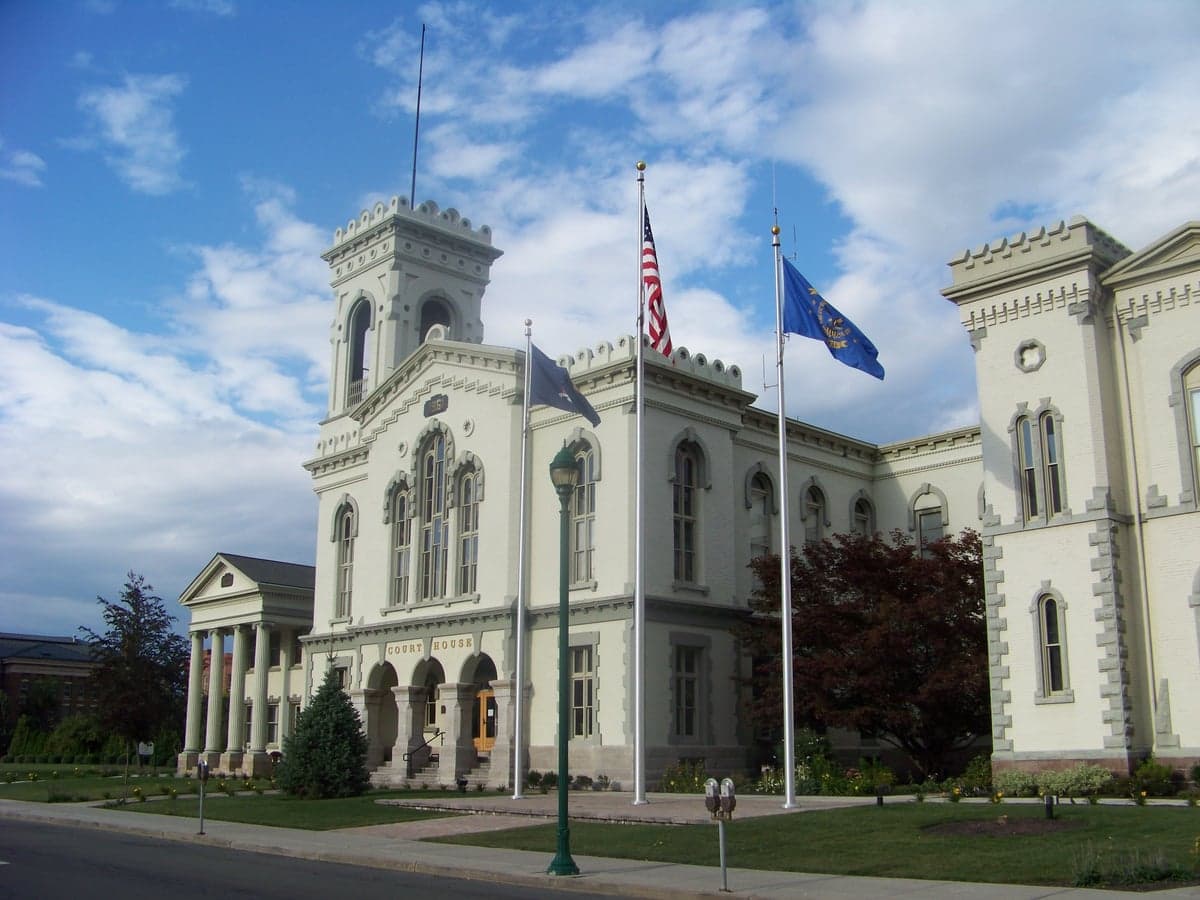
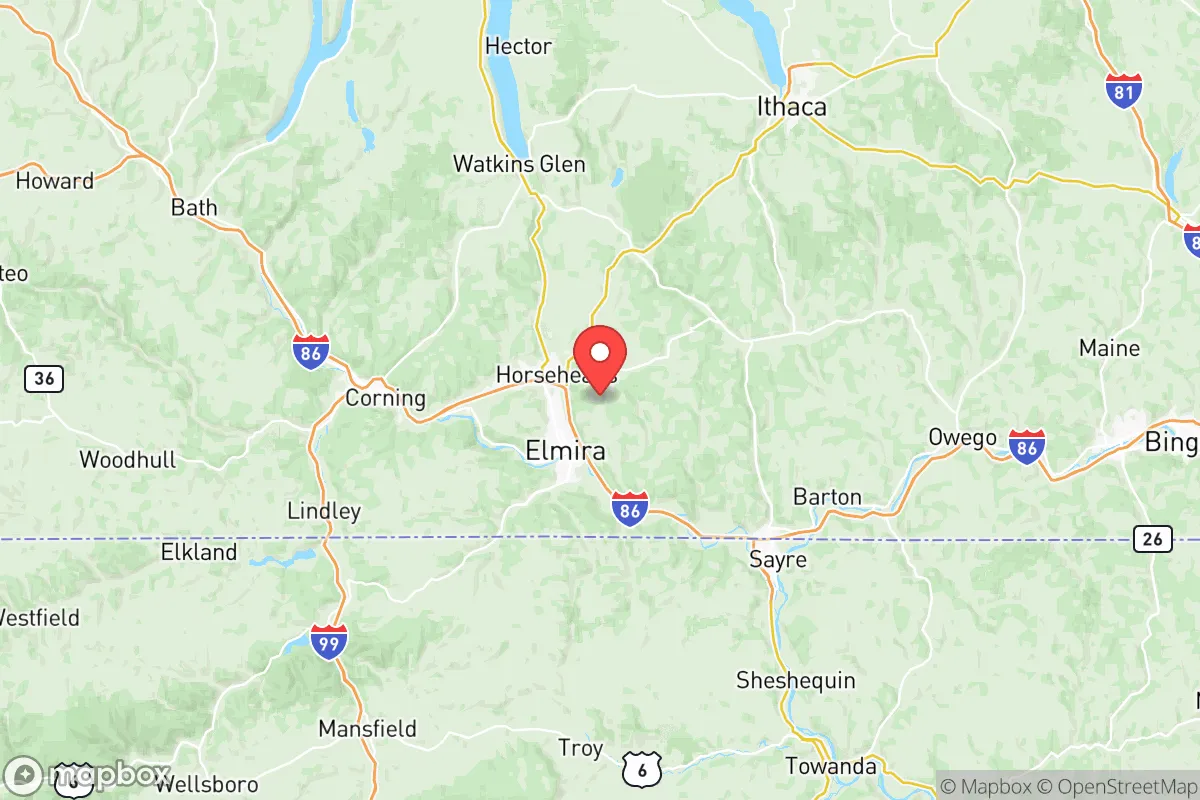
Chemung County, New York, is home to 82,805 residents, a population that is 84.5% white, with a notably small foreign-born share of just 1.7%. The county’s character is defined by its historic industrial roots in Elmira and the surrounding towns, a legacy of 19th-century migration that has given way to a stable, slowly diversifying community. Today, the population is older and less transient than the national average, with a distinctive identity shaped by the Erie Canal era, the Civil War prison camp, and a long reliance on manufacturing and healthcare employment.
Settlement & growth (pre-1960)
Before European settlement, the Chemung Valley was the homeland of the Cayuga Nation, one of the five original nations of the Haudenosaunee (Iroquois) Confederacy. The name "Chemung" itself derives from a Cayuga word meaning "big horn," referring to a large fossilized elk antler found in the river. The region was a strategic corridor for the Iroquois, connecting the Finger Lakes to the Susquehanna River. During the American Revolution, the Sullivan-Clinton Campaign of 1779 systematically destroyed Cayuga and other Iroquois villages along the Chemung River, including the major settlement of Chemung (the present-day town), clearing the way for American settlement.
After the war, the first wave of Euro-American settlers arrived in the 1780s and 1790s, primarily Yankees from New England and veterans of the Revolution who were granted land bounties. They established the core settlements of Elmira (founded 1792) and Newtown (now part of Elmira). The opening of the Chemung Canal in 1833, linking the Chemung River to the Erie Canal system, triggered a second wave of migration. Irish immigrants, fleeing the Great Famine of the 1840s, arrived in large numbers to dig the canal and build the railroads. They concentrated in Elmira’s Southside and Westside neighborhoods, forming the city’s first substantial Catholic community. German immigrants followed in the 1850s and 1860s, settling in Horseheads and Big Flats, where they worked as farmers, brewers, and skilled tradesmen. By 1860, Elmira was a bustling transportation hub, and the Civil War brought a third wave: the Elmira Prison Camp (1864-1865) held over 12,000 Confederate prisoners, but few stayed after the war.
The late 19th and early 20th centuries saw a smaller but significant influx of Italian and Polish immigrants, drawn by jobs in Elmira’s factories—including the American LaFrance fire engine company, the Eclipse Lawn Mower Company, and the Remington Rand typewriter plant. These groups settled in Elmira’s Eastside and Southport, establishing ethnic parishes and social clubs. The Great Migration of African Americans from the South reached Chemung County in modest numbers, primarily during World War I and World War II, when defense industries in Elmira and Horseheads offered employment. By 1950, the county’s population peaked at over 87,000, with a workforce heavily concentrated in manufacturing, railroading, and the emerging healthcare sector anchored by the Elmira Psychiatric Center (opened 1856) and Arnot Ogden Medical Center (opened 1886).
Modern era (post-1965)
The post-1965 era brought a stark reversal of Chemung County’s growth trajectory. The 1965 Hart-Cellar Act, which opened immigration to non-European nations, had a minimal impact here: the county’s foreign-born population remains just 1.7%, far below the national average of 13.7%. Instead, the dominant demographic story since the 1970s has been domestic out-migration. The decline of manufacturing—the closure of the American LaFrance plant in 1985, the Remington Rand plant in 1986, and the Eclipse plant in 1990—triggered a steady population loss from the 1970 peak of 97,000 to the current 82,805. Many younger residents left for the Sun Belt or larger upstate cities like Rochester and Syracuse.
Suburbanization reshaped the county’s internal geography. Horseheads and Big Flats grew as bedroom communities, with new housing developments and the Arnot Mall (opened 1977) drawing retail and services away from downtown Elmira. The county’s racial composition shifted slowly. The white share fell from over 96% in 1970 to 84.5% today, driven primarily by an increase in the Hispanic population (now 3.6%) and the Black population (now 5.8%). The Hispanic community, largely of Puerto Rican and Mexican origin, has concentrated in Elmira’s Southside and West Elmira. The Black population, many of whom are multi-generational families from the Great Migration era, remains concentrated in Elmira’s Eastside and Southport. East/Southeast Asian communities (1.0%) and Indian-subcontinent communities (0.6%) are small and dispersed, with no distinct enclave, though a handful of families have settled in Horseheads and Big Flats for employment at the county’s largest private employer, the Guthrie Robert Packer Hospital (part of the Guthrie Health System).
The county’s college-educated population stands at 26.9%, below the national average of 33.1%, reflecting the loss of higher-skilled jobs and the out-migration of younger degree-holders. The economy has shifted toward healthcare, education (Elmira College, founded 1855), and corrections (the Elmira Correctional Facility, a maximum-security prison, and the Southport Correctional Facility). These institutions provide stable employment but have not reversed the population decline.
The future
Chemung County’s population is projected to continue a slow decline over the next 10-20 years, driven by an aging population (median age 43.5, compared to the national 38.8) and limited in-migration. The county is becoming slightly more diverse, but at a glacial pace. The Hispanic and Black shares are expected to grow gradually, primarily through natural increase rather than new immigration, while the white share will continue to shrink. The East/Southeast Asian and Indian-subcontinent populations will likely remain very small, as the county lacks the high-tech job base or university magnet that attracts these groups to other parts of New York.
New residential development is concentrated in Big Flats and Horseheads, where land is available and school districts are perceived as stronger. Downtown Elmira has seen modest reinvestment, including the renovation of the Clemens Center performing arts venue and the creation of the Elmira Riverfront Park, but it has not attracted significant new residents. The county’s cultural identity remains rooted in its 19th-century industrial and canal-era heritage, with annual events like the Elmira Air Show and the Chemung County Fair reinforcing a traditional, family-oriented character. For a mover, this is a place of stability and low cost of living, but one with limited economic dynamism and a population that is slowly shrinking and aging.
For someone moving in now, Chemung County offers a quiet, affordable, and historically rooted community where the pace of change is slow. The county is becoming slightly more diverse, but remains overwhelmingly white and native-born. The key trade-off is between low housing costs and a stable, safe environment versus limited job growth, a smaller pool of young professionals, and a slower cultural evolution. It is a place for those seeking a predictable, family-oriented life in a small-city setting, not for those looking for rapid growth or a vibrant, multicultural urban scene.

* Values derived from national, state, county, city and local statistics and may differ in a specific area. Last updated: 2026-07-22T02:22:28.000Z
Narrative content on this page is AI-generated and may contain mistakes. Verify any details that matter before acting on them.
ReloMaps may earn a commission from affiliate links at no extra cost to you.

