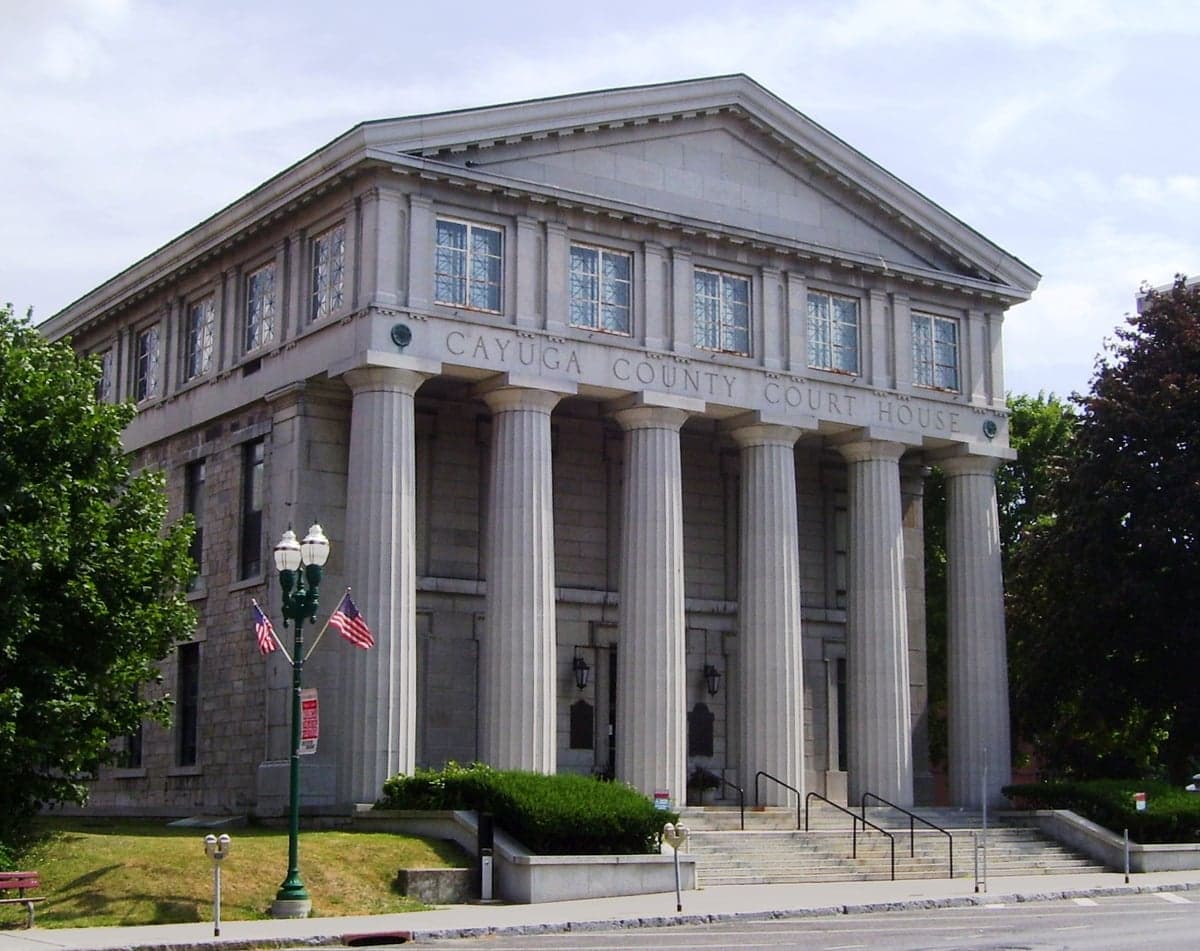
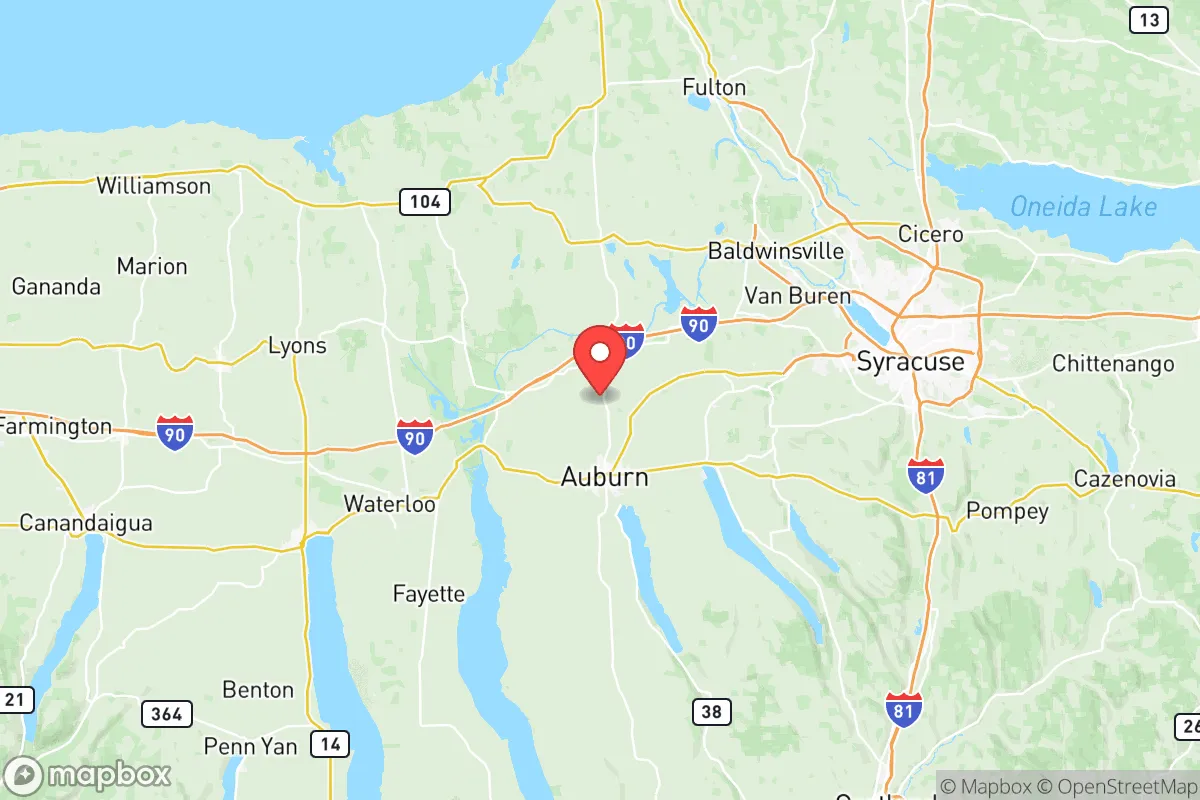
Photo: Wikipedia
Political ClimatePolitical Climate in Cayuga County
Showing district-level results — no local-only data available.
Local Political AnalysisPolitical Analysis of Cayuga County
Cayuga County has a solid Republican lean, with a Cook Partisan Voting Index of R+11, meaning it votes about 11 points more Republican than the national average. This isn't a deep-red monolith, though — it's a classic Upstate New York swing county that has shifted rightward over the past decade, driven largely by rural and exurban voters in towns like Auburn (the county seat and its only real city) and the more conservative towns of Moravia, Weedsport, and Port Byron. The county voted for Trump in 2016 and 2020 by margins of roughly 10-12 points, and that trajectory has only hardened since. Meanwhile, New York City — specifically Manhattan and Brooklyn — is one of the most reliably Democratic areas in the country, with a PVI likely in the D+30 to D+40 range, making the contrast between Cayuga County and NYC about as stark as you'll find within the same state.
How it compares
The political gap between Cayuga County and New York City isn't just about party labels — it's about what those labels mean in daily governance. In Cayuga, you'll find a mix of conservative-leaning independents and moderate Democrats who often cross over on local issues like taxes, school funding, and Second Amendment rights. The city of Auburn itself is the blue dot in a red sea: its wards near the downtown core and the Owasco Lake shoreline tend to vote Democratic, while the outer wards and the surrounding towns of Owasco, Sennett, and Throop lean heavily Republican. In contrast, New York City's political culture is overwhelmingly progressive on social and economic issues, with a Democratic primary often being the real election. A Cayuga County Republican might feel politically invisible in NYC, while a Cayuga County progressive might feel like they're in a different country when they visit Manhattan. The practical difference shows up in policy: Cayuga County's representatives in Albany tend to vote against NYC-centric bills on rent control, congestion pricing, and sanctuary city policies, while NYC legislators push back on Upstate priorities like agricultural exemptions and rural infrastructure funding.
What this means for residents
For conservative residents, Cayuga County offers a political environment where their views are the local norm — you can talk politics at the diner in Weedsport or Port Byron without feeling like an outlier. Local elections are often decided in Republican primaries, and the county legislature has a solid GOP majority. For liberal residents, especially in Auburn, it means being in a political minority but not an isolated one — there's an active Democratic committee, and the city itself provides a progressive-friendly bubble with things like a farmers market, a thriving arts scene at the Cayuga Museum of History and Art, and a vocal local activist community. The practical trade-off is that property taxes in Cayuga County are among the highest in the state (partly due to school district costs), and the county's rural character means fewer public transit options and a heavier reliance on cars — a contrast to NYC's dense, transit-oriented lifestyle. Both sides tend to agree on one thing: the cost of living is far lower than in NYC, and the pace of life is slower.
Culturally, Cayuga County is a place where the Finger Lakes wine trail, agricultural fairs, and hunting season define the calendar, not Broadway openings or subway schedules. The county has a strong tradition of localism — people know their neighbors, and politics is often less ideological and more personal than in NYC. You'll find conservative farmers and liberal artists sharing a beer at a Skaneateles brewery (Skaneateles is technically in Onondaga County, but the cultural overlap is real) and agreeing on local issues like lake water quality and road maintenance. The biggest policy distinction from NYC is probably the gun culture: Cayuga County has a high rate of firearm ownership, and local officials have pushed back against state-level gun control laws, while NYC has some of the strictest gun laws in the nation. That divide — rural versus urban, local control versus state mandates — is the throughline that explains most of the political tension between Cayuga County and New York City.

State Political ClimatePolitical Climate in New York
State Political AnalysisPolitical Environment in the State
New York State has been a solidly blue stronghold for decades, with Democrats holding every statewide office and both U.S. Senate seats, and the state consistently delivering its 28 electoral votes to Democratic presidential candidates by double-digit margins — 23 points for Biden in 2020 and 13 points for Harris in 2024. Over the past 20 years, the Democratic lean has deepened in the New York City metro area and along the Hudson Valley, while the rest of the state has shifted sharply to the right, creating one of the most politically polarized landscapes in the country. For a conservative-leaning relocator, that means living in a state where your vote may not matter much in statewide races, but where local control and municipal boundaries can create starkly different daily realities depending on whether you settle in the five boroughs, a Buffalo suburb, or a Finger Lakes farm town.
Urban vs. rural divide
New York's political map is essentially a war between downstate and upstate — and downstate always wins the numbers game. The five boroughs of New York City alone cast about 40% of the state's vote, with Manhattan, Brooklyn, and the Bronx producing Democratic margins of 70-80% in most elections. The inner-ring suburbs of Westchester, Nassau, and Suffolk counties on Long Island have historically been swing territory but have trended blue in recent cycles; Nassau County went to Biden by 8 points in 2020 and has a Democratic county executive. Moving north, the Hudson Valley counties — Dutchess, Ulster, Orange — are purple-to-blue, with Ulster reliably Democratic and Orange County flipping back and forth. Albany, the capital, and its surrounding suburbs are solidly Democratic. The real red comes from the Southern Tier (Steuben, Chemung, Allegany counties), the Mohawk Valley (Oneida, Herkimer), the North Country (Jefferson, St. Lawrence), and much of the Finger Lakes region outside Ithaca. Buffalo and Rochester are blue cities surrounded by red suburbs and rural areas — Erie County (Buffalo) went +20 for Biden, but nearby Wyoming County voted +45 for Trump. A notable recent flip: Staten Island, historically the most conservative borough, has drifted further red, voting +15 for Trump in 2024, reflecting a broader trend of outer-borough working-class voters moving right, while Manhattan and Brooklyn have only gotten bluer.
Policy environment
New York has one of the highest combined state and local tax burdens in the nation — property taxes average around 1.6% of home value, and state income tax rates range from 4% to 10.9% on top earners, with a flat $2,000 cap on state and local tax (SALT) deductions that hits high-income homeowners hard. The regulatory posture is business-heavy: New York has a state-level single-payer healthcare proposal (the New York Health Act) that hasn't passed but is periodically reintroduced, and the state has aggressively pursued climate goals through the Climate Leadership and Community Protection Act, mandating 70% renewable electricity by 2030. On education, New York has a universal school choice program that's limited; charter schools exist but are capped at 460 statewide, and there's no voucher or education savings account program. Parental rights have become a flashpoint: the state enacted a "safe schools" law in 2024 that explicitly bars schools from notifying parents of a student's gender identity changes without the student's consent, which has mobilized conservative opposition. Healthcare is broadly accessible — the state runs its own health insurance marketplace (NY State of Health) and expanded Medicaid under the ACA. Election laws are among the most permissive nationally: no-excuse absentee voting, early voting (9 days), automatic voter registration at DMV, and same-day registration. The state also passed the John Lewis Voting Rights Act in 2023, requiring preclearance for voting changes in certain counties.
Recent policy direction
Over the last five years, Albany has moved decisively left on almost every axis a conservative relocator would weigh. On gun rights: the state passed the SAFE Act in 2013, then the Concealed Carry Improvement Act (CCIA) in 2022 after the Bruen decision, requiring "good moral character" for permits, banning firearms in "sensitive locations" (including Times Square, subways, and private businesses that post signs), and raising the permit age to 21. The 2024 budget also included a microstamping requirement for semiautomatic pistols. On parental and education rights: the aforementioned gender identity notification ban, plus a 2024 law expanding "school climate" surveys that can include questions about student sexuality. On speech: New York has an anti-SLAPP law strengthened in 2020, but also a 2022 law allowing the state to go after social media platforms for "hateful conduct" that critics say chills speech. On privacy and surveillance: the state has a comprehensive biometric privacy law (filed private right of action) from 2024, but also maintains the largest public surveillance camera network in the country (the Domain Awareness System in NYC). On medical and bodily autonomy: New York has enshrined abortion rights into the state constitution via the 2024 Proposition 1 (the Equal Rights Amendment), codified no-copay abortion coverage, and expanded telehealth abortion access. On property rights: the state passed a sweeping rent stabilization expansion in 2019 (Housing Stability and Tenant Protection Act) that limits rent increases, restricts evictions, and eliminated vacancy decontrol, causing fierce landlord opposition particularly in upstate cities like Buffalo and Rochester. On taxation: the 2021 budget raised the top income tax rate to 10.9% on incomes over $25 million, and the corporate franchise tax to 7.25%. The state also passed a ban on fracking in 2014, still in effect, and a clean energy standard that effectively blocks new natural gas hookups in new buildings beginning in 2026 in larger buildings, and 2029 for all new construction.
Civil unrest & political movements
New York has been a national epicenter for both left-wing and right-wing activism. The 2020 George Floyd protests were some of the largest and most destructive in the state, particularly in Manhattan's SoHo and Midtown, with $1 billion in damages and 600 arrests. The Occupy Wall Street movement (2011) originated in Zuccotti Park. On the right, the "Walk Away" movement and the 2021 "Stop the Steal" rally in Albany drew thousands. More recently, the parental rights movement (including Moms for Liberty chapters in Suffolk and Erie counties) has organized heavily against the gender identity notification law and critical race theory in schools. Sanctuary policy: New York is a national leader — the 2017 "New York Stands for All" law restricts local law enforcement from cooperating with ICE, and the 2024 state budget extended driver's licenses to undocumented immigrants. This has caused friction with upstate counties (e.g., Rensselaer, Wyoming) that have passed resolutions declaring themselves "sanctuary for the unborn" or "Second Amendment sanctuaries," though these are purely symbolic. Election integrity controversies: the 2020 election saw New York repeatedly sued by Republicans for its vote-by-mail expansion; the state still requires signature matching and has a voter ID law only for absentee ballots, not in-person voting. The state's own elections board has been criticized for slow ballot counting (the 2022 gubernatorial primary took two weeks to call). There's also a minor secession movement: the "New York State of Mind" bill (never passed) and periodic calls for upstate counties to form a "New North" state, though no serious effort has traction.
Projection
Over the next 5-10 years, New York's political trajectory points further left at the state level, driven by the continued dominance of New York City and its rapidly growing progressive activist base. In-migration is a wild card: the state lost a net 500,000 residents to domestic migration between 2020 and 2025, concentrated among high-income earners from Manhattan and wealthy suburbs moving to Florida, Texas, and the Carolinas. This outflow of moderate and conservative voters may actually strengthen Democratic supermajorities in the legislature. Upstate, rural counties will likely continue trending red, but their share of the statewide vote shrinks with population loss. The key trend to watch is suburban Long Island and the Hudson Valley: if these areas continue to drift left, the state will become even more Democratic. A conservative relocator moving into the state today should expect property taxes to remain high, parental rights to remain a battleground (likely with more legislation codifying limited notification), and gun laws to get more restrictive — the SAFE Act and CCIA are likely to be expanded, not rolled back. The sanctuary state posture is embedded and likely to intensify; don't expect any state-level border enforcement. On the positive side for moderates: the state will likely continue investing heavily in public college tuition (Excelsior Scholarship), public transportation, and climate infrastructure. The next decade almost certainly won't see a Republican elected statewide, but a few downstate congressional seats could remain competitive.
Bottom line for a new resident: If you're a conservative family or individual, New York can still work — you just need to pick your location carefully. Conservative life is completely normal in western New York (think Chautauqua County, where Trump won +28 in 2024), the Southern Tier, or the Adirondack North Country. You'll pay some of the nation's highest property taxes and face state-level policies on guns, education, and immigration that you likely oppose, but your local community will often share your values, and your day-to-day life won't be dominated by state politics. If you move to a blue suburb like Westchester or a college town like Ithaca, you'll be the minority culturally and politically, and you need to be comfortable with that. The state's actual political lean is a heavy Democratic supermajority in Albany, and that isn't changing; so weigh whether the upsides — proximity to NYC careers, world-class healthcare, strong public schools in certain suburbs, the natural beauty of the Finger Lakes and Adirondacks — outweigh the policy environment that you'll be funding with your tax dollars.
* Values derived from national, state, county, city and local statistics and may differ in a specific area. Last updated: 2026-07-01T22:47:56.000Z
Narrative content on this page is AI-generated and may contain mistakes. Verify any details that matter before acting on them.
ReloMaps may earn a commission from affiliate links at no extra cost to you.

