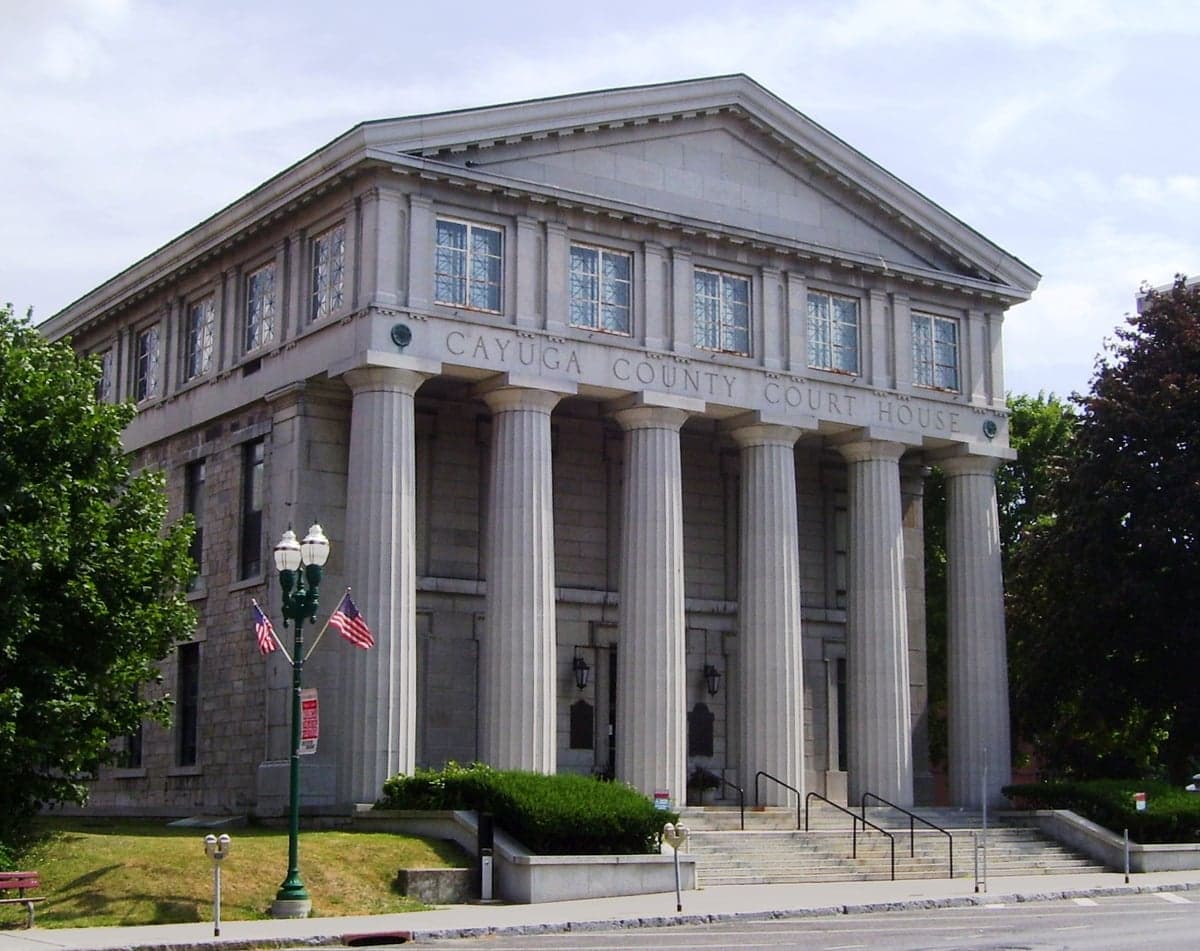
Photo: Wikipedia
Personal Sovereignty in Cayuga County
Moderate friction. Expect trade-offs in some aspect of personal liberty and independence.
What does Personal Sovereignty tell us?
Personal Sovereignty measures your capacity for self-reliance and independence with minimal government friction. Higher scores mean fewer barriers between you and the way you want to live... but it assumes you have the space you need and good neighbors.
What does this tell us?
Personal Sovereignty measures your capacity for self-reliance and independence with minimal government friction. Higher scores mean fewer barriers between you and the way you want to live... but it assumes you have the space you need and good neighbors.
State Policy
Energy independence: Importer (12% of energy produced in-state)
Personal Liberty

Personal Liberty Analysis
Cayuga County, New York, presents a nuanced environment for personal sovereignty, where a rural, self-reliant character coexists with New York State's broader regulatory framework. While the county offers more breathing room for individual autonomy than downstate urban centers, residents must navigate state-level policies on taxation, gun laws, and medical mandates that significantly shape daily life. For those prioritizing personal freedom, the key is understanding where local conditions—from tax burdens to zoning codes—create pockets of greater independence, particularly in towns like Auburn, Moravia, Weedsport, and Sterling.
Tax burden and regulatory posture in Cayuga County
New York State imposes a high overall tax burden, and Cayuga County is no exception. Property taxes are a primary concern, with the county's effective rate hovering around 2.5% to 3.0% of assessed home value, among the highest in the nation. This is driven by school district levies and county services. However, the regulatory posture at the county and town level is generally lighter than in downstate jurisdictions. Zoning is less restrictive in rural townships like Niles and Venice, where agricultural and residential uses mix freely. The county's sales tax rate is 8%, in line with state averages, but there is no local income tax beyond the state levy. For a family or individual, the property tax bill is the single largest recurring cost of autonomy here, and it directly funds local schools and infrastructure. The county's approach to business regulation is pragmatic, with fewer permitting hurdles for small-scale operations compared to urban areas, though state-level environmental and labor regulations still apply uniformly.
Self-defense rights and gun law specifics in New York
New York State's gun laws are among the most restrictive in the nation, and Cayuga County residents must comply fully. The Concealed Carry Improvement Act (CCIA), passed in 2022, requires a permit to carry a concealed handgun, mandates 16 hours of training, and designates "sensitive locations" where firearms are prohibited—including places of worship, public parks, and businesses unless the owner explicitly allows them. Cayuga County's Sheriff's Office processes permits, and local sentiment is generally pro-Second Amendment, but the legal framework is state-imposed. Open carry is not permitted. For self-defense, a pistol permit is the only legal path to carrying a firearm. The county's rural character means that many residents own long guns for hunting and sport, which do not require a permit for purchase, but all firearm transfers must go through a licensed dealer. There is no county-level preemption; local ordinances cannot loosen state restrictions. For a freedom-minded individual, this means accepting that personal defense options are legally constrained, though the practical enforcement culture in rural Cayuga County is less aggressive than in New York City or Albany.
Self-reliance and homesteading viability: lot sizes, zoning, and off-grid feasibility
Cayuga County offers strong potential for self-reliance, particularly in its rural townships. Minimum lot sizes vary: in agricultural zones, parcels of 2 to 5 acres are common, while more remote areas allow building on smaller lots with septic approval. Towns like Moravia and Sterling have permissive zoning for accessory structures, livestock, and home-based businesses. Off-grid living is legally feasible but requires adherence to state building codes and health department regulations for water and sewage. Solar panels are allowed, but net metering policies are set by the state's Public Service Commission, and fully disconnecting from the grid is permitted as long as the property meets safety standards. Rainwater collection is legal for non-potable uses. The county's agricultural heritage means that raising chickens, goats, or even larger livestock is generally accepted in rural areas. However, in villages like Auburn or Weedsport, municipal codes may restrict livestock and require connection to public water and sewer. For a family seeking a homesteading lifestyle, the rural townships outside of incorporated villages offer the greatest freedom, with lower regulatory friction and more land available at prices well below national averages.
Personal liberties: parental rights, medical autonomy, speech, and property
New York State's legal environment affects several dimensions of personal liberty. Parental rights are protected under state law, but the state mandates school curriculum standards, including health education that covers sexual health and consent. Parents can opt their children out of specific lessons, but the process varies by district. Medical autonomy is constrained by state vaccine mandates for school attendance and healthcare workers, though exemptions exist for medical and religious reasons. The COVID-19 era saw significant state-level emergency powers, but those have since lapsed. Free speech is protected under the First Amendment, and Cayuga County does not have local ordinances that restrict expression beyond state nuisance laws. Property rights are strong in rural areas, but the state's environmental conservation laws can affect land use near waterways or wetlands. The New York State Department of Environmental Conservation (DEC) has jurisdiction over activities that impact protected species or habitats, which can limit development on certain parcels. For a property owner, the key is due diligence on any environmental constraints before purchasing land. Overall, the county's local culture respects individual choice, but state-level mandates create a baseline that cannot be opted out of.
Compared to other regions in the United States, Cayuga County offers a moderate level of personal sovereignty. It is far more permissive than downstate New York or the West Coast in terms of land use and homesteading, but significantly more regulated than states like Texas, Florida, or New Hampshire in taxation and gun rights. For a conservative-leaning individual or family, the trade-off is clear: lower land costs and a rural, self-reliant lifestyle come with a higher tax burden and state-imposed restrictions on self-defense and medical choice. The county's strength lies in its community culture and practical enforcement, which often allows more freedom than the law technically permits. For those willing to navigate the regulatory landscape, Cayuga County provides a viable base for a life centered on personal responsibility and independence.

* Values derived from national, state, county, city and local statistics and may differ in a specific area. Last updated: 2026-07-01T22:47:56.000Z
Narrative content on this page is AI-generated and may contain mistakes. Verify any details that matter before acting on them.
ReloMaps may earn a commission from affiliate links at no extra cost to you.

