Photo: Wikipedia
Demographics of Cayuga County
Affluence Level in Cayuga County
A middle-class area roughly in line with national averages across income, home values, education, and employment.
People of Cayuga County
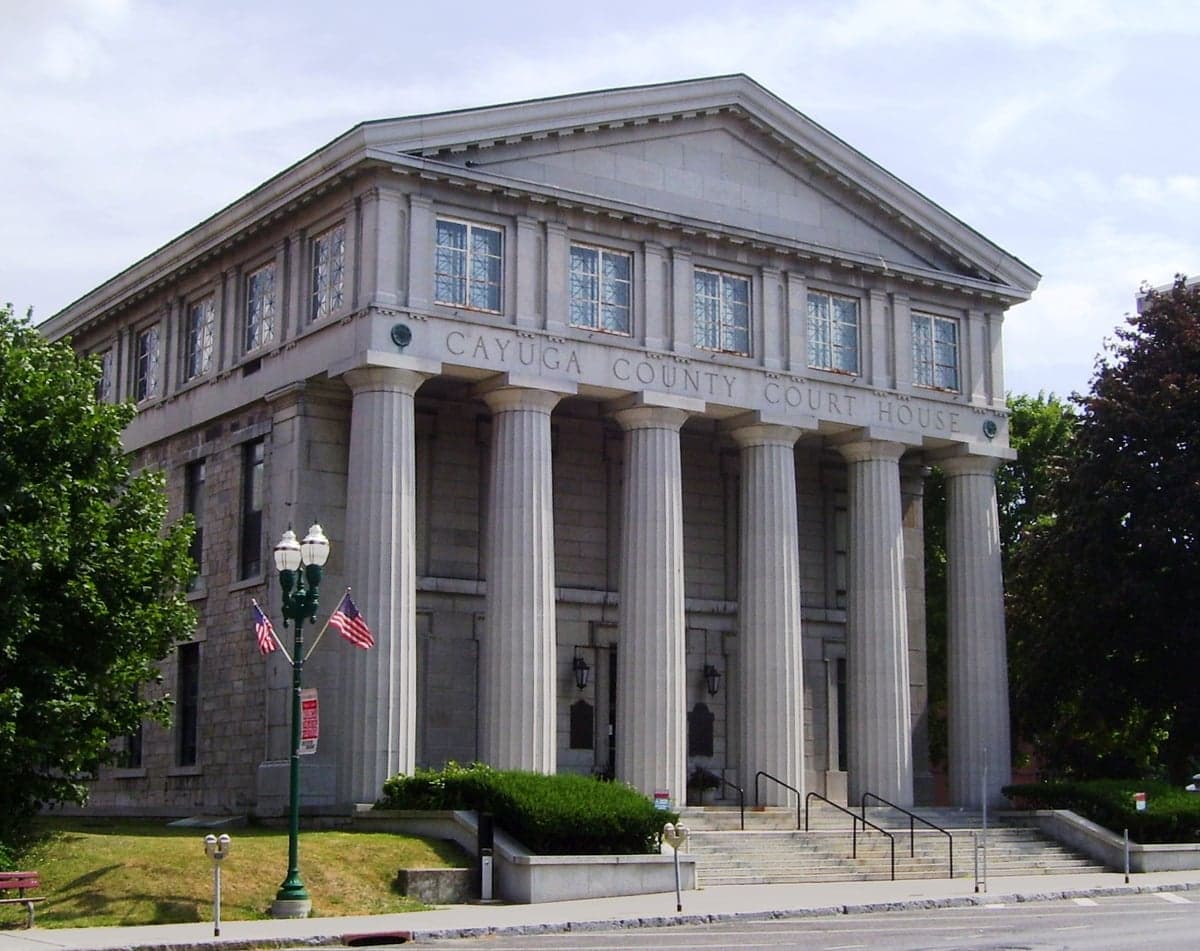
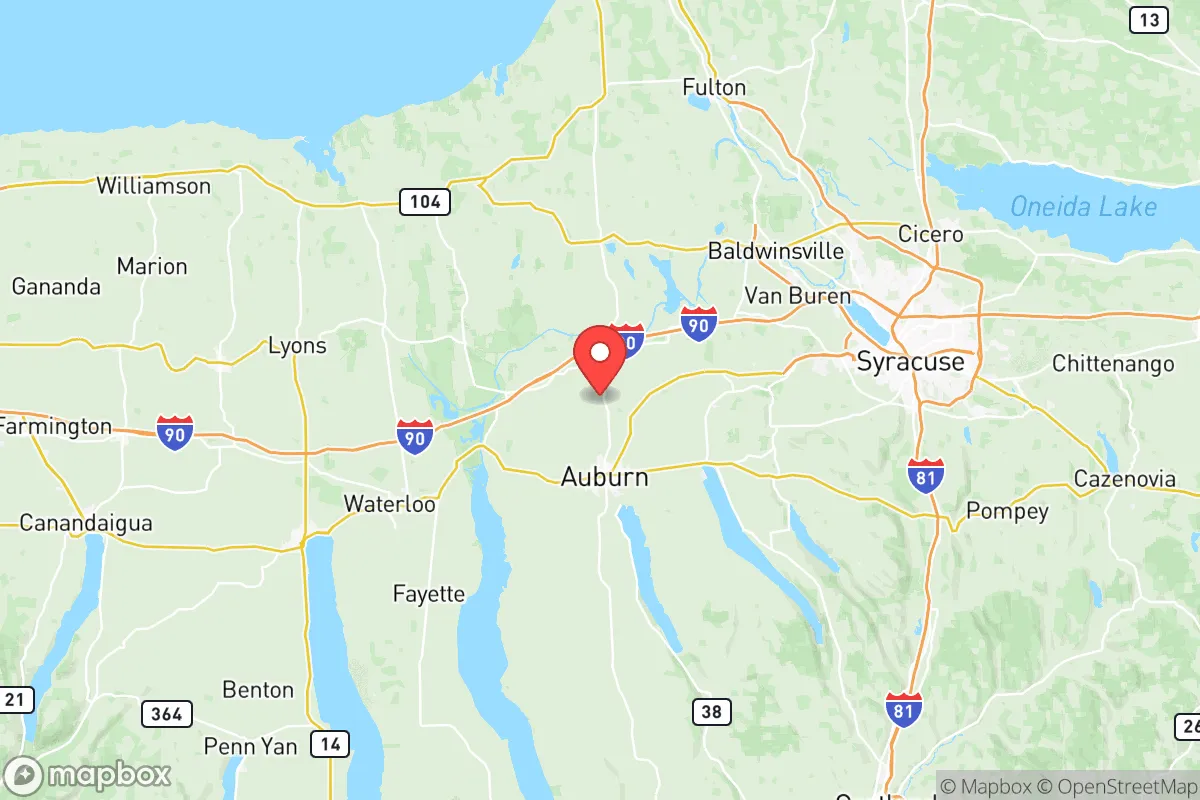
The people of Cayuga County, New York, today number 75,464, forming a predominantly white (87.6%) and rural population with a distinctive small-town character rooted in its agricultural and industrial past. The county’s identity is shaped by its location in the Finger Lakes region, with a low foreign-born share of just 0.9% and a modest college-educated rate of 23.9%, reflecting a workforce historically tied to farming, manufacturing, and state government. Unlike many upstate New York counties, Cayuga has a notable Hispanic minority (3.5%) and a small Black population (3.0%), but its demographic profile remains largely homogeneous, with East/Southeast Asian (0.5%) and Indian subcontinent (0.1%) communities barely present. The county’s population has been slowly declining since the 2010 census, a trend that continues to shape its character as a place where longtime families and local traditions still dominate daily life.
Settlement & growth (pre-1960)
Before European settlement, the region that is now Cayuga County was the heartland of the Cayuga Nation, one of the five original nations of the Iroquois Confederacy. The Cayuga people lived in longhouse villages along the shores of Cayuga Lake and the Owasco Lake, with major settlements near present-day Auburn and Union Springs. Their agricultural economy—based on corn, beans, and squash—supported a dense population for the region. The Sullivan Expedition of 1779, ordered by General George Washington, systematically destroyed Cayuga villages and crops, forcing most survivors to flee westward to Ontario, Canada, or to other Iroquois territories. Today, the Cayuga Nation retains a small land base near Aurelius and Seneca Falls, but the county’s Native American population is minimal.
After the American Revolution, New York State opened the Finger Lakes region to white settlement through a series of land purchases and treaties. The first major wave of settlers were Yankees from New England—primarily from Connecticut and Massachusetts—who arrived between 1790 and 1820, drawn by cheap land and the promise of fertile soil. They founded the county’s earliest towns, including Auburn (established 1793), Weedsport (1800), and Moravia (1789). These New Englanders brought with them a tradition of town-meeting governance, Congregationalist churches, and a strong emphasis on education, which laid the foundation for Auburn’s later role as a center of reform movements, including abolitionism and women’s rights.
The second major wave came from the British Isles, particularly Irish and English immigrants, who arrived between 1820 and 1860. The Erie Canal, completed in 1825, passed through the northern edge of Cayuga County, with a key port at Port Byron. Irish laborers built and maintained the canal, and many settled in canal towns like Port Byron and Weedsport, where they worked as boatmen, dockworkers, and farmers. English immigrants, often skilled farmers, purchased land in the towns of Brutus and Throop, establishing dairy and grain operations that remain today.
German immigrants arrived in smaller numbers, primarily between 1840 and 1880, settling in the rural towns of Niles and Sempronius, where they established small farms and Catholic parishes. Unlike the large German enclaves in Buffalo or Rochester, Cayuga County’s Germans were dispersed and quickly assimilated. Italian immigrants came later, between 1890 and 1920, drawn by jobs in the region’s growing manufacturing sector—particularly at the Auburn Prison (which employed guards and support staff) and at the Dunn & McCarthy shoe factory in Auburn. Italian families concentrated in Auburn’s west side, near the factories, and their descendants still form a visible part of the city’s Catholic community.
African American settlement in Cayuga County was small but historically significant. Before the Civil War, Auburn was a major stop on the Underground Railroad, thanks to the activism of local abolitionists like Harriet Tubman (who settled in Auburn in 1857) and William H. Seward. A small free Black community formed in Auburn’s “New Guinea” neighborhood, near the intersection of State and North Streets. After the Civil War, a few Black families moved to the county, but the Great Migration largely bypassed Cayuga County—the industrial jobs were too few and too low-paying to attract large numbers of Southern migrants. By 1960, the Black population was still under 2%.
Modern era (post-1965)
The 1965 Hart-Cellar Act had a minimal impact on Cayuga County. Unlike urban centers in New York, the county did not attract significant post-1965 immigration from Asia, Latin America, or Africa. The foreign-born share remained below 1% through the 2020s, a figure that reflects the county’s limited economic opportunities and its distance from major immigrant gateway cities. The small Hispanic population (3.5%) is largely composed of Puerto Ricans and Mexican Americans who moved to the county for agricultural work—particularly in the fruit orchards and vegetable farms around Scipio and Venice—or for jobs at the state prison system in Auburn. These families are concentrated in Auburn’s east side and in the rural town of Sennett, where seasonal farm labor is common.
The Black population grew modestly from 2.1% in 1990 to 3.0% in 2020, driven primarily by families moving from the Rochester and Syracuse areas for lower housing costs and quieter neighborhoods. Most Black residents live in Auburn, particularly in the city’s central and northern neighborhoods, but there is no distinct enclave. The East/Southeast Asian population (0.5%) is almost entirely composed of a small number of professionals—engineers and medical staff—employed at Auburn Community Hospital or at the Cayuga County government offices. The Indian subcontinent population (0.1%) is negligible, consisting of a handful of families working in higher education or healthcare.
Domestic migration has been the dominant demographic force since 1970. Cayuga County has experienced a steady outflow of young adults (ages 18-35) to the Syracuse and Rochester metro areas, where jobs in technology, healthcare, and education are more plentiful. This “brain drain” has been partially offset by an inflow of retirees from downstate New York—particularly from Long Island and Westchester County—who are drawn by the county’s low property taxes (relative to the New York City suburbs) and its rural scenery. These retirees tend to settle in lakefront communities like Fair Haven and Union Springs, where they buy second homes or seasonal cottages. Suburbanization has been limited: the county has no major suburbs, and the only significant growth area is the town of Owasco, just south of Auburn, where new single-family homes have been built on former farmland.
The future
Cayuga County’s population is projected to continue its slow decline, from 75,464 in 2020 to an estimated 72,000 by 2040, according to state demographic projections. The county’s birth rate is below replacement level, and outmigration of young adults shows no signs of reversing. The population is aging: the median age rose from 39.2 in 2000 to 44.8 in 2020, and the share of residents over 65 is now 20.5%. This aging trend will likely accelerate as the baby boomer generation retires in place.
Diversity will increase only marginally. The Hispanic population may grow to 5-6% by 2040, driven by continued agricultural labor demand and by families moving from the Rochester area. The Black population is likely to remain stable at 3-4%, as the county lacks the job base to attract significant new migration. The East/Southeast Asian and Indian subcontinent populations will remain tiny, as the county’s educational and professional opportunities are too limited to draw skilled immigrants. The county’s cultural identity will remain predominantly white, rural, and conservative-leaning, with a strong attachment to local traditions like the Cayuga County Fair and the Auburn Doubledays minor-league baseball team.
The most significant demographic change may be the continued growth of the retiree population, particularly in lakefront towns like Fair Haven and Union Springs. This influx of older, relatively affluent newcomers from downstate is already shifting the county’s political dynamics—making it slightly more competitive in local elections—and is driving demand for healthcare services, senior housing, and recreational amenities. However, this trend is unlikely to reverse the overall population decline, as the number of retirees moving in is smaller than the number of young people leaving.
For someone moving to Cayuga County now, the area offers a stable, low-cost, and safe environment with a strong sense of community, but it is not a place of rapid growth or increasing diversity. The county is becoming older, whiter, and more retiree-oriented, with a shrinking tax base and a workforce that is increasingly reliant on healthcare, corrections, and agriculture. New residents—particularly families—will find good schools in Auburn and the surrounding towns, affordable housing, and a slower pace of life, but they should expect limited job opportunities outside of the public sector and a population that is more homogeneous than the national average.

* Values derived from national, state, county, city and local statistics and may differ in a specific area. Last updated: 2026-07-01T22:47:56.000Z
Narrative content on this page is AI-generated and may contain mistakes. Verify any details that matter before acting on them.
ReloMaps may earn a commission from affiliate links at no extra cost to you.

