Photo: Wikipedia
Political ClimatePolitical Climate in Seward County
Showing district-level results — no local-only data available.
Local Political AnalysisPolitical Analysis of Seward County
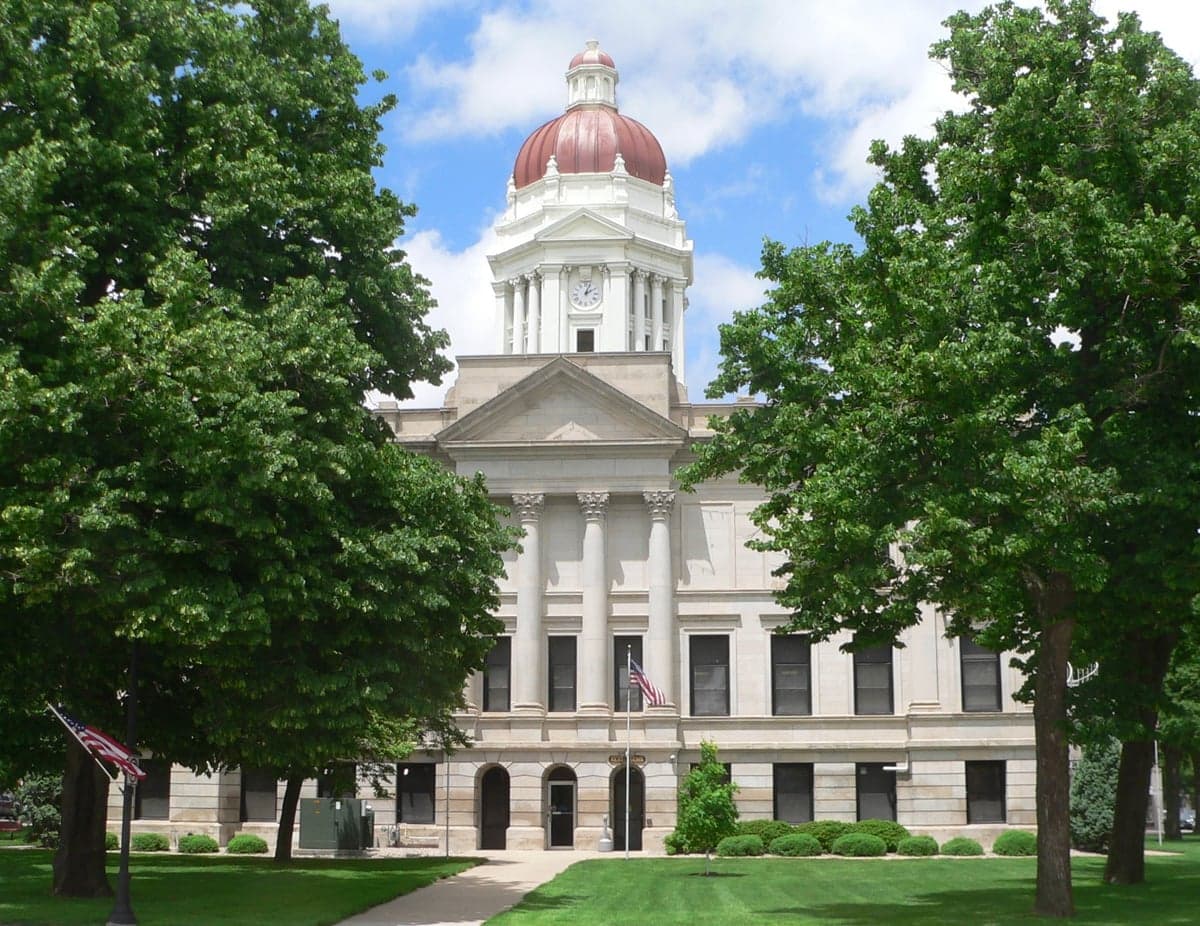
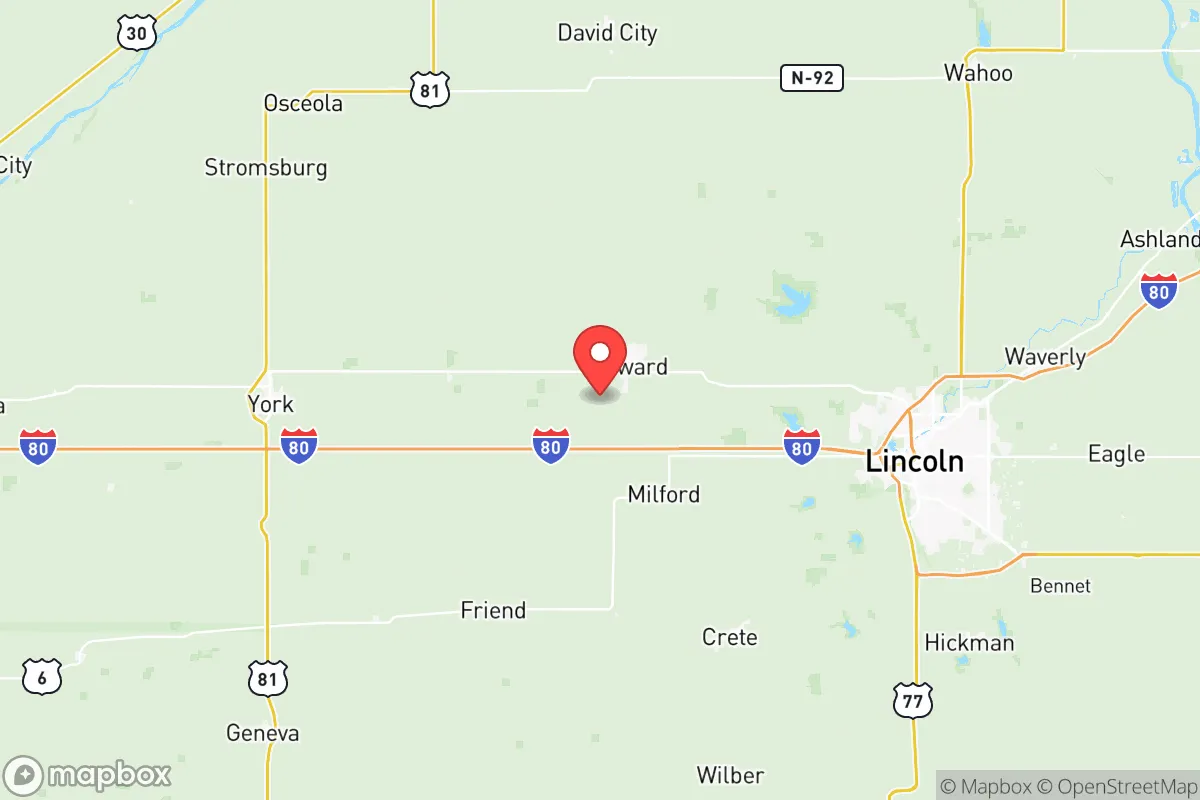
Seward County leans reliably Republican with a Cook Partisan Voting Index of R+6, making it redder than the national average but notably less conservative than Nebraska as a whole (R+10). That gap comes largely from the small but consistent blue pockets in precincts around Seward and Pleasant Dale, where commuters to Lincoln and staff at Concordia University pull the vote closer to the middle. Utica, Milford, and Goehner, in contrast, vote several points more Republican, while the rural precincts near Garland and Staplehurst are deep red. The county hasn't voted for a Democrat for president since 1964, though the margin in 2020 and 2024 was roughly 6-8 points closer than in neighboring Butler or York counties.
How it compares
Seward County’s R+6 sits four points to the left of Nebraska’s statewide R+10. That difference is real but modest — think of it as the difference between a county that votes 58% Republican and a state that votes 60% Republican. Proximity to Lincoln plays the biggest role: around 15% of Seward County’s workers commute into Lancaster County, and many of them bring more moderate views on education and spending back home. The county also has a small but visible liberal-conservative split between the city of Seward (population ~7,000) and everything east of the interstate. In Seward proper, you’ll see a handful of Democratic county board candidates and occasionally a split-ticket voter for state legislature; in Milford and Utica, straight-ticket Republican is the norm. Compared to Nebraska’s most conservative counties (e.g., Hooker or McPherson, both R+30+), Seward County is practically purple, but in the context of eastern Nebraska it’s still solidly red.
What this means for residents
For conservative residents, the county is a comfortable fit: local offices are dominated by Republicans, tax policy leans low and limited, and candidates typically run on agricultural and property-rights platforms. For liberal or moderate residents, life is straightforward but not hostile — there are active Democratic precinct captains, a visible presence at county fair booths, and a few regular candidates who receive 35–40% of the vote in Seward city precincts. What this means in practice: general elections are usually decided in the GOP primary, so local politics center on intra-party fights over school funding, road bonds, and zoning near the interstate corridor. Turnout in Seward precincts can swing a countywide race 2–3 points, which is enough to matter when the county board split is 4–3 Republican. Neither side feels suppressed; the climate is polite but with clear lines drawn around gun rights, school choice, and agricultural easements.
Cult

State Political ClimatePolitical Climate in Nebraska
State Political AnalysisPolitical Environment in the State
Nebraska is a rock-solid Republican state with a Cook PVI of R+10, but don't let that single number fool you into thinking it's monochrome. The big picture here is a deeply split personality: a fast-growing, moderate-to-liberal Omaha metro (Douglas County) that usually votes blue by small margins, set against a vast rural and small-town landscape that votes red by huge margins. Over the last 10–20 years, that rural area has only gotten redder, while Omaha has held steady blue — meaning statewide races haven't budged much, but the cultural and policy divides within the state have sharpened noticeably. In practice, that means a new resident relocating to, say, Omaha gets a very different lived experience than someone moving to Kearney or Scottsbluff, even though they're under the same governor and state legislature.
Urban vs. rural divide
The political geography of Nebraska is straightforward. Omaha and its immediate suburbs (Douglas County) are the Democratic engine — the city proper and close-in suburbs like Bellevue, Ralston, and parts of La Vista have been reliably blue in presidential years, though often only by a few points. Lincoln (Lancaster County) leans Democratic as well, but its margins are narrower; in 2024, Lancaster went for Trump by about 4,000 votes out of 177,000 cast, largely because the rural southern part of the county drags it right. The real red meat comes from the rest of the state. Sarpy County (Papillion, Gretna, the rest of the Omaha suburbs) flipped from purple to solid red over the last decade — it gave Trump 58% in 2024 after giving Romney 59% back in 2012, but the margin has widened as new housing developments attracted conservative families from Omaha. Platte County (Columbus), Hall County (Grand Island), Buffalo County (Kearney), and Scotts Bluff County (Scottsbluff) routinely vote 70%+ Republican. The panhandle is notably redder than central Nebraska, but even the "blue dot" of Omaha is shrinking in relative population share as the rest of the state grows faster. If you're looking for a politically distinct enclave within the red sea, Gretna and Papillion are the new conservative suburbs worth watching — they're fast-growing, family-focused, and reliably Republican.
Policy environment
At the state level, Nebraska's policy environment is consistently conservative, but with some moderate quirks. The state has no income tax on Social Security benefits, a flat 5.58% state income tax (down from a top rate of 6.84% in 2023), and a state sales tax of 5.5% that local jurisdictions can add to (Omaha and Lincoln add around 2%). Property taxes are high relative to the region — average effective rate around 1.45% — and are a perennial complaint, though the legislature has been chipping away with credits and buy-downs. Nebraska is a right-to-work state, has no state-level minimum wage above the federal $7.25 (though Omaha and Lincoln have local ordinances pegging it higher), and has a Republican supermajority in the legislature since 2023. Education policy: school choice has expanded incrementally — in 2024, the legislature passed LB 1402 creating a refundable tax credit for private school scholarships, though it was a compromise after a filibuster killed a full voucher bill. The state also passed a law allowing parents to opt out of school district mask mandates (LB 1022, 2021) and requires schools to adopt a "transparency" policy for instructional materials. Election laws: Nebraska has voter ID (passed in 2021, took effect 2024), no-excuse mail voting was eliminated for future primaries (2024 law), but early voting in person remains available. The state also maintains a unique "winner-take-all" debate over the Electoral College — Nebraska used to split its electoral votes by congressional district (Omaha's 2nd district can vote blue), and a 2024 effort to revert to statewide winner-take-all passed the legislature but fell short of the needed supermajority; the issue remains alive.
Recent policy direction
Over the last three to four years, Nebraska has moved notably in a conservative direction on almost every dimension a relocator would weigh. On guns and self-defense: the state passed constitutional carry in 2023 (LB 77), allowing concealed carry without a permit for anyone 21+ legally allowed to own a firearm. It also has Stand Your Ground law (codified in 2010) and preempts local firearm ordinances. On parental and education rights: the 2023 law LB 108 requires public schools to adopt policies on "parental involvement" and prohibits instruction on sexual orientation or gender identity in grades K-3; the 2024 LB 1402 scholarship tax credit also encourages school choice. On medical and bodily autonomy: Nebraska passed a 12-week abortion ban in 2023 (LB 574), with exceptions for rape, incest, and life of the mother. It also explicitly prohibits gender-affirming surgeries for minors (same bill) and restricts puberty blockers and hormone therapy for minors under 18. On property rights: Nebraska is generally pro-property rights, with limited zoning regulation outside cities; eminent domain battles are rare but have flared around pipeline projects (Keystone XL, now dead). On voting and ballot access: as noted, voter ID and tightening of mail-in ballots have been the main moves. On privacy and surveillance: the state has no broad data privacy law, but a 2024 bill (LB 1070) created a right to know what personal data businesses collect, though it was a weak version. Overall, the direction is toward fewer restrictions on gun rights, more parental control in schools, and tighter limits on medical procedures for minors — the full spread of what a conservative relocator might look for, while a liberal relocator would see a consistent rollback of certain protections.
Civil unrest & political movements
Nebraska is not known for major civil unrest. The most visible flashpoints in recent memory were the 2020 George Floyd protests in Omaha and Lincoln, which saw some property damage but no sustained violence. Organized activist movements exist on both sides: Nebraska Families Alliance (conservative Christian policy group) and Planned Parenthood Advocates of Nebraska are active at the capitol. Immigration politics: Nebraska has no sanctuary policies; in fact, the legislature passed a 2024 law (LB 804) requiring local law enforcement to cooperate with ICE detainers, though Omaha's city council has resisted. The state also considered a "Nebraska First" bill (LB 758) to restrict foreign land ownership, especially near military installations, but it didn't pass. Secession or nullification are not serious movements here — Nebraska is solidly part of the union. Election integrity controversies: the 2020 election in Nebraska was smooth, but after 2021 the legislature tightened mail-in voting rules, and some rural county commissioners have questioned Dominion voting machines (though none have been decommissioned). A new resident won't see daily protests, but they will hear arguments about property taxes and school funding at every neighborhood meeting.
Projection
Looking ahead 5–10 years, Nebraska is likely to become even more Republican at the state level, but the urban-rural split will sharpen. Demographic trends: Omaha's population is growing slower than the suburban ring (Sarpy County grew 14% from 2010 to 2020), while Lincoln is also buoyant. Rural counties, especially in the panhandle, are slowly shrinking. In-migration is modest — mostly from other Midwest states — and tends to be conservative-leaning. The Cook PVI of R+10 could easily become R+12 or R+14 if the Omaha metro's relative weight declines and the rural vote margin widens. On policy, expect further tax cuts, possibly moving to a flat 4% income tax, and continuing battles over school vouchers and property tax relief. The abortion ban could be tightened further if the legislature gets a supermajority again (they're one seat short in 2025). The winner-take-all electoral bill will likely pass within four years if Republicans hold the legislature. Someone moving in now should expect to find a state where conservative policies are the norm and likely to accelerate, but with blue pockets in Omaha and Lincoln that will fight back — and those pockets are still large enough to influence state politics on education and healthcare funding.
Bottom line for a new resident: If you lean conservative, Nebraska is a welcoming place — low taxes, strong gun rights, parental control in schools, and a generally business-friendly climate. If you lean liberal, you'll find like-minded communities in midtown Omaha, the Near South area of Lincoln, and college-town Kearney, but you'll be navigating a state legislature that is consistently set against your priorities on abortion, transgender rights, and voting access. The rural-urban divide matters a lot in daily life — your experience will be night and day depending on whether you settle in Papillion or Perkins County. Either way, you're moving to a state that is stable, politically predictable, and still small enough that one good local connection can shape your experience.
* Values derived from national, state, county, city and local statistics and may differ in a specific area. Last updated: 2026-06-24T06:48:50.000Z
Narrative content on this page is AI-generated and may contain mistakes. Verify any details that matter before acting on them.
ReloMaps may earn a commission from affiliate links at no extra cost to you.

