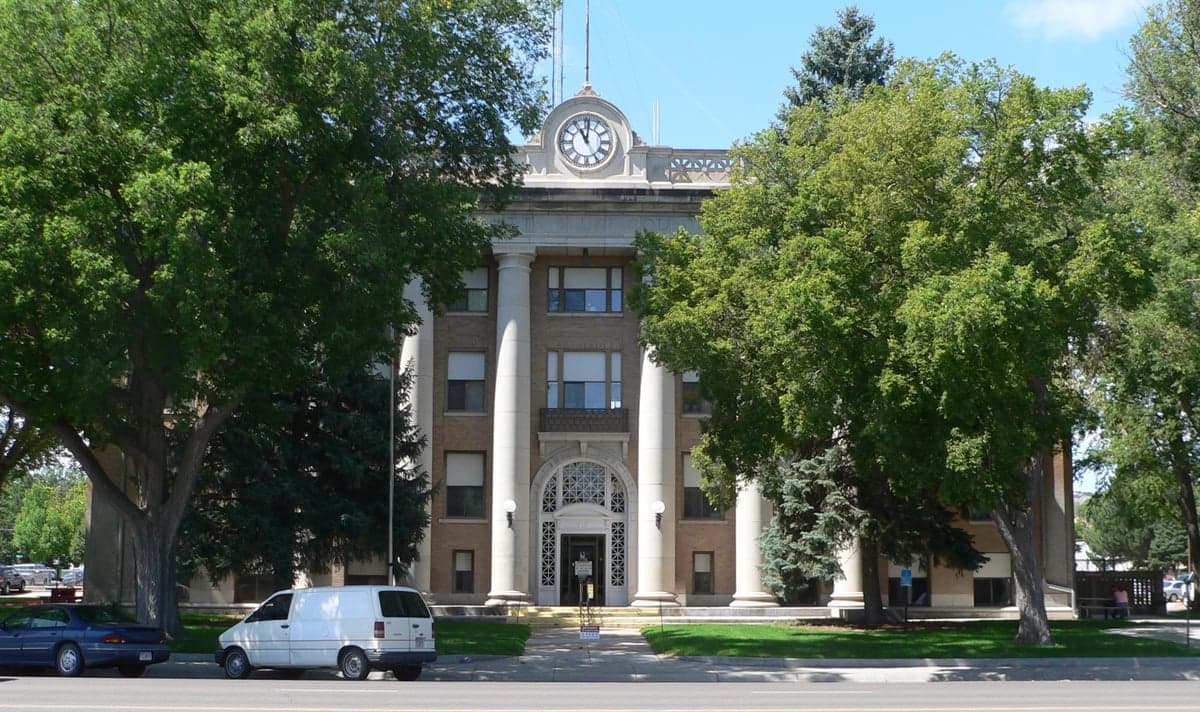
Photo: Wikipedia
Political ClimatePolitical Climate in Scotts Bluff County
Showing district-level results — no local-only data available.
Local Political AnalysisPolitical Analysis of Scotts Bluff County
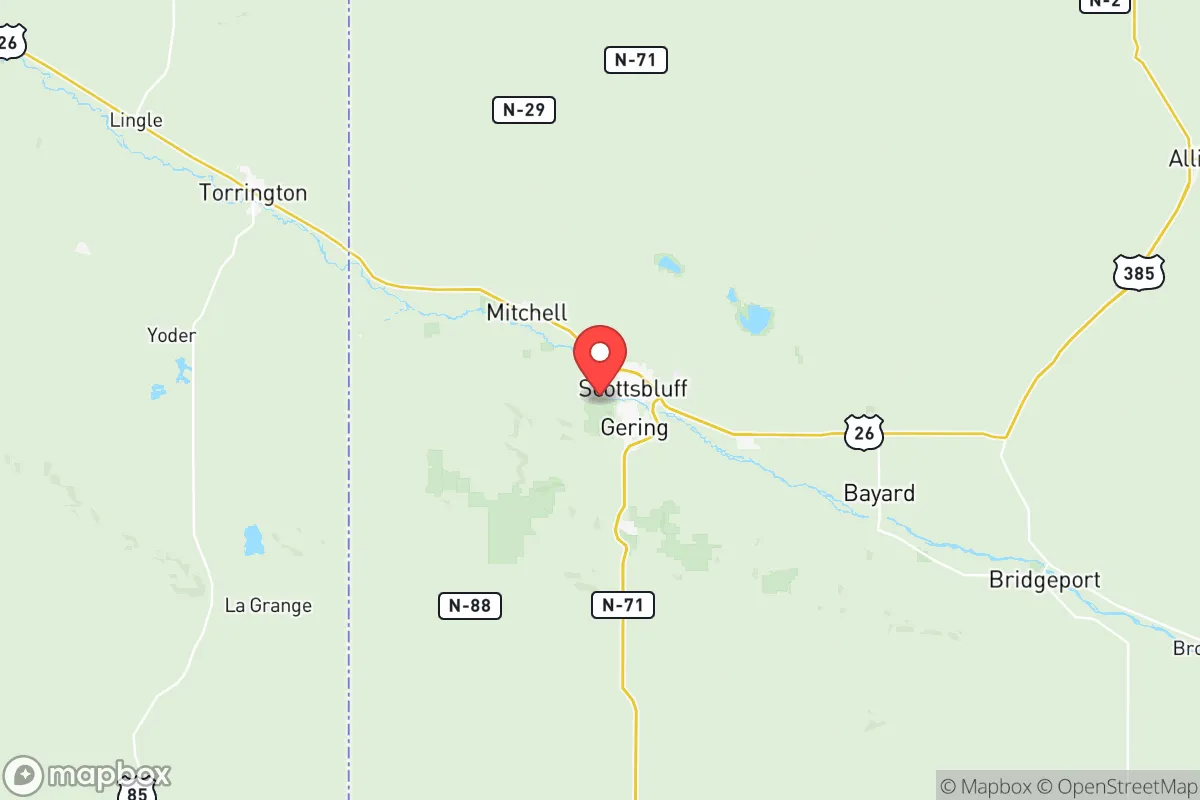
Scotts Bluff County is one of the most reliably Republican counties in Nebraska, with a Cook Partisan Voting Index (PVI) of R+27, making it significantly more conservative than the state as a whole, which sits at R+10. This isn't a recent shift; the county has voted for the GOP presidential candidate by wide margins for decades, with the 2024 election seeing Donald Trump carry the county with over 75% of the vote. The political center of gravity is firmly in the rural, agricultural areas outside the county's largest city, Scottsbluff, while the city itself and the neighboring town of Gering show slightly more competitive, though still Republican-leaning, precincts.
How it compares
The R+17 gap between Scotts Bluff County and the rest of Nebraska is substantial. To put it in perspective, while Nebraska as a whole is a safe red state, it contains a notable blue dot in Omaha's Douglas County (which voted for Joe Biden in 2020) and a handful of swing counties like Sarpy and Lancaster. Scotts Bluff County has none of that ambiguity. Its politics are closer to the deep-red western Nebraska plains than to the more moderate, suburban-leaning areas around Lincoln or Omaha. Within the county, the most conservative precincts are in the rural townships like Minatare, Morrill, and Lyman, where Republican turnout often exceeds 85%. The city of Scottsbluff itself is the most moderate area, with some precincts near the downtown and the regional medical center occasionally showing a Democratic vote in the low 30% range, but it has never been a swing area in a general election. Gering, the county seat, leans slightly more conservative than Scottsbluff but less so than the outlying towns, often serving as a bellwether for the county's overall mood.
What this means for residents
For conservative residents, the political climate is deeply affirming. Local offices—from the county commission to the school board—are overwhelmingly held by Republicans, and policy debates tend to center on tax rates, agricultural regulations, and property rights rather than social issues that might dominate in more purple areas. A conservative resident can expect their values to be the default in most public settings, from church gatherings to local business associations. For liberal or moderate residents, the reality is more about finding community within a minority. There is an active Democratic Party presence in Scottsbluff, but its influence is limited to local races and occasional primary challenges. Progressive residents often find their political expression through single-issue advocacy—like supporting the regional hospital or local environmental efforts—rather than through partisan electoral victories. The practical effect of the R+27 lean is that most local elections are decided in the Republican primary, meaning the general election is often a formality. This can lead to lower voter turnout in November, as many races are uncontested.
Culturally, the county's deep conservatism manifests in a strong emphasis on self-reliance, community volunteerism, and a wariness of federal oversight. The area is a hub for the region's agricultural economy, and policy discussions frequently revolve around water rights from the North Platte River, trade policy affecting sugar beet and cattle prices, and the availability of rural healthcare. There is a palpable sense of political stability here; the county's trajectory is not toward a purple shift but toward a deepening of its existing red hue, driven by an aging population and out-migration of younger, more moderate residents to urban centers. For anyone moving to Scotts Bluff County, understanding that the political landscape is both deeply conservative and largely unchanging is key to adjusting to daily life, whether you're attending a city council meeting in Scottsbluff or a county fair in Mitchell.

State Political ClimatePolitical Climate in Nebraska
State Political AnalysisPolitical Environment in the State
Nebraska is a solidly Republican state with a Cook PVI of R+10, but that blanket statement hides a more nuanced reality. The state has voted for the GOP presidential candidate in every election since 1968, with the sole exception of 1964’s Barry Goldwater landslide loss, and the margin has only widened in recent cycles — Donald Trump won the state by 19 points in 2020 and by over 20 in 2024. However, Nebraska is unique for splitting its Electoral College votes by congressional district, and the 2nd District (Omaha metro) has become a genuine battleground, flipping to Obama in 2008, Biden in 2020, and Harris in 2024, making it one of the few competitive districts in the Great Plains. Over the last 20 years, the state has drifted rightward in its rural areas while the Omaha and Lincoln metros have grown more Democratic, creating an increasingly sharp urban-rural divide that defines every statewide race.
Urban vs. rural divide
The political map of Nebraska is essentially three distinct zones. The eastern third, anchored by Omaha (Douglas County) and Lincoln (Lancaster County), is where Democrats have their stronghold — Douglas County went for Biden by 10 points in 2020 and Harris by a similar margin in 2024, while Lancaster County has trended blue in presidential races and now leans about 5-8 points Democratic. The 2nd Congressional District, which covers most of Douglas County plus suburban Sarpy County, is the only competitive federal race in the state; Sarpy County itself is a classic swing suburb, voting Republican but by shrinking margins as Omaha’s suburban sprawl brings in younger, more moderate families. The rest of the state is deeply red. Scottsbluff in the Panhandle, Grand Island in the central Platte Valley, and Norfolk in the northeast all vote Republican by 30-40 points in presidential races. The truly rural counties — places like Cherry County in the Sandhills or Chase County in the southwest — routinely deliver 80-85% of their vote to the GOP. The divide isn’t just about population density; it’s cultural. The urban cores are driven by a mix of college students, young professionals, and a growing minority population (Omaha’s Hispanic and African American communities are sizable), while rural Nebraska remains overwhelmingly white, older, and economically tied to agriculture and ranching.
Policy environment
Nebraska’s policy environment is shaped by its unique unicameral, nonpartisan legislature — the only one in the country. In practice, this means bills are advanced by coalitions rather than strict party-line votes, and committee chairs wield outsized influence. The state has no income tax on Social Security benefits and a flat individual income tax rate that was cut from 6.84% to 5.84% in 2023, with a scheduled drop to 3.99% by 2027. Property taxes are a perennial headache, among the highest in the region as a share of home value, and the legislature has passed multiple rounds of relief via state-funded credits and school funding shifts. Nebraska is a right-to-work state, has no state-level minimum wage above the federal $7.25 (though a 2022 ballot measure raised it to $15 by 2026), and maintains a conservative regulatory posture on business and energy. On education, the state has seen a push for school choice — a 2023 law created a tax-credit scholarship program for private school tuition, though it was temporarily suspended by a referendum challenge and is pending a 2024 ballot measure. Election laws are moderately restrictive: voter ID was passed in 2023 and took effect in 2024, early voting is available without an excuse, and same-day registration is not permitted. Nebraska also has a unique "winner-take-all" debate over its Electoral College system — Republicans have repeatedly tried to switch the state to a winner-take-all model to eliminate the 2nd District’s swing status, but have so far failed to get the 33 votes needed to overcome a filibuster.
Recent policy direction
The last three legislative sessions (2023-2025) have been defined by a sharp rightward push on social and cultural issues, even as fiscal policy has moved in a more traditionally conservative direction. On guns, Nebraska passed constitutional carry in 2023, allowing permitless concealed carry for anyone 21 or older, and preempted local gun ordinances — Omaha’s city-level restrictions on assault weapons and magazine capacity were effectively nullified. On parental rights and education, the legislature passed LB 574 in 2023, which banned gender-affirming care for minors and restricted abortion after 12 weeks, with exceptions for rape, incest, and medical emergencies. That same bill also included a provision requiring schools to notify parents of any changes to a student’s "mental, emotional, or physical health," which critics say targets LGBTQ+ students. On abortion specifically, Nebraska’s 12-week ban is among the stricter in the Midwest, though a 2024 ballot initiative to enshrine abortion rights in the state constitution failed to qualify for the ballot after a signature challenge. On property rights, the state has not passed any major eminent domain or land-use reforms recently, but a 2024 law did expand the ability of landowners to challenge regulatory takings. On privacy and surveillance, Nebraska has no comprehensive state data privacy law, though a 2023 bill to create one stalled in committee. On voting access, the 2023 voter ID law requires a valid state ID or passport to vote in person, and mail-in ballot applications must include the voter’s driver’s license number — a provision that has drawn lawsuits from voting rights groups. The overall direction is clear: the legislature, under a Republican supermajority (32 of 49 seats), is moving to codify conservative social policy while cutting taxes and limiting local control.
Civil unrest & political movements
Nebraska is not a state known for large-scale civil unrest, but it has seen its share of organized political activity. The most visible flashpoint in recent years has been the debate over the 2nd Congressional District’s Electoral College vote — after Biden won the district in 2020, Republicans launched a concerted effort to switch to winner-take-all, leading to a dramatic 2021 special session that ultimately failed by a single vote. That fight has become a perennial source of tension, with national Democrats pouring money into the district and national Republicans pushing for the change. On the left, the Nebraska Democratic Party has been revitalized by the Omaha metro’s growth, and groups like Nebraskans for Abortion Access and the ACLU of Nebraska have been active in ballot initiative campaigns and legal challenges. On the right, the Nebraska Republican Party has seen a factional split between establishment conservatives and a more populist, Trump-aligned wing, with the latter gaining ground in county party organizations. Immigration politics have been relatively quiet compared to border states, but a 2024 bill to require local law enforcement to cooperate with ICE (a "sanctuary city" ban) passed the legislature and was signed into law, targeting Omaha’s more welcoming stance. There have been no serious secession or nullification movements, though some rural counties have passed symbolic resolutions asserting local control over federal land management. The most visible protest activity in recent years has been around abortion — both anti-abortion rallies at the state capitol and counter-protests by reproductive rights groups, particularly after the 2023 ban. A new resident in Omaha or Lincoln would notice occasional protests on the University of Nebraska campuses and at the capitol during legislative sessions, but the overall atmosphere is orderly and low-key compared to coastal states.
Projection
Over the next 5-10 years, Nebraska’s political trajectory points toward continued polarization along the urban-rural axis, with the Omaha metro’s growth slowly making the 2nd District more competitive while the rest of the state hardens its Republican identity. The 2020 Census showed Douglas County growing at about 8% per decade, while many rural counties lost population, and that trend is expected to continue. If the 2nd District remains a swing seat, the fight over winner-take-all will resurface every election cycle, and a future Republican supermajority could eventually succeed in changing the rules. On policy, the tax cuts already scheduled will likely continue, with pressure to further reduce or eliminate the state income tax entirely — a move that would require either deep spending cuts or a shift to higher sales or property taxes. The social policy direction will depend on the courts: the 2023 abortion ban and gender-affirming care ban are both facing legal challenges, and a future Democratic governor (unlikely but not impossible given the 2nd District’s trend) could veto further restrictions. The biggest wildcard is in-migration: Nebraska is seeing modest growth from remote workers and retirees drawn by low housing costs in places like Lincoln and Fremont, but it’s not experiencing the explosive growth of Texas or Florida. A new resident moving in now should expect a state that remains reliably Republican at the statewide level, with a legislature that will continue to push conservative policy on taxes, guns, and social issues, but with a persistent blue island in the east that keeps the politics interesting and occasionally produces surprises like the 2020 electoral vote split.
For a new resident, the bottom line is that Nebraska offers a stable, low-drama political environment where conservative policies are the norm but not enforced with the intensity of some southern states. If you’re a conservative, you’ll find a state government that generally aligns with your views on taxes, guns, and education, with the caveat that property taxes will remain a frustration. If you’re a liberal, you’ll find a livable environment in Omaha or Lincoln where your vote matters in local and congressional races, but you’ll be living under a state government that opposes most of your policy preferences. The practical takeaway is that Nebraska rewards those who engage locally — the nonpartisan legislature means that relationships and committee dynamics matter more than party labels, and a well-organized minority can still block the worst outcomes. It’s a place where politics is serious but not all-consuming, and where most people, regardless of party, share a common culture of pragmatism and neighborliness.
* Values derived from national, state, county, city and local statistics and may differ in a specific area. Last updated: 2026-06-17T22:17:14.000Z
Narrative content on this page is AI-generated and may contain mistakes. Verify any details that matter before acting on them.
ReloMaps may earn a commission from affiliate links at no extra cost to you.

