Photo: Wikipedia
Political ClimatePolitical Climate in Dakota County
Showing district-level results — no local-only data available.
Local Political AnalysisPolitical Analysis of Dakota County
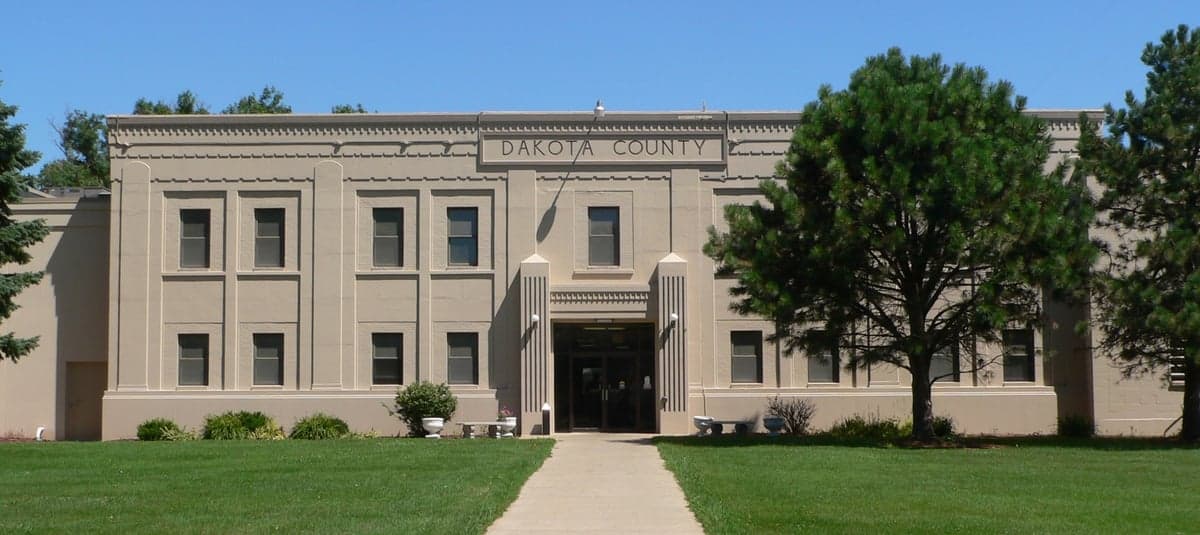
Dakota County is one of the most reliably Republican corners of Nebraska, carrying a Cook Partisan Voting Index (PVI) of R+27 — meaning it votes about 27 points more Republican than the national average. That’s a full 17 points redder than the state of Nebraska as a whole (PVI R+10), and it’s been that way for decades. The county hasn’t backed a Democrat for president since Lyndon Johnson in 1964, and even then it was a squeaker. The real story, though, is the internal split: the county’s politics are not a monolith, and the divide between the small industrial city of South Sioux City and the surrounding farm towns tells you everything you need to know about where the votes come from and where things might be headed.
How it compares
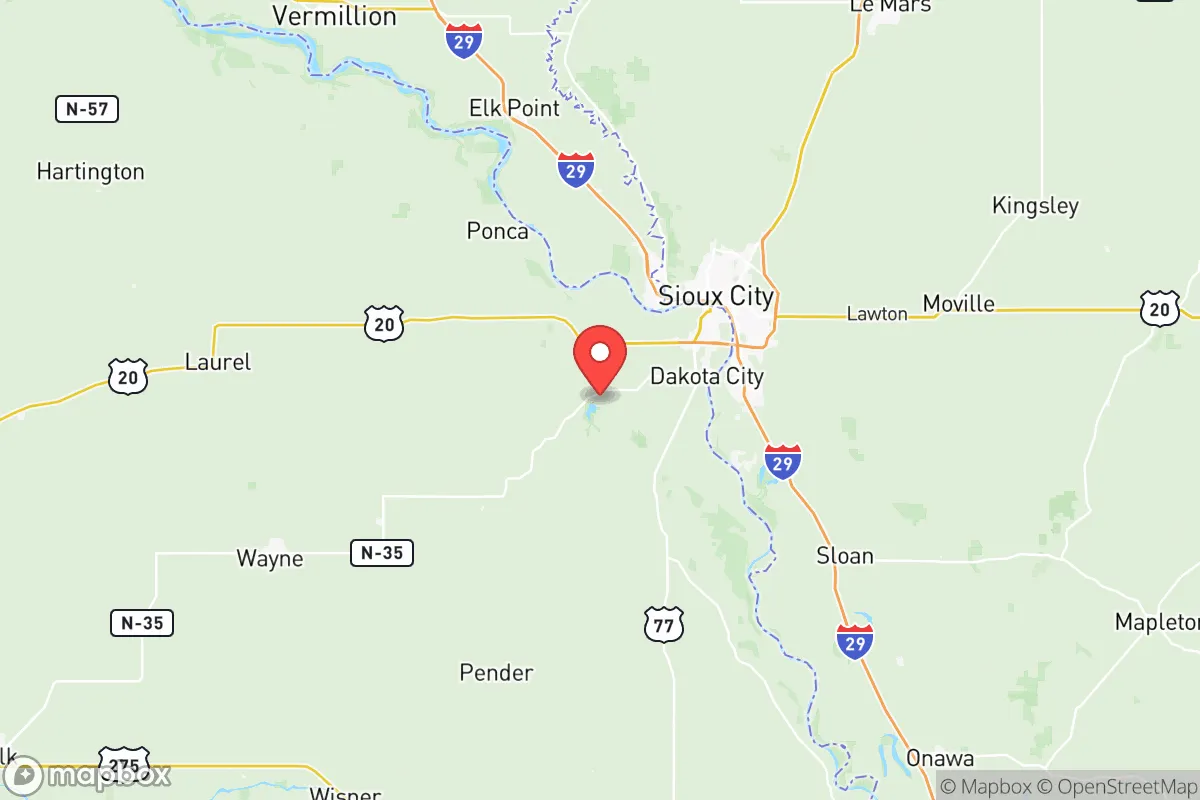
Compared to Nebraska’s statewide R+10 lean, Dakota County’s R+27 is a different planet. The state as a whole has a few blue pockets — Lincoln and Omaha’s Douglas County — but Dakota County has no such urban counterweight. The county’s largest town, South Sioux City (pop. ~13,000), is the only place where you’ll find any real Democratic presence. Precincts around the Missouri River and the industrial parks near the I-129 bridge have voted for Democrats in recent local races, driven largely by a growing Latino population (about 40% of the city) and unionized meatpacking workers at the Tyson Foods plant. But even South Sioux City’s liberal precincts are only blue by a few points — think 52-48 — and they’re surrounded by deep-red rural precincts that go 80-20 Republican. Towns like Emerson, Hubbard, and Jackson are the real engine of the county’s R+27 rating; these are farming communities where the GOP primary is the only election that matters. The swing precincts, if you can call them that, are in the unincorporated areas between South Sioux City and Dakota City — places like Dakota City itself, where the county seat’s mix of government workers and agribusiness employees can tip a race by a few hundred votes, but always toward the right.
What this means for residents
For conservative residents, Dakota County is about as comfortable as it gets. You can count on your state senator and county commissioners to be reliably pro-life, pro-Second Amendment, and anti-tax. The county’s property tax levies are among the lowest in Nebraska, and there’s little appetite for the kind of urban spending you see in Lincoln or Omaha. For liberal residents, the reality is more isolating. You’ll find a small but active Democratic club in South Sioux City, and the local school board races occasionally get competitive, but statewide elections are a foregone conclusion. The practical effect is that progressive policy ideas — like expanding Medicaid (already done in Nebraska, but controversial here) or raising the minimum wage — are dead on arrival in local government. That said, the county’s politics are not hostile to all change: the Tyson plant and the nearby casino in South Sioux City have brought a pragmatic, pro-business attitude that sometimes cuts against pure ideology. The county commission, for instance, has supported tax incentives for industrial development that would make a national libertarian cringe.
The cultural distinction that sets Dakota County apart from the rest of Nebraska is its tri-state border identity. Living here means you’re constantly comparing yourself to Iowa (right across the river) and South Dakota (20 miles north). That proximity has made the county more economically conservative than the rest of Nebraska — residents see how low-tax South Dakota operates and wonder why Nebraska can’t match it. At the same time, the meatpacking workforce has brought a visible diversity that’s rare in rural Nebraska, creating a quiet tension between the county’s red voting record and its increasingly multicultural daily life. Longtime residents will tell you the politics haven’t changed much in 50 years, but the people have — and that’s the slow-burn story that will define Dakota County’s next decade.

State Political ClimatePolitical Climate in Nebraska
State Political AnalysisPolitical Environment in the State
Nebraska is a solidly Republican state with a Cook PVI of R+10, but that headline number hides a more complicated reality than you might expect. The state has been reliably red in presidential elections since 1968, with the last Democrat to carry it being Lyndon Johnson in 1964, yet it’s also the only state that splits its Electoral College votes by congressional district — a quirk that gave a single electoral vote to Barack Obama in 2008 and Joe Biden in 2020. Over the last 20 years, the rural-to-urban population shift has deepened the partisan divide, with the two big metro areas — Omaha and Lincoln — trending bluer while the vast agricultural expanse has hardened its conservative edge. The result is a state where Republicans hold supermajorities in the legislature and every statewide office, but where a non-trivial chunk of the population lives under Democratic local governance in the cities.
Urban vs. rural divide
The political map of Nebraska is essentially a tale of two islands in a red sea. Douglas County (Omaha) and Lancaster County (Lincoln) together hold about 45% of the state’s population, and both have been drifting leftward for a decade. In 2024, Douglas County voted for Kamala Harris by about 8 points, while Lancaster County was a toss-up that ultimately went for Trump by a narrow margin. The rest of the state — the Sandhills, the Panhandle, the Platte River valley — is deeply Republican. Scottsbluff in the Panhandle and Grand Island in the central Platte valley are reliably red, though Grand Island’s growing Latino population has introduced some Democratic-leaning precincts. The Omaha suburbs like Papillion and La Vista are the real battlegrounds: they’re still Republican-leaning but have been shifting toward the center, especially among college-educated voters. The rural counties, by contrast, routinely deliver 80-85% of the vote to Republican candidates, making the state’s overall lean far more conservative than the metro numbers suggest.
Policy environment
Nebraska’s policy environment is shaped by its unique unicameral, nonpartisan legislature — the only one in the country. In practice, this means bills are advanced by coalitions rather than party-line whip votes, but the Republican supermajority (currently 33 of 49 seats) ensures conservative priorities dominate. The state has no income tax on Social Security benefits and a flat individual income tax rate that is being phased down to 3.99% by 2027, with a goal of eliminating the income tax entirely over the long term. Property taxes are a perennial flashpoint, with agricultural landowners pushing for relief and urban homeowners feeling the squeeze from rising valuations. Education policy is a major battleground: Nebraska has a robust system of public schools, but the 2023 passage of LB 753 created a school choice program offering tax credits for private school scholarships, and the 2024 session saw a push for charter school expansion that ultimately stalled. Election laws are moderately restrictive — Nebraska requires a photo ID to vote, a law that took full effect in 2024 after a 2022 ballot measure passed with 65% support. The state also has a voter registration deadline 11 days before the election, and no-excuse absentee voting is available.
Recent policy direction
The last three legislative sessions have moved Nebraska decisively to the right on several fronts. In 2023, the legislature passed LB 77, which eliminated the requirement for a permit to carry a concealed handgun, making Nebraska a constitutional carry state. The same year saw the passage of LB 574, which banned gender-affirming care for minors and restricted abortion access to the first 12 weeks of pregnancy — a bill that sparked a record-breaking filibuster and ultimately passed after a contentious special session. On education, LB 705 (2024) expanded parental rights by requiring schools to notify parents of any curriculum involving sexual orientation or gender identity, and it allowed parents to opt their children out of such instruction. Property rights saw a win for landowners with LB 406 (2023), which limited the use of eminent domain for carbon pipeline projects — a direct response to the controversial Summit Carbon Solutions pipeline. On the privacy front, Nebraska has no comprehensive data privacy law, but a 2024 bill to create a consumer data privacy framework is pending. Medical marijuana remains illegal for both recreational and medical use, though a ballot initiative for medical use is expected to appear in 2024 or 2026. Voting access has tightened: the 2021 LB 76 shortened the early voting window and required a notarized signature for mail-in ballot requests, though a 2024 court ruling struck down the notarization requirement.
Civil unrest & political movements
Nebraska is not a hotbed of civil unrest, but it has seen its share of organized political activity. The 2020 George Floyd protests in Omaha were the largest in state history, with several nights of demonstrations that included property damage and a police shooting of a protester, leading to a federal investigation. Since then, the Black Lives Matter movement in Omaha has remained active but less visible. On the right, the Nebraska Republican Party has been split between establishment conservatives and a more populist, Trump-aligned faction, with the 2022 gubernatorial primary featuring a contentious race between Jim Pillen (the eventual winner) and Charles Herbster, who was backed by Trump. Immigration politics have been a flashpoint in smaller communities like Schuyler and Lexington, where meatpacking plants have drawn large Latino populations; local tensions have occasionally flared over language access and housing, but no sanctuary city policies exist. The Summit Carbon Solutions pipeline has galvanized a grassroots property rights movement across the state, with landowners in counties like Stanton and Burt organizing against eminent domain. Election integrity controversies have been muted compared to states like Arizona or Georgia, but the 2020 election saw Trump’s campaign challenge Nebraska’s split electoral vote system, and some rural counties have pushed for hand-counting ballots. The most visible political movement in recent years has been the anti-abortion and parental rights coalition, which successfully pushed through the 12-week ban and the education transparency bills.
Projection
Over the next 5-10 years, Nebraska’s political trajectory points toward a continued but uneven rightward shift, tempered by the growing influence of the Omaha and Lincoln metros. The state’s population is aging and slowly declining in rural areas, while Douglas and Lancaster counties are growing — a trend that will gradually erode the Republican supermajority in the legislature. However, the in-migration Nebraska is seeing is not from coastal liberals but from neighboring states like Colorado and California, often retirees or remote workers seeking lower taxes and a slower pace of life, which tends to reinforce the conservative lean. The biggest wildcard is the Latino population, which is growing rapidly in the meatpacking towns of the Platte River valley and in Omaha; if this community becomes more politically engaged, it could shift the balance in a few legislative districts. The push to eliminate the state income tax will likely continue, with the goal of making Nebraska competitive with no-income-tax states like Texas and South Dakota. On social issues, expect further restrictions on abortion — a total ban is possible if the legislature flips to a filibuster-proof majority — and continued expansion of school choice. The property rights movement against pipelines will remain a potent force, but it’s unlikely to stop the Summit Carbon project entirely. For a new resident, the Nebraska of 2035 will look much like today: reliably red, low-tax, and culturally conservative in the countryside, with blue islands in the cities that are growing but not yet threatening the state’s overall direction.
For a conservative relocator, Nebraska offers a policy environment that aligns closely with your values — low taxes, strong gun rights, parental control in education, and a legislature that moves steadily rightward. For a liberal relocator, the picture is more mixed: you’ll find welcoming communities in Omaha and Lincoln, with progressive local governments and a vibrant arts scene, but you’ll be living under a state government that is actively restricting abortion access, limiting transgender rights, and expanding school choice. The practical takeaway is that Nebraska is a state where your daily life is shaped heavily by which county you choose to live in. If you want the full conservative package, look at the suburbs of Papillion or the rural towns of the Platte valley. If you need a more moderate environment, stick to the urban cores of Omaha or Lincoln, where the local politics will buffer some of the state-level policies. Either way, the state’s political stability and low cost of living make it a predictable choice for anyone who values consistency over volatility.
* Values derived from national, state, county, city and local statistics and may differ in a specific area. Last updated: 2026-07-08T02:09:17.000Z
Narrative content on this page is AI-generated and may contain mistakes. Verify any details that matter before acting on them.
ReloMaps may earn a commission from affiliate links at no extra cost to you.

