
Photo: Wikipedia
Personal Sovereignty in Dakota County
Viable for self-reliance. Generally workable, though some barriers may limit total independence.
What does Personal Sovereignty tell us?
Personal Sovereignty measures your capacity for self-reliance and independence with minimal government friction. Higher scores mean fewer barriers between you and the way you want to live... but it assumes you have the space you need and good neighbors.
What does this tell us?
Personal Sovereignty measures your capacity for self-reliance and independence with minimal government friction. Higher scores mean fewer barriers between you and the way you want to live... but it assumes you have the space you need and good neighbors.
State Policy
Energy independence: Importer (35% of energy produced in-state)
Personal Liberty
Homesteading

Personal Liberty Analysis
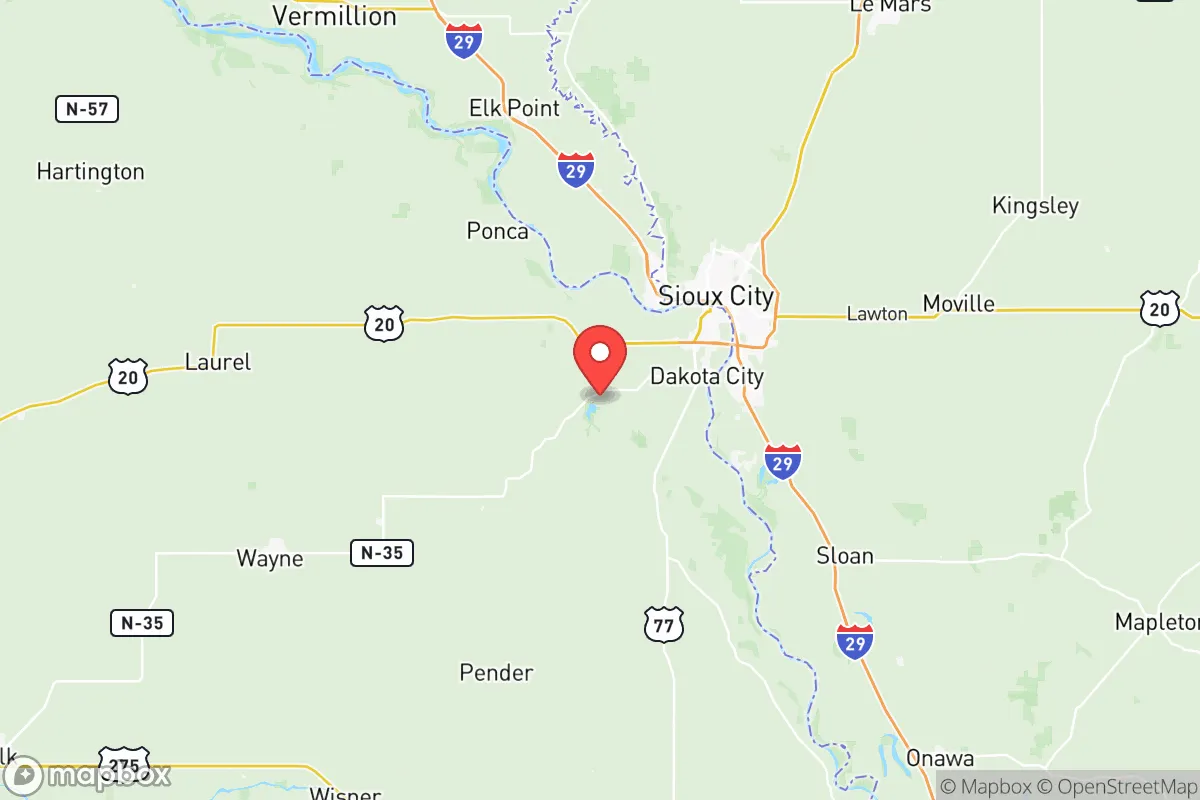
Dakota County, Nebraska, offers a personal sovereignty environment shaped by its position on the Missouri River border with Iowa and South Dakota, blending Midwestern self-reliance with a state-level legal framework that generally favors individual autonomy. The county's three primary municipalities—Dakota City, South Sioux City, and Emerson—each present distinct regulatory and cultural flavors, from the more urbanized, commercial corridors of South Sioux City to the quieter, agricultural expanses around Hubbard and Jackson. For a conservative-leaning individual or family seeking to minimize government intrusion while maximizing personal control over daily life, Dakota County provides a solid foundation, though the specific trade-offs vary by location and local ordinance.
Tax burden and regulatory posture: How local and state policies affect your wallet
Nebraska's overall tax burden is moderate compared to neighboring states, but Dakota County residents benefit from a relatively low property tax levy for a county with a significant industrial base. The county's mill levy for 2025-2026 is approximately 0.35 per $100 of assessed value, which is below the state average of 0.42, thanks in part to the tax base provided by major employers like the Tyson Foods plant in Dakota City and the agribusiness operations along the river. South Sioux City, the county's largest city, imposes a local sales tax of 1.5% on top of the state's 5.5%, bringing the combined rate to 7%—competitive with Sioux City, Iowa, just across the bridge. Emerson, a smaller town in the county's southwest, has no additional city sales tax, making it a more tax-efficient choice for cost-conscious families. The regulatory posture at the county level is light-touch: there are no county-wide zoning ordinances for agricultural land, and building permits are required only for new structures or major renovations, not for routine repairs or fences. This contrasts with the more restrictive codes in South Sioux City, where the city enforces a uniform building code and requires permits for sheds over 120 square feet. For a reader prioritizing minimal regulatory friction, the unincorporated areas around Jackson and Hubbard offer the most freedom, with no local business licensing requirements beyond state-level registration.
Self-defense and gun law specifics: What you can carry and where
Nebraska is a shall-issue state for concealed carry permits, and Dakota County's sheriff's office processes applications efficiently, typically within 30 days. The state does not require a permit to open carry, and as of 2023, permitless concealed carry is legal for residents 21 and older who are not prohibited from firearm possession. This makes Dakota County one of the more permissive environments in the region for self-defense. South Sioux City, however, has a city ordinance that prohibits the discharge of firearms within city limits except at approved ranges, which restricts recreational shooting on residential property. In contrast, the unincorporated areas and towns like Emerson and Hubbard have no such restrictions, allowing target practice on private land as long as it is done safely and not within 100 yards of a dwelling. The county has no additional magazine capacity restrictions or assault weapon bans, aligning with state preemption laws that prevent local governments from enacting stricter firearm regulations than the state. For a family concerned with self-defense, the practical reality is that you can carry a concealed handgun into most businesses, restaurants, and public spaces in Dakota County, though private property owners can post signs prohibiting firearms. The sheriff's office is known for a pro-Second Amendment stance, and the county's gun culture is robust, with several local shooting clubs and the Dakota County Sportsmen's Club hosting regular events.
Self-reliance and homesteading viability: Lot sizes, zoning, and off-grid feasibility
Homesteading and off-grid living are genuinely viable in Dakota County, particularly outside the city limits of South Sioux City and Dakota City. The county's zoning code for agricultural land requires a minimum lot size of 40 acres for a new homestead, but existing parcels of 5 to 20 acres are common in the areas around Jackson and Hubbard, often sold with grandfather clauses that allow residential use. Off-grid systems are legal: Nebraska has no state-level ban on rainwater collection, and Dakota County does not require a permit for solar panel installation on residential property, though grid-tied systems must meet utility interconnection standards. Composting toilets and greywater systems are permitted under the state's alternative wastewater system regulations, which require a permit from the Nebraska Department of Environment and Energy but are routinely approved for rural properties. South Sioux City, by contrast, requires connection to municipal sewer and water for any habitable structure within city limits, effectively prohibiting off-grid living there. For a family seeking to raise livestock, the county allows up to four chickens per household in residential zones without a permit, and larger animals like goats or horses are permitted on parcels of one acre or more in agricultural zones. The county's extension office in Dakota City offers workshops on soil management, canning, and small-scale farming, reflecting a community that values self-sufficiency. Emerson, with its small-town character and proximity to the Missouri River bluffs, is particularly attractive for homesteaders due to its low land prices—typically $3,000 to $5,000 per acre for undeveloped parcels—and minimal local government oversight.
Personal liberties: Parental rights, medical autonomy, speech, and property
Nebraska law provides strong protections for parental rights, including the right to direct a child's education and medical care. Dakota County's school districts—South Sioux City Community Schools, Dakota City Community Schools, and Emerson-Hubbard Public Schools—all allow parents to opt their children out of specific curriculum materials or health education modules without penalty. The state does not require parental consent for a minor's COVID-19 vaccination, but local school boards in Dakota County have not mandated any vaccines beyond the standard state requirements for school attendance. Medical autonomy is generally respected: Nebraska has no state-level mask or vaccine mandates in effect as of 2026, and Dakota County's health department does not enforce any local mandates. Speech and assembly rights are robust, with the county's public spaces—including the Dakota County Courthouse lawn and the South Sioux City Riverfront Park—available for protests or gatherings without a permit for groups under 50 people. Property rights are protected by Nebraska's strong eminent domain laws, which require just compensation and a public purpose for any taking, and Dakota County has not initiated any controversial condemnations in recent memory. The county's planning commission, which reviews subdivision and land-use changes, is known for deferring to property owners' wishes unless a clear public safety issue exists. For a reader who values the ability to make decisions about their family's health, education, and property without government interference, Dakota County's legal environment is favorable, though the more urbanized South Sioux City does impose stricter noise and nuisance ordinances that can limit activities like late-night bonfires or outdoor machinery use.
Overall, Dakota County offers a personal sovereignty profile that is strong for the Midwest, particularly in its rural and unincorporated areas, where regulatory oversight is minimal and self-reliance is culturally embedded. The county's tax burden is manageable, its gun laws are among the most permissive in the region, and its support for homesteading and off-grid living is genuine, especially in Emerson, Hubbard, and Jackson. The trade-offs are clear: South Sioux City and Dakota City provide more services and infrastructure but come with tighter local ordinances, while the smaller towns and rural areas offer greater freedom at the cost of convenience. For a conservative-leaning individual or family weighing relocation, Dakota County ranks favorably against neighboring counties in Iowa and South Dakota, where property taxes are often higher or gun laws more restrictive. The key is to choose the specific location within the county that aligns with your personal priorities—whether that's the tax efficiency of Emerson, the gun-friendly culture of Hubbard, or the commercial access of South Sioux City with its slightly heavier regulatory hand.

* Values derived from national, state, county, city and local statistics and may differ in a specific area. Last updated: 2026-07-08T02:09:17.000Z
Narrative content on this page is AI-generated and may contain mistakes. Verify any details that matter before acting on them.
ReloMaps may earn a commission from affiliate links at no extra cost to you.

