Photo: Wikipedia
Demographics of Dakota County
Affluence Level in Dakota County
A middle-class area roughly in line with national averages across income, home values, education, and employment.
People of Dakota County
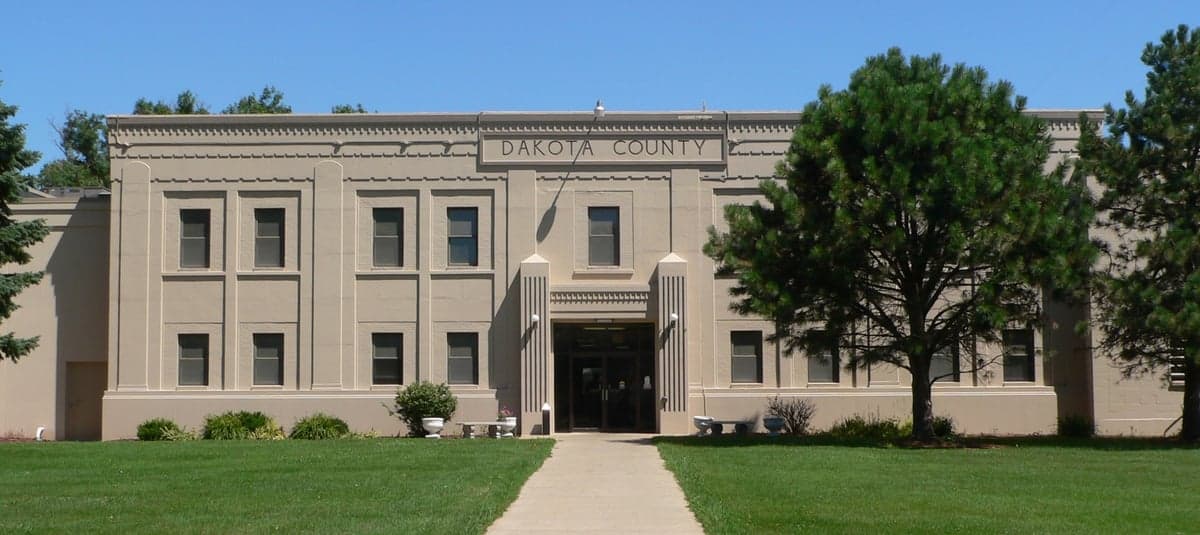
Today, Dakota County, Nebraska, is one of the most ethnically diverse and densely populated counties in the state, home to roughly 21,300 residents. Its character is defined by a striking demographic profile: a population that is 43.3% White, 41.2% Hispanic, 8.1% Black, and 2.7% East/Southeast Asian, with a foreign-born share of 10.6% that is nearly double the Nebraska state average. The county’s identity is a blend of its historic agricultural and meatpacking roots, a growing working-class Hispanic community, and a small but established Black population, all concentrated in the Missouri River corridor cities of South Sioux City, Dakota City, and Homer.
Settlement & growth (pre-1960)
Before American settlement, the area that is now Dakota County was part of the ancestral homeland of the Omaha and Ponca nations, who lived in semi-permanent villages along the Missouri River and relied on agriculture, bison hunting, and trade. The first European incursion came with French fur traders in the 18th century, but sustained non-Native settlement did not begin until after the 1854 Kansas-Nebraska Act opened the territory to homesteading. The county was formally organized in 1855, and its earliest American settlers were overwhelmingly Yankee migrants from New England and the Upper Midwest, drawn by cheap land along the river bottomlands. They founded the county seat of Dakota City in 1856 and the river port of South Sioux City (originally called "East Omaha") shortly after.
A second wave arrived in the 1870s and 1880s: German and Irish immigrants, recruited by railroad companies and land agents to farm the fertile loess hills. Many of these families settled in the rural townships around Homer and Jackson, where German Lutheran and Catholic churches still stand as markers of that era. The Irish, in particular, found work building the Sioux City and Pacific Railroad, which connected the county to the transcontinental line. By 1900, the county’s population had reached roughly 8,000, nearly all White and native-born or of Northern European descent.
The most transformative pre-1960 event was the opening of the John Morrell & Co. meatpacking plant in South Sioux City in the 1920s. This drew a new wave of internal migrants: Southern-born Whites from Missouri and Arkansas, and later Mexican laborers who arrived as part of the Bracero Program during World War II. These Mexican workers were the county’s first significant non-White population, settling in a small barrio near the packing plant in South Sioux City. By 1960, the county’s population had grown to 12,000, but it remained overwhelmingly White (over 95%) and rural in character.
Modern era (post-1965)
The 1965 Hart-Cellar Act, combined with the expansion of the meatpacking industry, fundamentally reshaped Dakota County’s demographics. Beginning in the 1970s, the John Morrell plant (later owned by Smithfield Foods) aggressively recruited immigrant labor to fill jobs that native-born workers increasingly avoided. The first major post-1965 group was Mexican and Central American migrants, who arrived in large numbers through the 1980s and 1990s. They established a dense, Spanish-speaking enclave in South Sioux City, particularly along 4th Street and Dakota Avenue, where Mexican grocery stores, taquerias, and Catholic parishes now anchor the community. By 2000, the Hispanic share of the county’s population had risen to 25%.
A second, smaller wave came in the 1990s and 2000s: East/Southeast Asian refugees and secondary migrants, primarily Vietnamese and Karen (Burmese) families, resettled through church-sponsored refugee programs. They concentrated in South Sioux City and Dakota City, where a handful of Asian grocery stores and Buddhist temples serve a community that now accounts for 2.7% of the county’s population. At the same time, a Black population grew from near-zero in 1970 to 8.1% today, driven by African American migrants from Chicago and other Midwestern cities who came for meatpacking jobs. This Black community is concentrated in South Sioux City’s lower-income neighborhoods near the plant, though it remains more dispersed than the Hispanic enclave.
Domestic migration has also played a role. Since 2000, Dakota County has seen a modest inflow of White retirees and commuters from the Sioux City, Iowa metro area, who have built new subdivisions on the outskirts of South Sioux City and in the unincorporated area around Willow Creek. This has created a visible geographic divide: the newer, Whiter subdivisions on the county’s western edge contrast with the older, denser, and more diverse neighborhoods along the Missouri River. The county’s college-educated share remains low at 15.1%, reflecting the working-class nature of the dominant meatpacking and logistics economy.
The future
Dakota County is projected to become more diverse and more Hispanic over the next 10-20 years. The Hispanic population, already 41.2%, is the youngest demographic cohort in the county, with a median age roughly 10 years younger than the White population. Natural increase (births minus deaths) will continue to drive Hispanic growth, while the White population is aging and declining slightly. The East/Southeast Asian and Black populations are likely to remain stable or grow slowly, as meatpacking automation reduces the demand for low-skill labor that originally attracted these groups.
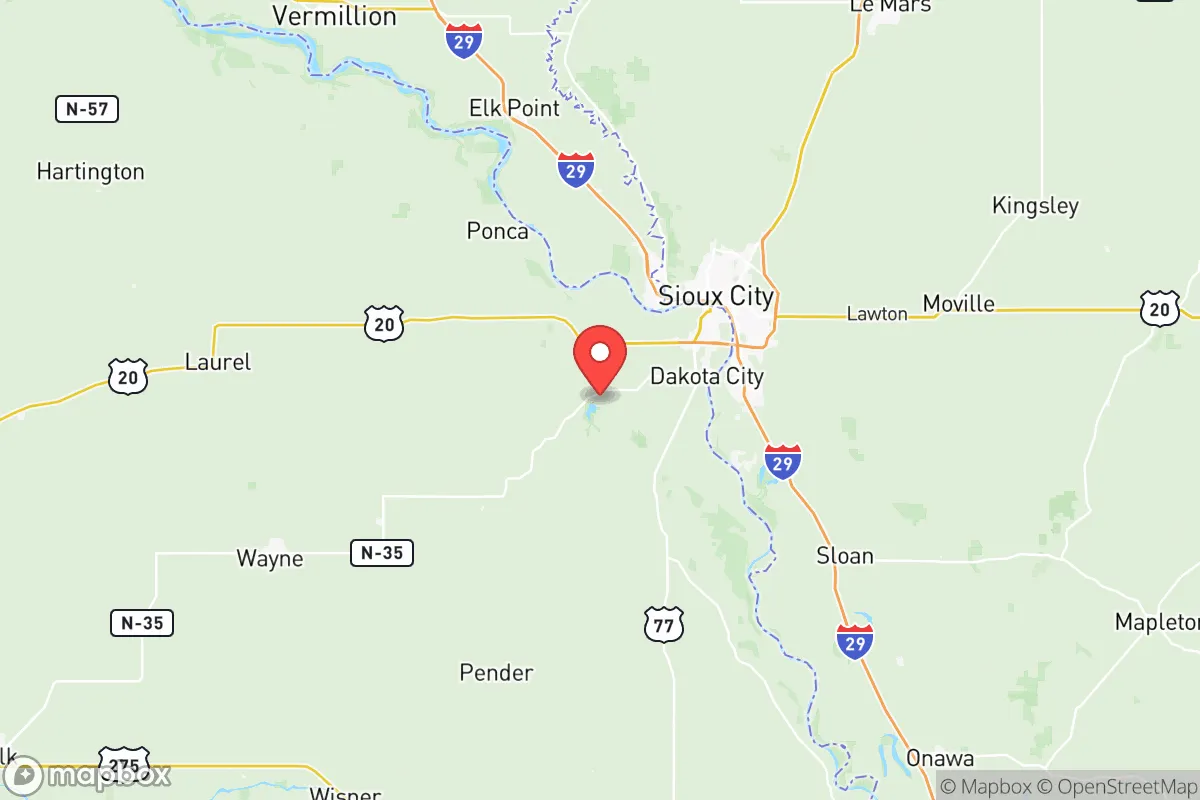
Geographically, growth will concentrate in South Sioux City, which already holds over 60% of the county’s population. New housing developments are planned along the Highway 20 corridor west of town, aimed at attracting commuters to Sioux City and Dakota City. The rural townships around Homer and Jackson will likely continue to lose population, as young people leave for urban jobs and few new residents arrive. Culturally, the county is evolving from a historically White, agricultural community into a majority-minority, working-class suburb of the Sioux City metro area. Spanish is increasingly heard in public spaces, and local schools in South Sioux City now serve a student body that is over 60% Hispanic.
For someone moving in now, Dakota County offers a low cost of living and a strong sense of community, but also a clear demographic and economic reality: it is a place where the future is being shaped by Hispanic families, meatpacking wages, and the slow decline of its older White farming population. The county is not becoming a cosmopolitan melting pot, but rather a working-class, bilingual borderland between the Great Plains and the urban Midwest — a place where the old and new Nebraska are meeting, sometimes uneasily, but with a shared reliance on the same industrial economy.

* Values derived from national, state, county, city and local statistics and may differ in a specific area. Last updated: 2026-07-08T02:09:17.000Z
Narrative content on this page is AI-generated and may contain mistakes. Verify any details that matter before acting on them.
ReloMaps may earn a commission from affiliate links at no extra cost to you.

