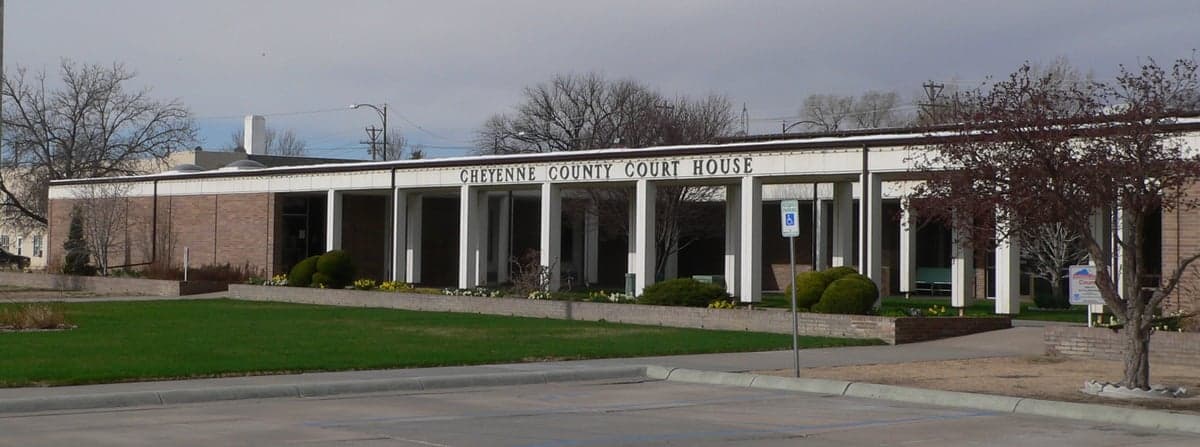
Photo: Wikipedia
Political ClimatePolitical Climate in Cheyenne County
Showing district-level results — no local-only data available.
Local Political AnalysisPolitical Analysis of Cheyenne County
Cheyenne County, Nebraska, is one of the most reliably Republican counties in the state, carrying a Cook Partisan Voting Index (PVI) of R+27 — meaning it votes roughly 27 points more Republican than the national average. That’s a full 17 points redder than Nebraska as a whole, which sits at R+10. The county hasn’t voted for a Democratic presidential candidate since Lyndon B. Johnson in 1964, and even then it was a squeaker. The political center of gravity is in Sidney, the county seat and largest town, where you’ll find the most moderate voters — but even Sidney hasn’t gone blue in a statewide race in decades. Out in the smaller towns like Potter, Gurley, and Lodgepole, the vote tends to be even more lopsided, often pushing 80% or higher for Republican candidates. The only real variation comes from a handful of precincts around the county’s edges, where a few dozen independent-minded farmers or railroad workers might swing a local race, but those are the exceptions that prove the rule.
How it compares
When you stack Cheyenne County against the rest of Nebraska, the difference is stark. The state as a whole is already solidly red at R+10, but Cheyenne County’s R+27 puts it in the same league as the most conservative rural counties in the Panhandle. For context, neighboring Deuel County is even redder, while Scotts Bluff County to the west is slightly less so, thanks to the more diverse population around Gering and Scottsbluff. The real contrast, though, is with the state’s blue dots — Lincoln and Omaha’s Douglas County — which pull Nebraska’s overall PVI toward the center. In Cheyenne County, you simply don’t see that kind of counterbalance. The county’s Republican lean has actually intensified over the past decade, mirroring a national trend where rural areas have moved rightward even as suburbs have become more competitive. In 2020, Donald Trump won Cheyenne County with over 80% of the vote, up from about 75% in 2016. That’s a shift you can feel on the ground: yard signs are almost exclusively red, and local party meetings draw a fraction of the turnout they did 20 years ago, but the ones who show up are more committed than ever.
What this means for residents
For conservative residents, Cheyenne County’s political climate means their values are reflected in nearly every level of local government — from the county commission to the school board to the planning department. Tax policy is reliably low, gun rights are broadly supported, and social issues tend to align with traditional conservative positions. For liberal residents, the reality is more isolating. There’s no organized Democratic Party presence to speak of; the county party is essentially a mailing list. That doesn’t mean progressive voices are silenced — there are a handful of active Democrats in Sidney and a few more scattered on farms — but they have to work harder to be heard, and they rarely win elections. The practical effect is that local policy debates tend to be about how conservative to be, not whether to be conservative at all. A recent zoning dispute in Sidney, for example, pitted property-rights absolutists against those who wanted modest growth controls — a classic intra-conservative fight. For newcomers, especially those from blue states, the adjustment can be jarring, but most find that neighborliness transcends politics in day-to-day life.
Culturally, Cheyenne County’s politics are woven into the fabric of daily life in ways that go beyond voting. The county is home to a strong agricultural economy, a significant railroad presence (BNSF has a major yard in Sidney), and a growing number of remote workers drawn by low housing costs. The local newspaper, the Sidney Sun-Telegraph, leans conservative in its editorial stance but covers local news with a relatively even hand. One notable policy distinction: Cheyenne County is a Second Amendment sanctuary, a symbolic but meaningful gesture that reflects the local consensus on gun rights. The county also tends to resist state-level mandates on everything from mask requirements to renewable energy targets, preferring local control. For the foreseeable future, the political trajectory points further right, driven by an aging population and the out-migration of younger, more moderate residents to Lincoln or Denver. But the county’s small size — about 10,000 people — means that personal relationships still matter more than party labels in most local decisions.

State Political ClimatePolitical Climate in Nebraska
State Political AnalysisPolitical Environment in the State
Nebraska is a solidly Republican state with a Cook PVI of R+10, but it’s not a monolith — it’s a state where the political reality is shaped by a deep urban-rural split, a fiercely independent streak, and a slow but steady demographic shift. Over the last 20 years, the state has moved rightward in rural areas while Omaha and Lincoln have become more competitive, creating a political landscape that feels more like two states than one. For a conservative-leaning relocator, Nebraska offers a reliably red policy environment at the state level, but the day-to-day experience varies dramatically depending on whether you’re in a small farming town, a suburb of Omaha, or a college town like Lincoln.
Urban vs. rural divide
The political map of Nebraska is defined by a stark contrast between its two major metro areas and everything else. Douglas County (Omaha) and Lancaster County (Lincoln) together hold about half the state’s population and are the only real Democratic strongholds. Omaha’s 2nd Congressional District has become a national bellwether — it flipped to Biden in 2020 and has sent a Democrat to the House in recent cycles, though it remains highly competitive. Lincoln, home to the University of Nebraska, leans left but is less reliably blue than Omaha. Meanwhile, the rest of the state is deeply red. Counties like Scotts Bluff, Hall (Grand Island), and Platte (Columbus) routinely vote 70-80% Republican, and the rural Panhandle and Sandhills regions are among the most conservative areas in the entire country. The divide isn’t just about population density — it’s cultural. Omaha and Lincoln are growing, diversifying, and trending younger, while rural counties are aging and shrinking, which only amplifies the political gap.
Policy environment
Nebraska’s state-level policy environment is consistently conservative, shaped by a unicameral, nonpartisan legislature that nonetheless operates with a clear Republican majority. The state has no income tax on Social Security benefits and a flat state income tax rate that has been gradually lowered — it’s currently 5.84% and scheduled to drop further under LB 754, passed in 2024. Property taxes are a perennial frustration for residents, among the highest in the region as a percentage of home value, though the legislature has passed multiple rounds of relief through state-funded credits and homestead exemptions. Nebraska is a right-to-work state, has no statewide mask or vaccine mandates, and has enacted some of the strongest abortion restrictions in the country — a 12-week ban passed in 2023, with exceptions for rape, incest, and medical emergencies. Election laws are moderately restrictive: voter ID is required as of 2024, and the state has no automatic or same-day voter registration. Gun laws are permissive — Nebraska is a shall-issue state for concealed carry, with no permit required for open carry, and preemption laws prevent local governments from enacting their own restrictions. The state also passed a “stand your ground” law in 2023.
Recent policy direction
The last few years have seen Nebraska move decisively to the right on several fronts, though not without internal friction. LB 574, passed in 2023, banned gender-affirming care for minors and restricted abortion at 12 weeks, making Nebraska one of the first states to combine both restrictions in a single bill. On education, the state passed a school choice program in 2023 that provides tax-credit scholarships for private school tuition, though it faced a repeal attempt via referendum that was ultimately blocked by the Nebraska Supreme Court. Parents’ rights have been a major theme — the legislature has debated bills on curriculum transparency and library content, though none have passed as broadly as in some neighboring states. On gun rights, the 2023 “stand your ground” law removed the duty to retreat in self-defense situations, and a constitutional carry bill (permitting concealed carry without a permit) was introduced in 2024 but stalled. Property rights remain strong — Nebraska has no statewide rent control, and eminent domain for private economic development is limited. On privacy and surveillance, the state has no comprehensive data privacy law, though a bill to restrict government use of facial recognition was introduced in 2024. Voting access tightened with the 2024 voter ID requirement, but Nebraska also expanded early voting and mail-in ballot access during the pandemic and has not rolled those back.
Civil unrest & political movements
Nebraska is not a state known for frequent protests or political violence, but there have been notable flashpoints. The 2020 George Floyd protests in Omaha were among the largest in the state’s history, with several nights of unrest that included property damage and a police shooting of a protester. Since then, activist groups on both sides have become more organized — progressive groups like Nebraskans for Peace and the ACLU of Nebraska are active in Lincoln and Omaha, while conservative groups like the Nebraska Family Alliance and county-level Republican parties have pushed the legislature rightward. Immigration politics have been relatively quiet compared to border states, but in 2024, the legislature debated a bill to require local law enforcement to cooperate with ICE — it passed in a modified form. There is no sanctuary city policy anywhere in the state; in fact, several rural counties have passed resolutions declaring themselves “Second Amendment sanctuaries” in response to federal gun proposals. Election integrity has been a recurring topic — the 2020 and 2022 cycles saw no major fraud cases, but the legislature nonetheless passed the voter ID law and considered bills to limit drop boxes. A small but vocal secession movement exists in the Panhandle — the “State of Jefferson” style proposal to form a separate state called “West Nebraska” has been floated periodically but has no serious legislative traction.
Projection
Over the next 5-10 years, Nebraska is likely to remain a solidly red state at the statewide level, but the urban-rural divide will continue to widen. Omaha’s 2nd District will remain competitive and could become reliably Democratic if population trends continue, while Lincoln may follow a similar path more slowly. The rural population is aging and declining, which means the political weight of Omaha and Lincoln will grow — but so will the Republican majority in the legislature, because rural districts are overrepresented in the nonpartisan unicameral system. In-migration is modest compared to Sun Belt states, but Nebraska is attracting some remote workers and retirees from higher-tax states like California and Illinois, which could slightly moderate the political climate. The biggest wildcard is the state’s abortion politics — the 12-week ban is unpopular with a narrow majority of voters according to polling, and a ballot initiative to enshrine abortion rights in the state constitution is likely for 2026. If it passes, it would be the most significant political shift in the state in decades. For now, expect continued conservative policy direction on taxes, education, and gun rights, with periodic battles over social issues driven by the legislature’s more conservative rural members.
For a new resident, the bottom line is this: if you’re conservative, you’ll find a state government that generally aligns with your values, low taxes on income and retirement, and a business-friendly regulatory environment — but you’ll also pay relatively high property taxes and live in a state where the two biggest cities are increasingly liberal. If you’re liberal, you’ll find welcoming communities in Omaha and Lincoln, but you’ll be living under a state government that is actively restricting abortion access, limiting transgender rights, and expanding gun rights. Either way, Nebraska is a state where politics is serious but not all-consuming — people tend to be polite, neighborly, and more focused on weather and Husker football than on partisan warfare. That’s the Nebraska way.
* Values derived from national, state, county, city and local statistics and may differ in a specific area. Last updated: 2026-07-02T15:29:05.000Z
Narrative content on this page is AI-generated and may contain mistakes. Verify any details that matter before acting on them.
ReloMaps may earn a commission from affiliate links at no extra cost to you.

