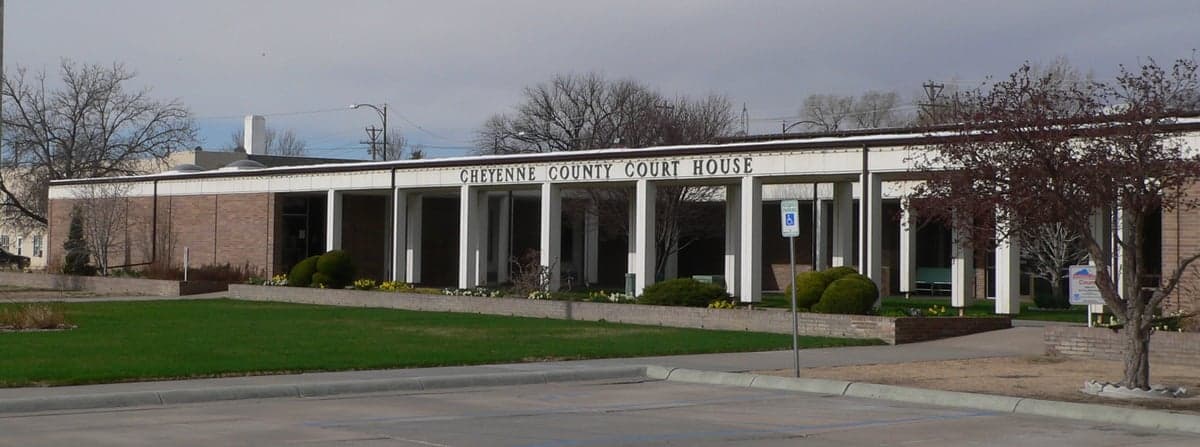
Photo: Wikipedia
Demographics of Cheyenne County
Affluence Level in Cheyenne County
A middle-class area roughly in line with national averages across income, home values, education, and employment.
People of Cheyenne County
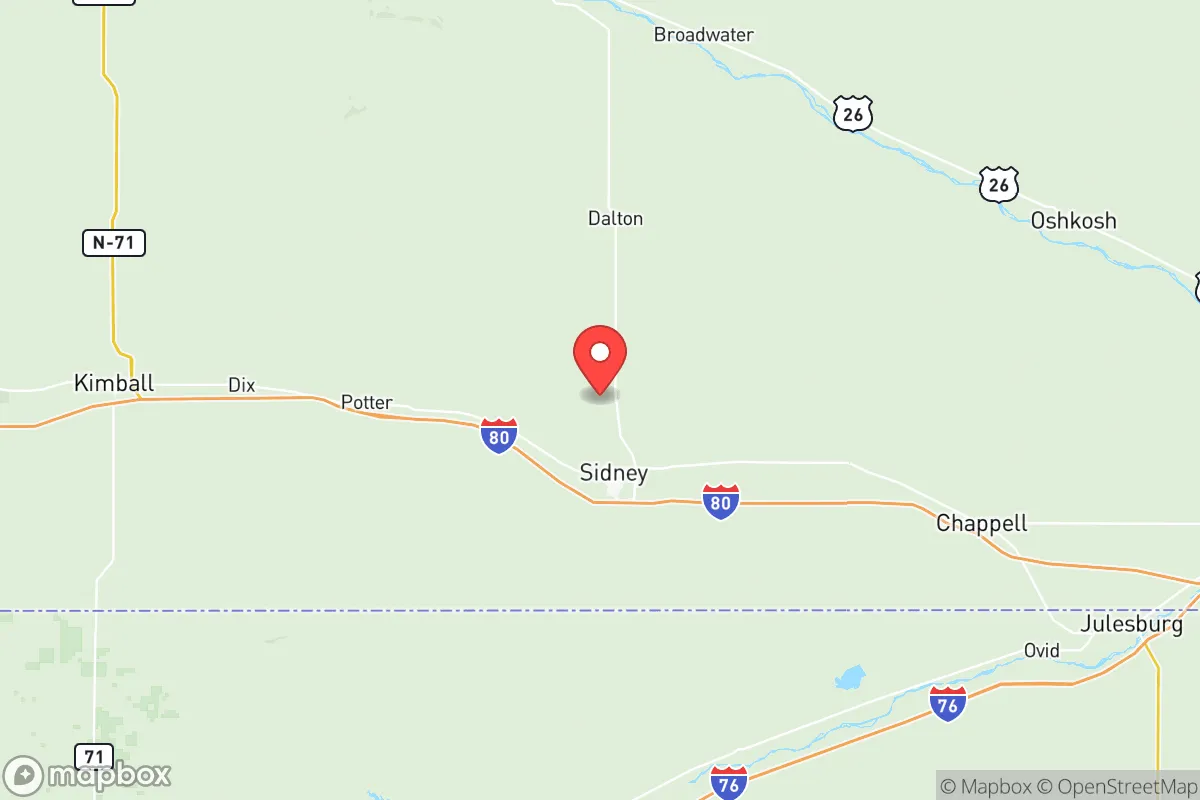
Today, Cheyenne County, Nebraska is home to roughly 9,478 residents, a population that is predominantly white (87.4%) with a growing Hispanic community (8.3%) and small but established Black (2.1%) and East/Southeast Asian (0.5%) populations. The county’s character is shaped by its agricultural and railroad heritage, with a low foreign-born rate of just 0.8% and a college-educated share of 22.1% reflecting its rural, working-class roots. Its people are concentrated in the county seat of Sidney, with smaller clusters in Potter, Gurley, and Lodgepole, and the overall identity leans conservative, self-reliant, and rooted in the land.
Settlement & growth (pre-1960)
Before Euro-American settlement, the area that is now Cheyenne County was part of the traditional territory of the Cheyenne and Lakota peoples, who followed bison herds across the High Plains. The region saw little permanent Native habitation due to its arid climate, but it served as a seasonal hunting ground and a corridor for trade and conflict. The first non-Native presence came with the Oregon Trail and later the Transcontinental Railroad, which brought surveyors and traders through the area in the 1840s and 1850s, though no permanent settlements took hold until after the 1862 Homestead Act.
The county was formally organized in 1871, and the arrival of the Union Pacific Railroad in 1867 was the decisive event that drew settlers. The railroad established Sidney as a division point and depot, and the town quickly became a hub for cattle shipping and supply. The first major wave of settlers were Anglo-American homesteaders from the Midwest and Upper South—primarily from Iowa, Illinois, and Missouri—who arrived in the 1870s and 1880s to claim 160-acre parcels under the Homestead Act. These families were largely of English, Scots-Irish, and German ancestry, and they established the county’s foundational agricultural economy, growing wheat and corn and raising cattle on the shortgrass prairie.
A secondary wave of German and Czech immigrants arrived in the 1880s and 1890s, drawn by railroad land grants and the promise of cheap farmland. Many of these families settled in the rural areas around Potter, Gurley, and Lodgepole, where they established small farming communities and Lutheran and Catholic churches that remain active today. The town of Potter, founded in 1886, became a center for German-speaking farmers, while Lodgepole, named for the nearby creek, attracted a mix of homesteaders and railroad workers. By 1900, the county’s population had reached roughly 5,000, and it remained stable through the early 20th century as agriculture intensified and the railroad continued to drive commerce.
The Dust Bowl of the 1930s hit Cheyenne County hard, causing many families to abandon their farms and move west to Colorado or California. The population declined from a peak of around 8,000 in 1930 to roughly 6,500 by 1940. Recovery came slowly, aided by the expansion of irrigation from the Ogallala Aquifer in the 1950s, which allowed for more reliable crop production and the growth of feedlot cattle operations. The post-World War II period also saw the construction of U.S. Highway 30 and later Interstate 80, which reinforced Sidney’s role as a transportation and service center. By 1960, the population had rebounded to about 7,500, still overwhelmingly white and native-born, with a strong agricultural and railroad employment base.
Modern era (post-1965)
The 1965 Hart-Cellar Act had a minimal direct impact on Cheyenne County, as the region did not attract the large-scale immigration seen in coastal or urban areas. The foreign-born population remains very low at 0.8%, and the county’s demographic shifts since 1965 have been driven primarily by domestic migration and natural change rather than international arrivals. The most significant change has been the growth of the Hispanic population, which rose from less than 2% in 1990 to 8.3% today, driven by Mexican-American families moving from Texas and the Southwest for work in agriculture, meatpacking, and construction.
Hispanic residents are concentrated in Sidney, where they work in the Cargill meatpacking plant and in local construction and service industries. The community is largely second- and third-generation Mexican-American, with a smaller number of newer arrivals from Central America. Sidney’s public schools have seen a notable increase in Hispanic enrollment, and Spanish-language services are increasingly available at local businesses and healthcare providers. The Black population, at 2.1%, is small but stable, with most families having roots in the post-World War II migration of African-American railroad workers and military personnel stationed at the now-closed Sidney Air Force Base, which operated from 1942 to 1968.
The East/Southeast Asian population, at 0.5%, is primarily composed of Vietnamese and Filipino families who arrived in the 1980s and 1990s, many drawn by job opportunities in the meatpacking and manufacturing sectors. The Indian-subcontinent population, at 0.2%, is very small and consists mainly of professionals working in healthcare and engineering at Sidney’s regional hospital and industrial firms. Domestic out-migration has been a persistent trend since the 1980s, as younger residents leave for college and urban jobs in Denver, Omaha, and Lincoln, contributing to an aging population profile. The county’s population peaked at around 10,000 in 1980 and has since declined slightly to 9,478, reflecting the broader rural depopulation of the Great Plains.
The future
Cheyenne County’s population is projected to remain stable or decline slightly over the next 10 to 20 years, with continued aging and out-migration of young adults. The Hispanic share is expected to grow gradually, potentially reaching 12-15% by 2040, as families already in the area have higher birth rates and as agricultural and industrial employers continue to recruit Latino workers. The white population will likely decline in absolute numbers, but the county will remain predominantly white and culturally conservative. New residential development is concentrated in Sidney, particularly on the south and east sides, where newer subdivisions are attracting retirees and a small number of remote workers drawn by lower housing costs and the area’s quiet, rural lifestyle.
The county’s cultural identity is evolving slowly, with increasing recognition of Hispanic heritage through events like Sidney’s annual Fiesta celebration, but the overall character remains rooted in its agricultural and railroad history. The low foreign-born rate and limited diversity mean that new residents, particularly those from outside the region, may find the social environment insular but welcoming to those who integrate into local institutions like churches, schools, and the volunteer fire department. The closure of the Cargill plant in 2023 was a significant economic blow, but the county is diversifying into logistics and renewable energy, with wind farms and a growing trucking industry providing new employment.
For someone moving in now, Cheyenne County offers a stable, affordable, and safe environment with a strong sense of community, but it is not a place of rapid demographic change or cultural dynamism. The population is slowly becoming more Hispanic, but the county will remain overwhelmingly white and native-born for the foreseeable future. The key question for prospective residents is whether they value the low cost of living, open spaces, and conservative social norms enough to accept limited economic opportunity and a long distance from major urban amenities. For those who do, Sidney, Potter, Gurley, and Lodgepole offer a genuine slice of High Plains life that has changed only gradually since the railroad first brought settlers here 150 years ago.

* Values derived from national, state, county, city and local statistics and may differ in a specific area. Last updated: 2026-07-02T15:29:05.000Z
Narrative content on this page is AI-generated and may contain mistakes. Verify any details that matter before acting on them.
ReloMaps may earn a commission from affiliate links at no extra cost to you.

