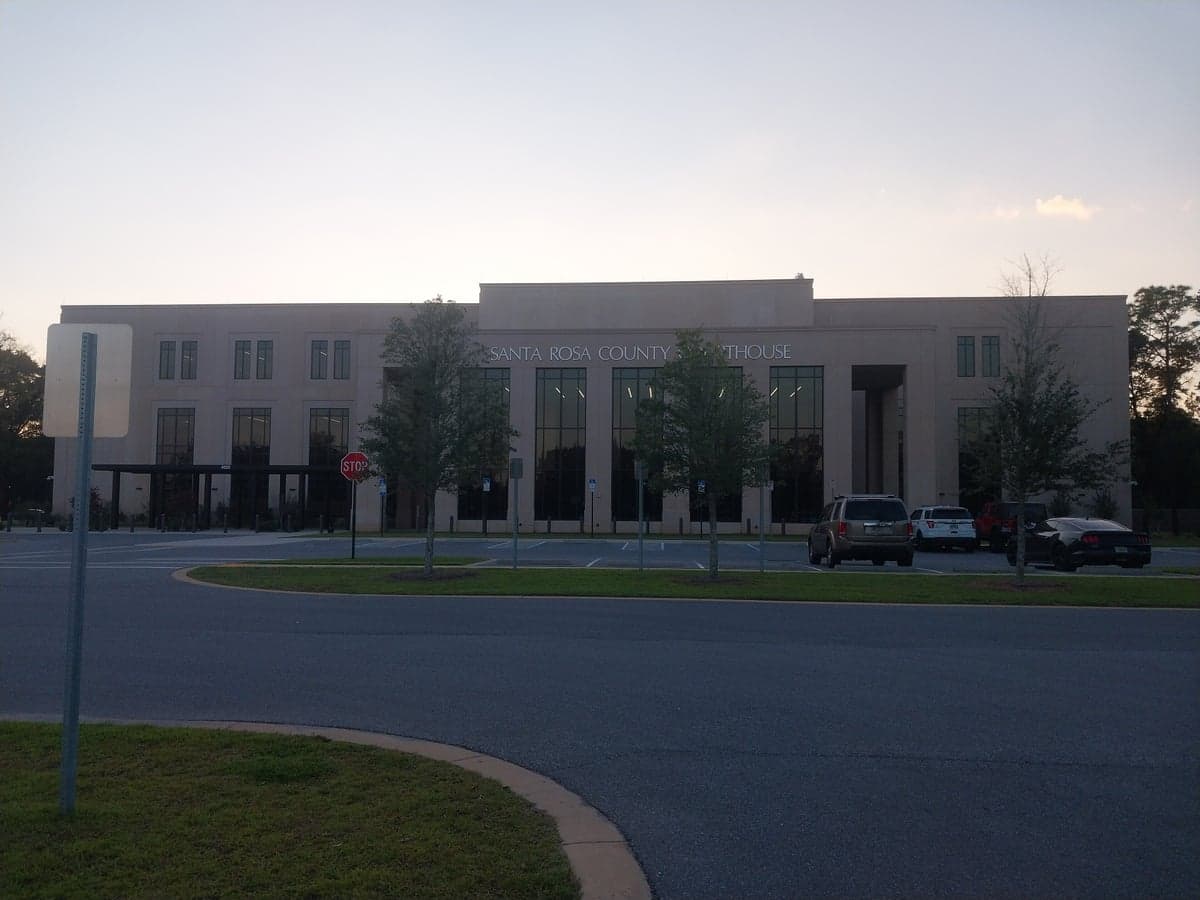
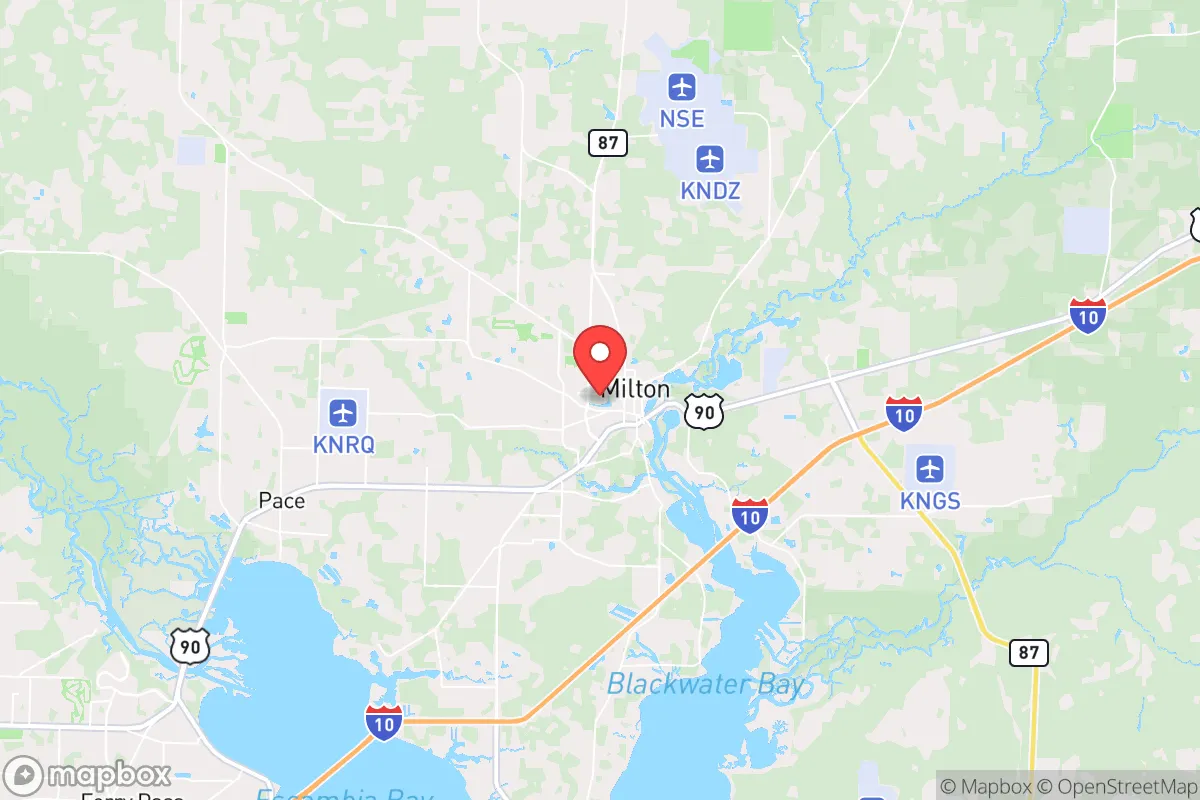
Photo: Wikipedia
Political ClimatePolitical Climate in Milton, FL
District shown is the primary district for this city’s centroid. Cities may span multiple districts.
Inherited from parent county — no local data available.
* Lean and PVI are calculated from Milton, FL’s own 2020 presidential results (precinct returns summed to the city), with 2024 estimated from the surrounding county’s 2020–2024 shift, Cook-style. Sources: state election offices; VEST 2020 precinct results (CC BY 4.0).
Political rankings in Florida
- Most Conservative Cities in Florida
- Most Liberal Cities in Florida
- Best Liberal-Leaning Towns in the South
- Safest Liberal-Leaning Towns in the South
- Safest Conservative-Leaning Towns in the South
- Safest Liberal-Leaning Towns on the East Coast
- Safest Conservative-Leaning Towns on the East Coast
- Affordable Small Towns for Conservatives
- Most Conservative Counties in Florida
- Most Liberal Counties in Florida
Local Political AnalysisPolitical Analysis of Milton, FL
Milton, Florida, is a deeply conservative community, and that’s not a recent development—it’s been the dominant political reality here for decades. The Cook Partisan Voting Index (PVI) of R+18 tells you the baseline: this area votes about 18 points more Republican than the national average. In practice, that means you can reliably expect Republican candidates to win by comfortable margins in most local, state, and federal races. The political trajectory here has been steady, not volatile. While some parts of the Florida Panhandle have seen demographic shifts from out-of-state migration, Milton has remained largely stable in its conservative lean, with no signs of a significant leftward drift. The surrounding Santa Rosa County is one of the most reliably Republican counties in the state, and Milton sits right in the middle of that reality.
How it compares
Comparing Milton to the rest of Florida is a study in contrasts. The state of Florida as a whole is a classic swing state—it’s purple, with a slight Republican lean in recent cycles, but it can flip depending on the election. Miami-Dade, Orange County (Orlando), and Broward County (Fort Lauderdale) are Democratic strongholds, while the Panhandle, including Milton, is the state’s most consistently red region. Even within the Panhandle, Milton stands out as more conservative than nearby Pensacola, which has a more moderate, military-influenced electorate and a small but visible liberal presence around the University of West Florida. Drive east to Tallahassee, and you’re in a blue island surrounded by red counties. Milton, by contrast, has no such counterbalance—it’s solidly conservative, with no major university or urban core to pull it left. The R+18 PVI is roughly comparable to places like rural North Florida or the Deep South, not the competitive suburbs of Tampa or Orlando.
What this means for residents
For conservative residents, Milton’s political climate is comfortable and affirming. Local government, school boards, and law enforcement tend to align with conservative values, and you’ll find that issues like gun rights, lower taxes, and limited regulation are mainstream positions. Churches and civic organizations often reflect this lean, and there’s a strong sense of community around shared values. For liberal residents, the reality is more nuanced. You won’t be ostracized, but you’ll be in a clear minority. Political discussions at work or social gatherings can feel one-sided, and finding like-minded people might require seeking out specific groups or online communities. That said, Milton is not a place where political differences lead to open hostility—it’s more of a quiet, everyday assumption that most people agree on the basics. The practical effect is that policy decisions—like zoning, school funding, and law enforcement priorities—tend to reflect conservative priorities, which can feel limiting if you’re on the other side of the aisle.
Culturally, Milton’s political lean is woven into daily life. You’ll see more “Don’t Tread on Me” flags than rainbow flags, and local events often have a patriotic, military-friendly tone, given the proximity to Whiting Field Naval Air Station and Eglin Air Force Base. The area’s policy distinctions from the rest of Florida are subtle but real: Santa Rosa County has been slower to adopt state-level trends like expanded Medicaid or certain environmental regulations, and local ordinances tend to favor property rights and minimal government intervention. Compared to a place like Miami or St. Petersburg, Milton feels like a different world politically—more rural, more traditional, and more insulated from the cultural battles that dominate state-level news. If you’re moving here, expect a community where political consensus is the norm, not the exception, and where the pace of change is slow and deliberate. That’s the Milton way, and it’s not likely to shift anytime soon.

State Political ClimatePolitical Climate in Florida
State Political AnalysisPolitical Environment in the State
Florida has transformed from a quintessential swing state into a solidly Republican-leaning powerhouse over the past decade, driven by a massive influx of conservative-leaning migrants from the Northeast and Midwest. The state’s overall partisan lean now sits roughly R+3 to R+5 in statewide races, a stark shift from the 2000 and 2008 cycles when it was a true toss-up. This rightward trajectory accelerated sharply after 2020, fueled by Governor Ron DeSantis’s aggressive policy agenda and a realignment of Hispanic voters, particularly in Miami-Dade County, which flipped from blue to red in the 2022 gubernatorial election.
Urban vs. rural divide
The political map of Florida is a study in stark contrasts. The major urban centers—Miami, Fort Lauderdale, Orlando, Tampa, and Jacksonville—still lean Democratic, but their margins have shrunk dramatically. Miami-Dade, once a Democratic stronghold, voted for DeSantis by 11 points in 2022, a seismic shift driven by Cuban-American and Venezuelan voters who prioritize anti-socialism rhetoric and economic freedom. Meanwhile, the sprawling suburbs of Tampa (Hillsborough County) and Orlando (Orange County) remain competitive but are trending right, especially in fast-growing exurbs like Lakeland and Clermont. Rural North Florida—places like Panama City, Lake City, and the Panhandle—is deeply Republican, with margins often exceeding 30 points. The I-4 corridor, stretching from Tampa to Daytona Beach, remains the state’s most contested battleground, but even here, the GOP has made steady gains. The Florida Keys (Monroe County) are a unique outlier, leaning libertarian-leaning Republican but with strong environmentalist streaks.
Policy environment
Florida’s policy environment is defined by a low-tax, low-regulation posture that appeals to conservative relocators. There is no state income tax, a major draw for high-earners and retirees. Property taxes are moderate, with a $50,000 homestead exemption and a 3% annual cap on assessed value increases (Save Our Homes). The regulatory climate is business-friendly, with minimal zoning restrictions in most areas and a right-to-work law that weakens union influence. Education policy has been a flashpoint: the state leads in school choice, with over 1.3 million students using vouchers or tax-credit scholarships, and it has banned critical race theory and DEI programs in public schools. Healthcare is a mixed bag—Florida did not expand Medicaid under the ACA, leaving roughly 800,000 uninsured, but it has a robust private insurance market. Election laws have tightened significantly: the 2021 SB 90 law added voter ID requirements, limited drop boxes, and restricted third-party ballot collection, while the 2023 SB 7050 further restricted voter registration drives. Gun laws are permissive: permitless carry (constitutional carry) was enacted in 2023, and the state has a “stand your ground” law with no duty to retreat.
Recent policy direction
The last three years have seen a cascade of legislation that signals a clear rightward shift. On guns, the 2023 permitless carry law (HB 543) allows any adult legally able to own a firearm to carry it concealed without a permit, though open carry remains restricted. On education, the 2022 Parental Rights in Education Act (HB 1557, dubbed “Don’t Say Gay” by critics) bans classroom instruction on sexual orientation and gender identity through third grade, later expanded to all grades. The 2023 Stop WOKE Act (HB 7) restricts workplace and school training on race and gender. On speech, the state has targeted social media platforms with SB 7072, which bars de-platforming political candidates. On privacy and surveillance, Florida has no comprehensive data privacy law, but it does ban local governments from creating surveillance programs like license plate readers without state approval. On medical and bodily autonomy, the state enacted a 6-week abortion ban (HB 5) in 2023, with no exceptions for rape or incest, though a 2024 ballot initiative (Amendment 4) to restore access failed to reach the 60% threshold. Property rights are strongly protected: the 2021 SB 112 limits local governments’ ability to impose rent control, and the 2023 Live Local Act preempts local zoning to allow affordable housing development. Voting access has been tightened, but early voting and mail-in voting remain widely available.
Civil unrest & political movements
Florida has seen its share of political flashpoints. The 2020 Black Lives Matter protests in Miami, Orlando, and Jacksonville were large but largely peaceful, though they led to local curfews. The state has been a national epicenter of the school board wars, with conservative parents’ groups like Moms for Liberty (founded in Brevard County) successfully flipping multiple school boards in 2022 and 2023. Immigration politics are hot: Governor DeSantis’s 2023 SB 1718 requires hospitals to ask patients about immigration status and bans local governments from issuing ID cards to undocumented immigrants, while also funding the transport of migrants to sanctuary cities like Martha’s Vineyard. There is no sanctuary city movement in Florida—state law preempts any local “sanctuary” policies. Election integrity remains a live issue: the 2020 recount in Broward and Palm Beach counties sparked ongoing litigation, and the state’s new Office of Election Crimes and Security has prosecuted several cases of double voting. Secession or nullification rhetoric is minimal, though some Panhandle counties have floated secession from Florida to form the “State of West Florida” over cultural differences with South Florida.
Projection
Over the next 5-10 years, Florida is likely to become even more Republican, driven by two powerful demographic forces. First, the continued influx of conservative-leaning migrants from New York, New Jersey, and California—about 1,000 people move to Florida per day—will deepen the GOP base, especially in fast-growing suburbs like The Villages, Naples, and St. Augustine. Second, the Hispanic realignment, particularly among Cuban-Americans in Miami-Dade and Puerto Ricans in Central Florida, shows no signs of reversing. However, there are countercurrents: the growing population of young, diverse renters in downtown Miami and Orlando could shift those areas leftward, and the 2024 ballot initiative on abortion access (which failed but got 57% support) suggests the state is not uniformly conservative on social issues. Climate change and rising insurance costs may also slow migration from the Northeast, potentially dampening the GOP’s growth. A new resident moving in now should expect a state where Republican dominance is the baseline, but where local politics vary wildly—from deep-red Panhandle counties to purple suburbs to blue urban cores.
For a new resident, the bottom line is this: Florida offers a policy environment that strongly favors conservative priorities—low taxes, school choice, gun rights, and limited regulation—while still providing a vibrant, diverse cultural landscape. Liberal residents will find themselves in a minority in most of the state, but they’ll have strongholds in Miami Beach, Key West, and parts of Orlando and Tampa. The practical takeaway is to choose your location carefully: if you want a red community, look at Naples, The Villages, or the Panhandle; if you want a purple or blue enclave, stick to the urban cores or the Keys. Either way, the state’s trajectory is clear—Florida is solidifying as a conservative powerhouse, and that’s unlikely to change anytime soon.
* Values derived from national, state, county, city and local statistics and may differ in a specific area. Last updated: 2026-11-08T01:59:48.000Z
Narrative content on this page is AI-generated and may contain mistakes. Verify any details that matter before acting on them.
ReloMaps may earn a commission from affiliate links at no extra cost to you.

