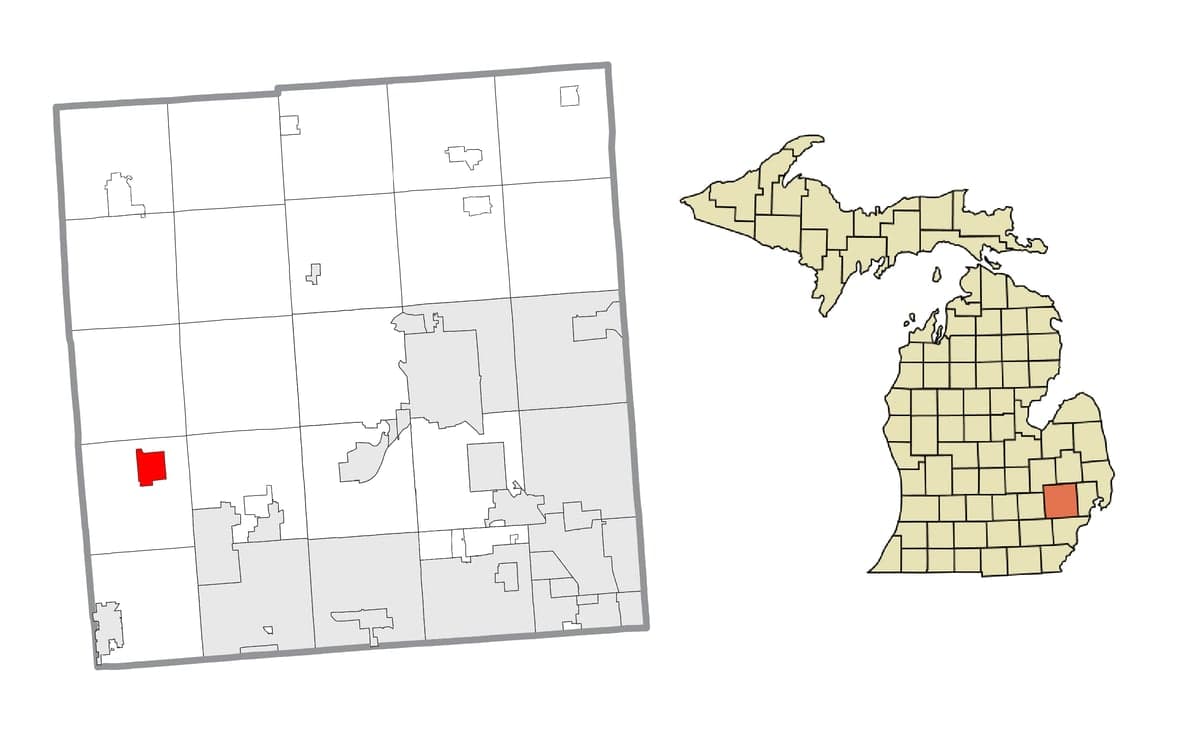
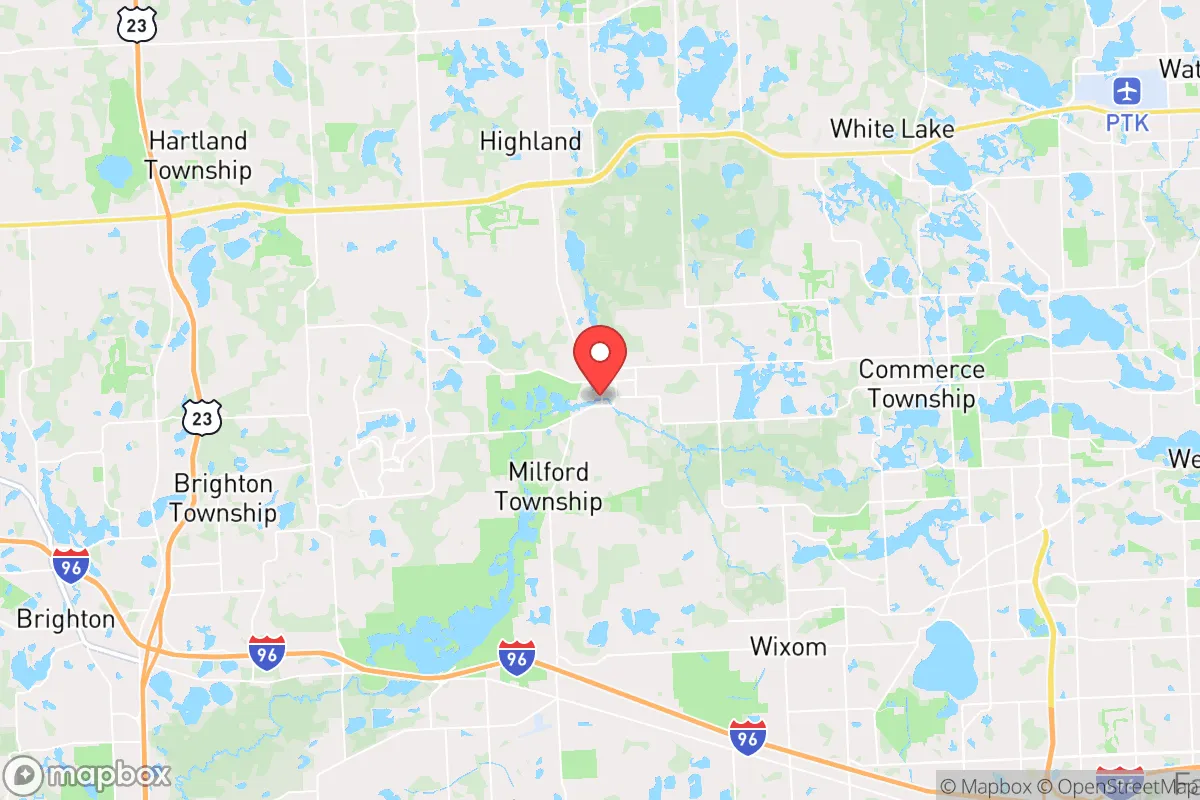
Photo: Wikipedia
Political ClimatePolitical Climate in Milford, MI
District shown is the primary district for this city’s centroid. Cities may span multiple districts.
Local Political AnalysisPolitical Analysis of Milford, MI
Milford, Michigan, leans heavily Republican, with a Cook PVI of R+16, making it one of the more conservative pockets in a state that is politically evenly split (Cook PVI EVEN). This isn't a new development—the area has been reliably red for decades, but the intensity has shifted. Back in the '90s and early 2000s, you'd get a mix of Reagan Democrats and moderate Republicans; now, the local precincts consistently deliver 60-65% of the vote for GOP candidates in presidential and statewide races. The trajectory is stable, not swinging—Milford isn't flipping blue anytime soon, but it's also not getting dramatically redder. The real story is how this deep-red suburb sits just 15 miles from Ann Arbor (a solidly blue college town) and 10 miles from Novi (a more purple, affluent suburb), creating a sharp political contrast that shapes local conversations.
How it compares
Compared to Michigan as a whole, Milford is a political outlier. The state's EVEN rating reflects a near-perfect 50-50 split, driven by Detroit, Grand Rapids, and the suburban ring around Detroit. Milford, however, sits in Oakland County's western edge, where the rural and exurban character dominates. Neighboring towns like Walled Lake and Commerce Township lean Republican but less heavily (R+8 to R+10), while Brighton to the west is even more conservative (R+18). The contrast is starkest with Ann Arbor, where Democrats routinely win by 40+ points. For residents, this means local elections are often decided in the Republican primary, and the township board, school board, and county commission seats are almost entirely held by Republicans. Statewide races, however, are competitive—Milford's votes matter, but they're part of a larger, more balanced electorate.
What this means for residents
For conservative residents, Milford feels like a safe space where their values are the norm. Local government tends to favor low taxes, limited regulation, and a pro-business stance. The township has resisted high-density development and kept zoning strict, which aligns with the "keep it rural" sentiment. For liberal residents, it can feel isolating—there's no real progressive organizing, and local Democratic candidates often struggle to find volunteers. But it's not hostile; most folks are polite, and you'll find a few "In This House We Believe" signs mixed in with the Trump flags. The practical effect is that policy debates are muted—there's little pushback on things like school funding or road repairs, but hot-button cultural issues rarely surface at township meetings. The biggest tension is over growth: conservatives want to preserve the small-town feel, while some newer residents (often from more liberal areas) push for more amenities and diversity.
One cultural distinction worth noting: Milford's political identity is tied to its history as a mill town and later a bedroom community for Detroit's auto industry. The local paper, the Milford Times, still runs letters to the editor about property taxes and deer management, not national politics. The annual Milford Memories festival draws everyone, regardless of party, and the local diners are where you'll hear more talk about the high school football team than the latest Supreme Court ruling. That said, the 2020 election saw a noticeable uptick in yard sign intensity, and the 2024 cycle brought more door-knocking from both sides. Looking ahead, as Detroit's exurban sprawl continues creeping west, Milford may see a slow demographic shift—but for now, it remains a reliably conservative enclave where the political reality is straightforward: you know where your neighbors stand, and that's just fine with most of them.

State Political ClimatePolitical Climate in Michigan
State Political AnalysisPolitical Environment in the State
Michigan is the ultimate swing state, with a Cook PVI of EVEN that perfectly captures its knife-edge balance between the two major parties. Over the last 10-20 years, the state has shifted from a reliably blue stronghold in presidential races (voting for Democrats from 1992 to 2012) to a true battleground that flipped to Donald Trump in 2016 by just 10,704 votes, then flipped back to Joe Biden in 2020 by 154,000 votes. The dominant coalitions are a shrinking union-and-auto-worker base in the southeast (Wayne County, Macomb County) versus a growing, increasingly conservative exurban and rural vote across the Lower Peninsula’s “Thumb” and the entire Upper Peninsula. The trajectory is a slow, grinding rightward shift in the exurbs and rural areas, offset by Democratic consolidation in the core cities and a new wave of college-educated suburban voters in places like Oakland County and Kent County (Grand Rapids).
Urban vs. rural divide
The political map of Michigan is a story of three distinct regions. Wayne County (Detroit) and Washtenaw County (Ann Arbor) are the Democratic engine, delivering massive margins — Biden won Wayne by 330,000 votes and Washtenaw by 100,000. These are the only places in the state where Democrats can run up the score. The “blue wall” suburbs of Oakland County (Bloomfield Hills, Royal Oak, Ferndale) have shifted sharply left since 2016, driven by college-educated professionals repelled by Trumpism. Meanwhile, Macomb County (Warren, Sterling Heights) — the iconic Reagan Democrat stronghold — has become a pure swing county, flipping from Obama to Trump to Biden by narrow margins. The rural Lower Peninsula (counties like Lapeer, Sanilac, Huron, and the entire northern Lower Peninsula) votes 65-70% Republican, while the Upper Peninsula (Marquette, Houghton) has shifted from blue to red over the past decade, with Trump winning it by 10 points in 2020. The Grand Rapids metro (Kent County) is the most interesting battleground: once a GOP stronghold, it’s now a purple county where the city of Grand Rapids votes blue and the outer townships (Ada, Caledonia) vote deep red.
Policy environment
Michigan’s policy environment is a patchwork of competing priorities. Taxes are moderate: a flat 4.25% individual income tax (down from 4.35% in 2023 via automatic trigger), a 6% sales tax, and property taxes that average about 1.5% of market value, though they vary wildly by school district. Regulatory posture is mixed — the state has a right-to-work law (repealed in 2023 for private-sector workers, but still in effect for public employees via a 2024 court ruling), and it’s a “shall-issue” state for concealed carry permits with no permit required for open carry. Education policy is a flashpoint: Michigan has a universal school choice system (charter schools, inter-district open enrollment), but the state’s per-pupil funding formula has been a source of constant litigation. Healthcare is dominated by the expansion of Medicaid under the Affordable Care Act (Healthy Michigan Plan), which covers about 1.2 million residents. Election laws are relatively accessible: no-excuse absentee voting was approved by voters in 2018 via Proposal 3, and same-day voter registration is available. The state has an independent redistricting commission (created by voters in 2018) that drew the current legislative maps, which are widely considered fair.
Recent policy direction
The last two years have seen a dramatic shift under Democratic Governor Gretchen Whitmer and a Democratic-controlled legislature (2023-2024). Gun and self-defense law: In 2023, the legislature passed universal background checks and a “red flag” law (extreme risk protection orders), and in 2024, they banned open carry of firearms at polling places and the state capitol. Parental and education rights: The state repealed its 1990s-era ban on discussing LGBTQ+ issues in schools (the “No Promo Homo” law) and expanded LGBTQ+ anti-discrimination protections in the Elliott-Larsen Civil Rights Act. Speech and privacy: No major changes, though the state has a strong shield law for journalists. Medical and bodily autonomy: In 2023, the legislature repealed a 1931 law banning abortion (which had been blocked by court order since 2022) and passed a law protecting abortion providers from out-of-state lawsuits. Property rights: The state has a strong “takings” clause in its constitution, but no major changes. Taxation: The 2023 budget included a temporary income tax cut (from 4.25% to 4.05% for 2023 only) and a permanent expansion of the Earned Income Tax Credit. Voting and ballot access: In 2022, voters passed Proposal 2, which established nine days of early voting, drop boxes, and automatic voter registration. For a conservative relocator, the key takeaway is that Michigan has moved left on guns, abortion, and LGBTQ+ rights in the last two years, but remains a relatively low-tax state with strong school choice and a fair election system.
Civil unrest & political movements
Michigan has been a national flashpoint for political activism. The “Wolverine Watchmen” plot to kidnap Governor Whitmer in 2020 (foiled by the FBI) exposed a militant anti-government strain in the state’s rural areas. The 2020 election integrity controversy was intense: Trump’s campaign filed lawsuits in Michigan alleging fraud, and the state’s GOP-led legislature held hearings on election irregularities, though no evidence of widespread fraud was found. The “Operation Gridlock” protests at the state capitol in 2020 (where armed protesters entered the building) were a national symbol of pandemic-era unrest. Immigration politics are less heated than in border states, but the city of Detroit is a “sanctuary city” (limited cooperation with ICE), and the state has a 2017 law prohibiting local police from asking about immigration status. Secession/nullification rhetoric is minimal, though the Upper Peninsula has a small “UP secession” movement (mostly symbolic). The “Right to Life” movement remains strong in rural areas, with annual marches at the capitol. A new resident would notice the stark contrast between the progressive activism in Ann Arbor and Grand Rapids (Black Lives Matter, climate protests) and the conservative activism in the Thumb and UP (Second Amendment rallies, anti-vaccine mandates).
Projection
Over the next 5-10 years, Michigan is likely to remain a swing state, but the demographic trends favor a slight rightward shift. In-migration is modest — the state’s population grew by only 0.2% from 2020 to 2024, with most new arrivals coming from Illinois and Ohio, and they tend to be older and more conservative. The suburbanization of the Grand Rapids area (Kent, Ottawa counties) is pulling the state’s center of gravity west, while the continued decline of Detroit’s population (down 7% since 2020) weakens the Democratic base. The Upper Peninsula is becoming more Republican as younger residents leave and retirees from downstate move in. The college-educated suburbs of Oakland County are likely to stay blue, but the exurban ring around Detroit (Livingston, St. Clair counties) is growing fast and voting 65%+ Republican. The wild card is the 2024 presidential election: if Trump wins Michigan again, it will accelerate the GOP’s rural/exurban consolidation; if Biden wins, Democrats will try to lock in their suburban gains. Either way, expect the state to remain a toss-up for at least another decade, with the balance of power determined by turnout in Macomb County and the Grand Rapids suburbs.
For a new resident, the bottom line is that Michigan offers a genuinely competitive political environment where your vote actually matters. If you’re conservative, you’ll find strong communities in the exurbs (Caledonia, Fenton, Traverse City) and rural areas (Houghton Lake, Alpena), but you’ll need to accept that the state government will likely be controlled by Democrats for the near future. If you’re liberal, you’ll feel at home in Ann Arbor, Royal Oak, or Grand Rapids’ Eastown, but you’ll be living in a state where the legislature is often split and the governor’s race is always a toss-up. The practical takeaway: Michigan is not a place where you can take your politics for granted — it’s a state where both sides have to show up, and where the outcome of every election feels genuinely uncertain.
* Values derived from national, state, county, city and local statistics and may differ in a specific area. Last updated: 2026-10-05T03:56:56.000Z
Narrative content on this page is AI-generated and may contain mistakes. Verify any details that matter before acting on them.
ReloMaps may earn a commission from affiliate links at no extra cost to you.

