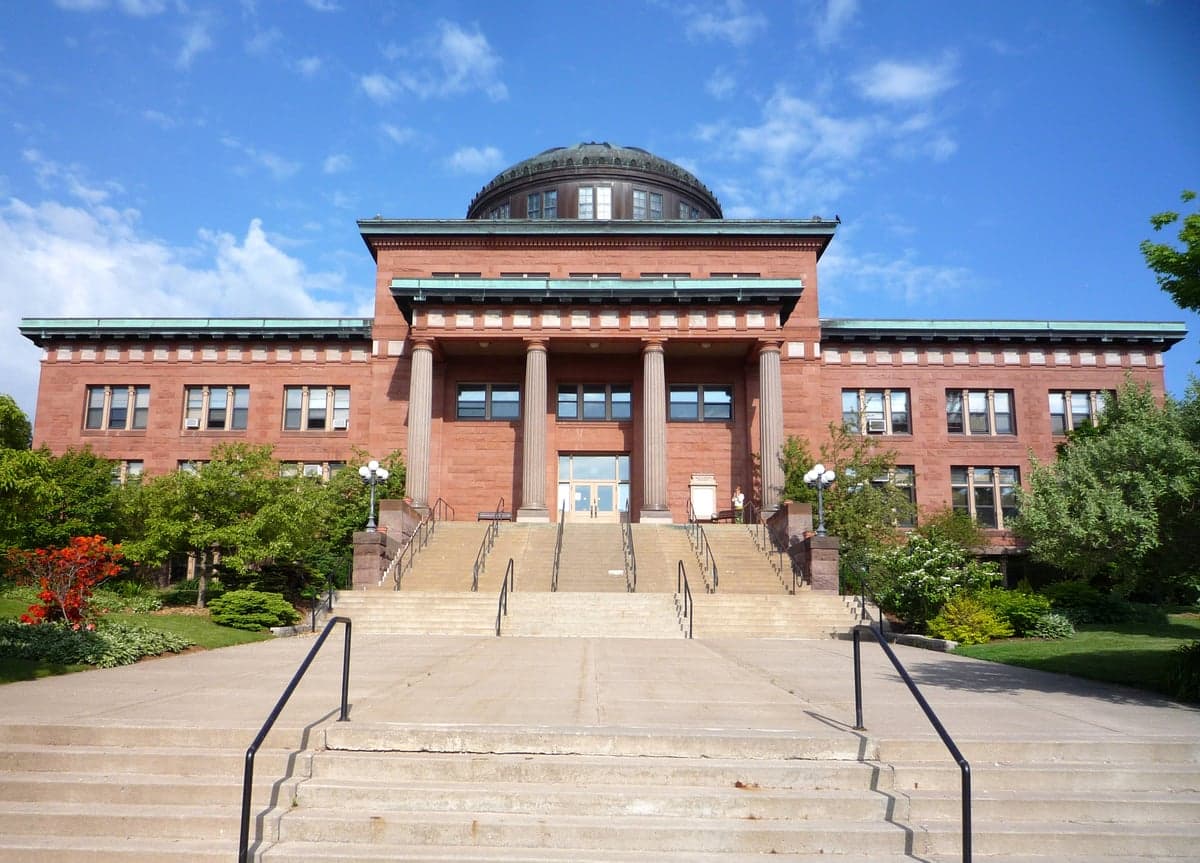
Photo: Wikipedia
Political ClimatePolitical Climate in Marquette County
Showing district-level results — no local-only data available.
Local Political AnalysisPolitical Analysis of Marquette County
Marquette County is a reliably Republican stronghold in Michigan’s Upper Peninsula, with a Cook Partisan Voting Index (PVI) of R+11, meaning it votes about 11 points more Republican than the national average. This stands in stark contrast to the state of Michigan as a whole, which has a Cook PVI of EVEN, reflecting its status as a perennial swing state. The county has held this conservative lean for decades, though the margin has tightened slightly in recent presidential cycles as the city of Marquette itself has grown more Democratic.
How it compares
Michigan’s statewide PVI of EVEN means the state is a pure battleground, flipping between parties in close elections. Marquette County, by contrast, is a solid red anchor in the Upper Peninsula. The difference is most visible in presidential races: while Michigan as a whole went for Joe Biden by 2.8 points in 2020, Marquette County voted for Donald Trump by about 12 points. The county’s Republican lean is driven by its rural and small-town character, but it’s not monolithic. The city of Marquette, home to Northern Michigan University and a growing arts scene, consistently votes blue—often by 15–20 points in local races. Meanwhile, the towns of Ishpeming and Negaunee are more mixed, with precincts that can swing either way depending on the candidate and turnout. Outlying towns like Gwinn and Harvey lean heavily Republican, often by 20 points or more. This urban-rural split mirrors the state’s own divide, but on a smaller scale.
What this means for residents
For conservative residents, Marquette County feels like a safe haven in a state that often tilts left. Local offices—county commission, sheriff, and most township boards—are reliably held by Republicans, and policy debates tend to focus on mining, logging, and Second Amendment rights. For liberal residents, especially in the city of Marquette, the county’s red lean can feel isolating, but it also means their votes carry more weight in local primaries. The real tension isn’t between parties but between the city and the countryside: debates over land use, mining permits, and school funding often split along geographic lines. In practice, most residents describe the political climate as civil but passionate, with local issues like the future of the Empire Mine and the expansion of the county’s trail system drawing more attention than national politics.
Culturally, Marquette County stands apart from the rest of Michigan in its fierce independence. The Upper Peninsula’s “Yooper” identity—rooted in mining, hunting, and a strong work ethic—transcends party labels. You’ll find as many Democrats who own guns and snowmobiles as Republicans who support public land access. The county’s policy distinctions are subtle but real: it’s one of the few places in Michigan where local officials openly push back against state-level environmental regulations, and where the county commission has formally opposed wolf reintroduction. At the same time, the city of Marquette has embraced renewable energy and bike-friendly infrastructure, creating a patchwork of priorities that keeps local politics interesting. For newcomers, the key takeaway is that Marquette County is red, but not in a way that feels hostile to blue-leaning residents—it’s more like a place where everyone agrees on the basics (good schools, safe streets, clean lakes) and argues about the details.

State Political ClimatePolitical Climate in Michigan
State Political AnalysisPolitical Environment in the State
Michigan is the ultimate swing state, carrying a Cook PVI of EVEN, meaning it’s a perfect 50-50 toss-up in presidential elections. Over the last 20 years, the state has shifted from a reliably blue stronghold in the auto-industrial era to a fiercely competitive battleground, with Donald Trump flipping it in 2016 by just 10,704 votes, Joe Biden reclaiming it in 2020 by 154,000, and the 2024 race again razor-thin. The dominant coalitions are a three-way split: the heavily unionized, diverse urban core of Detroit and its inner suburbs; the growing, educated, and increasingly liberal suburbs of Grand Rapids and Ann Arbor; and the vast, rural, and deeply conservative “Up North” and Thumb regions. This isn’t a state that’s drifting left or right in a straight line—it’s a state that’s polarizing, with each side digging in deeper.
Urban vs. rural divide
The political map of Michigan is a story of three distinct Michigans. Wayne County (Detroit) alone delivers about 30% of the state’s Democratic votes, with a heavily Black and unionized electorate that reliably turns out for Democrats. The city itself is a Democratic fortress, but the inner-ring suburbs like Dearborn (home to a large Arab-American population) and Southfield are also solidly blue. The second Michigan is the “West Michigan” corridor anchored by Grand Rapids and Holland. Historically a conservative Dutch Reformed stronghold, Grand Rapids’ Kent County has flipped from red to purple to blue in the last decade, driven by an influx of young professionals and a growing Hispanic population. The third Michigan is everything else: the rural Upper Peninsula, the northern Lower Peninsula (traverse City is a blue island in a red sea), and the Thumb region. Counties like Oscoda and Alcona in the northeast vote 70%+ Republican, while Macomb County (north of Detroit) is the ultimate bellwether—a working-class, white, union-heavy area that swung hard for Trump in 2016 and has stayed competitive. The divide isn’t just urban vs. rural; it’s also suburban vs. exurban, with places like Rochester Hills and Novi trending left while outer-ring towns like Romeo and Armada stay red.
Policy environment
Michigan’s policy environment is a patchwork that reflects its split identity. The state has a flat income tax rate of 4.25%, which is moderate by national standards, but local property taxes can be high—especially in affluent suburbs like Birmingham or Ann Arbor, where millage rates for schools and services push effective rates above 2%. Sales tax is 6%, with no tax on groceries or prescription drugs. The regulatory posture is mixed: Michigan is a “right-to-work” state (law passed in 2012, repealed in 2023 by Democrats), meaning unions are strong in the auto and public sectors but weaker in newer industries. Education policy is a flashpoint: the state has a robust charter school system (one of the most permissive in the Midwest) and a school choice program, but Detroit’s public schools remain in receivership and underfunded. Healthcare is dominated by the Big Three insurers (Blue Cross, Priority Health, McLaren), and the state expanded Medicaid under the Affordable Care Act in 2013. Election laws are relatively open: no-excuse absentee voting was approved by voters in 2018, and same-day voter registration is available. For a conservative relocator, the tax burden is manageable, but the regulatory environment—especially around environmental rules for the Great Lakes and auto emissions—can be stricter than in neighboring Indiana or Ohio.
Recent policy direction
The last two years have seen a dramatic shift under Democratic Governor Gretchen Whitmer and a Democratic-controlled legislature (2023-2024). Gun laws tightened significantly: the state passed universal background checks, safe storage requirements, and a “red flag” law (extreme risk protection orders) in 2023, all opposed by the NRA. Parental and education rights saw a major win for conservatives with the passage of a “Parents’ Bill of Rights” in 2024, requiring schools to notify parents of curriculum changes and allowing them to opt kids out of sex ed. Abortion rights were enshrined in the state constitution via Proposal 3 in 2022, making Michigan one of the most protective states in the Midwest—no waiting periods, no mandatory ultrasounds, and public funding allowed. Property rights are generally strong, with no statewide rent control and a relatively straightforward eminent domain process, though environmental regulations on shoreline development (especially around the Great Lakes) can be onerous. Voting and ballot access expanded: the 2022 ballot initiative (Proposal 2) established nine days of early voting, drop boxes, and automatic voter registration. For a conservative, the recent direction is a mixed bag: gun rights took a hit, but parental rights and school choice got a boost. The state’s privacy and surveillance posture is average—no statewide ban on facial recognition, but local police departments (like Detroit’s) have been sued over its use.
Civil unrest & political movements
Michigan has been a flashpoint for political movements on both sides. The 2020 election integrity controversy was intense: Trump’s “Stop the Steal” rallies drew thousands to the state capitol in Lansing, and the “Wolverine Watchmen” militia group was charged in a plot to kidnap Governor Whitmer. That event still resonates—many rural conservatives view Whitmer’s COVID lockdowns (which were among the strictest in the nation) as authoritarian overreach, while urban liberals see the militia plot as domestic terrorism. Immigration politics are relatively quiet compared to border states, but the city of Detroit is a “sanctuary city” (policy since 2017), and Washtenaw County (Ann Arbor) has similar policies. The “Upper Peninsula secession” movement is a perennial fringe idea, with some residents feeling ignored by Lansing, but it has no real traction. Protest history is robust: the 2020 George Floyd protests in Detroit and Grand Rapids saw significant property damage, and the 2023 pro-Palestinian protests at the University of Michigan (Dearborn and Ann Arbor) were large and ongoing. A new resident would notice the stark cultural divide: drive 20 miles outside any major city, and you’ll see Trump flags and “Fuck Biden” signs; drive into Ann Arbor, and you’ll see “In This House We Believe” yard signs. It’s a state that wears its politics on its sleeve.
Projection
Over the next 5-10 years, Michigan is likely to remain a toss-up, but the demographic trends favor Democrats slightly. The Grand Rapids metro is growing fast (Kent County added 50,000 people between 2010 and 2020), and it’s trending blue as young professionals and immigrants move in. The Detroit exurbs (like Macomb County) are aging and losing population, which could weaken the GOP’s base. However, the rural areas are not shrinking as fast as in other states, and the “Up North” retirement corridor (from Traverse City to Petoskey) is attracting conservative-leaning retirees from Ohio and Indiana. The wildcard is the auto industry transition to EVs: if the state loses manufacturing jobs to the Sun Belt, the working-class vote could swing even harder to the GOP. For a new resident, expect the policy pendulum to keep swinging: a Republican governor in 2026 could repeal the red flag law and cut taxes, while a Democratic trifecta could push a carbon-free energy mandate. The state’s in-migration is modest (net positive from Illinois and California, but negative to Florida and Texas), so the political culture will evolve slowly.
For a conservative relocator, Michigan offers a manageable tax burden and a strong school choice system, but you’ll need to accept that the state’s major cities and college towns are deeply liberal. If you’re moving to Grand Rapids or Traverse City, you’ll find a mix of conservative and liberal neighbors; if you’re moving to Detroit or Ann Arbor, you’ll be in a blue bubble. The bottom line: Michigan is not a red state or a blue state—it’s a battlefield. You’ll have to engage in local politics if you want your voice heard, because every election is a knife fight. The schools are good in the suburbs, the outdoor recreation is world-class, and the cost of living is reasonable, but the political climate is as unpredictable as the weather. Come for the lakes, stay for the fight.
* Values derived from national, state, county, city and local statistics and may differ in a specific area. Last updated: 2026-07-24T06:01:11.000Z
Narrative content on this page is AI-generated and may contain mistakes. Verify any details that matter before acting on them.
ReloMaps may earn a commission from affiliate links at no extra cost to you.

