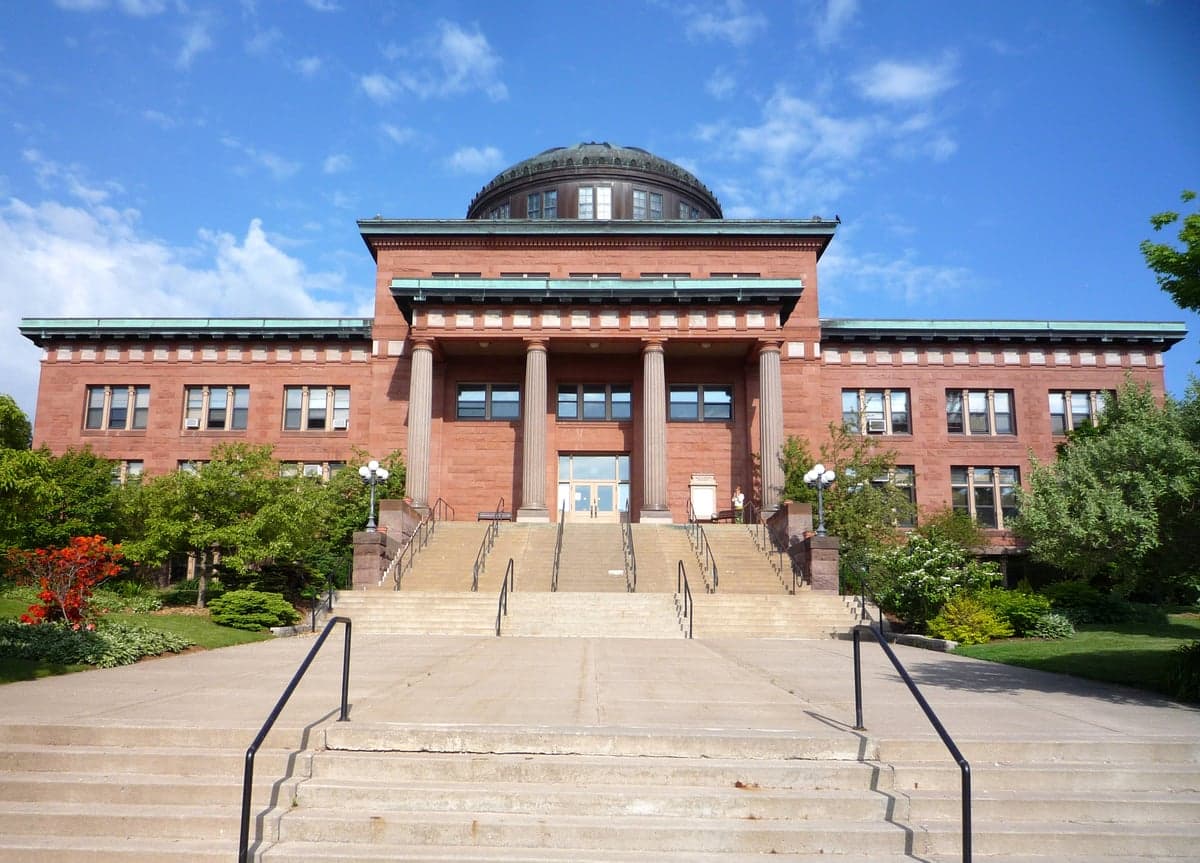
Photo: Wikipedia
Demographics of Marquette County
Affluence Level in Marquette County
A middle-class area roughly in line with national averages across income, home values, education, and employment.
People of Marquette County
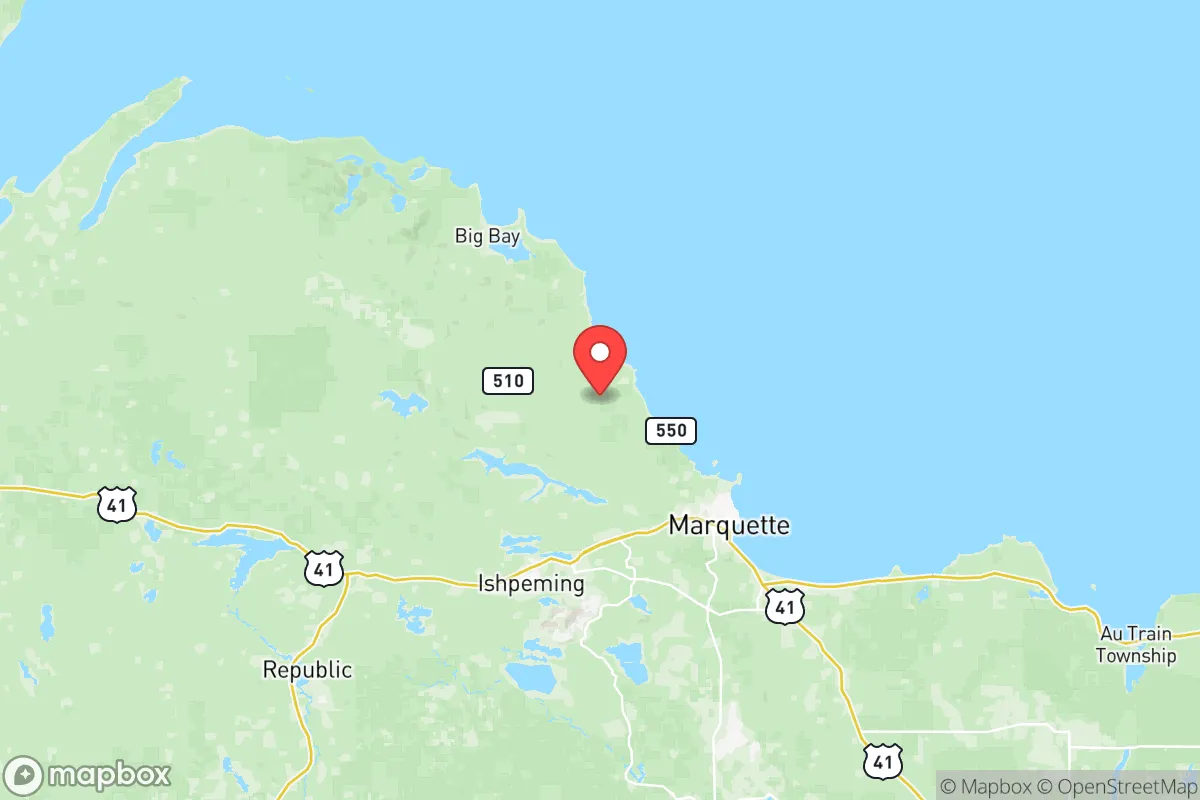
Marquette County’s 66,430 residents form the most populous county in Michigan’s Upper Peninsula, yet the population is notably homogeneous: 90.9% white, with a foreign-born share of just 0.7% — among the lowest in the state. The county’s identity is shaped by a deep-rooted Finnish, Italian, and Cornish mining heritage, a strong outdoor-recreation culture, and a slow but steady diversification driven by the presence of Northern Michigan University in Marquette. Despite its remote location, the county has a college-educated rate of 35.8%, well above the national average, reflecting a population that is both blue-collar and academically inclined.
Settlement & growth (pre-1960)
Long before European arrival, the area now known as Marquette County was home to the Ojibwe (Chippewa) people, who lived in seasonal villages along the Lake Superior shoreline and the inland rivers, particularly near what is now the city of Marquette and the Keweenaw Bay. The Ojibwe ceded the land in the 1842 Treaty of La Pointe, opening the region to American settlement. French-Canadian voyageurs and fur traders had passed through earlier, but permanent European settlement began in earnest only after the discovery of iron ore in the 1840s.
The first major wave of American settlers were Cornish miners — known as “Cousin Jacks” — who arrived from England in the 1850s to work the newly opened iron mines around Negaunee and Ishpeming. These two towns, just west of Marquette city, became the epicenter of the iron boom. By the 1870s, the mines were drawing large numbers of Finnish immigrants, who would become the dominant ethnic group in the county. Finns settled heavily in the towns of Republic, Champion, and Gwinn, as well as in the rural townships, where they established farms and logging camps. The Finnish language and sauna culture remain visible in these communities today.
Italian immigrants arrived in the 1890s and early 1900s, concentrating in the city of Marquette and in Ishpeming, where they worked in the mines and on the railroad. A smaller wave of Polish and German immigrants also settled in the county during this period, primarily in Marquette city and Negaunee. The iron mines were the economic engine: by 1910, the county’s population had surged past 40,000, with nearly every able-bodied man employed in mining or related industries. The Great Depression hit the county hard, but World War II revived demand for iron ore, and the population held steady through the 1950s at around 47,000.
Modern era (post-1965)
The 1965 Hart-Cellar Act had minimal direct impact on Marquette County, as the region never attracted significant post-1965 immigration. The foreign-born population remains under 1%, and the county’s ethnic composition has changed only modestly since the 1960s. The most notable demographic shift has been the gradual decline of the mining workforce and the rise of the service and education sectors. Northern Michigan University, founded in 1899 but expanded dramatically after 1965, now employs over 1,000 faculty and staff and draws students from across the Midwest, injecting a modest degree of racial and ethnic diversity into the city of Marquette.
Domestic migration has been more consequential. Since the 1980s, the county has experienced a slow out-migration of young adults seeking jobs in the Lower Peninsula or beyond, balanced by an influx of retirees and remote workers drawn to the area’s low cost of living and natural beauty. The Hispanic population, while still small at 2.0%, has grown slightly, concentrated in Marquette city and Harvey, where seasonal agricultural and hospitality work has drawn some Mexican-American families. The Black population, at 1.5%, is largely centered in Marquette city, tied to the university and the county’s healthcare system (UP Health System – Marquette is the largest employer). East/Southeast Asian residents (0.5%) are almost entirely students and faculty at NMU, while the Indian-subcontinent population (0.1%) is negligible.
Suburbanization has been limited by the county’s geography and low density. The only real suburban corridor is along US-41 between Marquette city and Negaunee, where new subdivisions have been built since the 1990s. The towns of Harvey and Sands have grown as bedroom communities for Marquette, but most of the county remains rural and forested. The county’s population peaked at 76,000 in 1980 and has since declined to 66,430, reflecting the long-term contraction of the Upper Peninsula’s resource-based economy.
The future
Marquette County is likely to remain one of the whitest counties in Michigan for the foreseeable future. The foreign-born share is projected to stay below 2%, as the region lacks the job base or ethnic enclaves to attract significant immigration. The Hispanic and Black populations may grow slowly, driven by healthcare and university employment, but will remain small shares. The most significant demographic trend is aging: the median age is 41.5, and the county is losing young adults to out-migration while gaining retirees. This will put pressure on the housing market in Marquette city, where demand for lakefront and walkable properties is already high.
Remote work is the wild card. Since 2020, Marquette has attracted a small but growing number of telecommuters from Chicago, Detroit, and the Twin Cities, drawn by the area’s high quality of life and relatively low home prices. If this trend accelerates, the county could see modest population growth for the first time in decades, concentrated in Marquette city and the Harvey corridor. However, the county’s cultural identity — rooted in Finnish saunas, pasty shops, and iron-mining history — is unlikely to change dramatically. The population will remain predominantly white, politically moderate-to-conservative, and deeply connected to the outdoors.
For someone moving in now, Marquette County offers a stable, safe, and culturally distinct community with a strong sense of place. The population is not diversifying quickly, but it is not shrinking as fast as the rest of the Upper Peninsula. The key trade-off is between the region’s natural beauty and low crime rates versus its limited job market and long winters. New arrivals will find a welcoming but insular population, where family history and local ties still matter, and where the Finnish word sisu — grit and determination — still defines the local character.

* Values derived from national, state, county, city and local statistics and may differ in a specific area. Last updated: 2026-07-24T06:01:11.000Z
Narrative content on this page is AI-generated and may contain mistakes. Verify any details that matter before acting on them.
ReloMaps may earn a commission from affiliate links at no extra cost to you.

