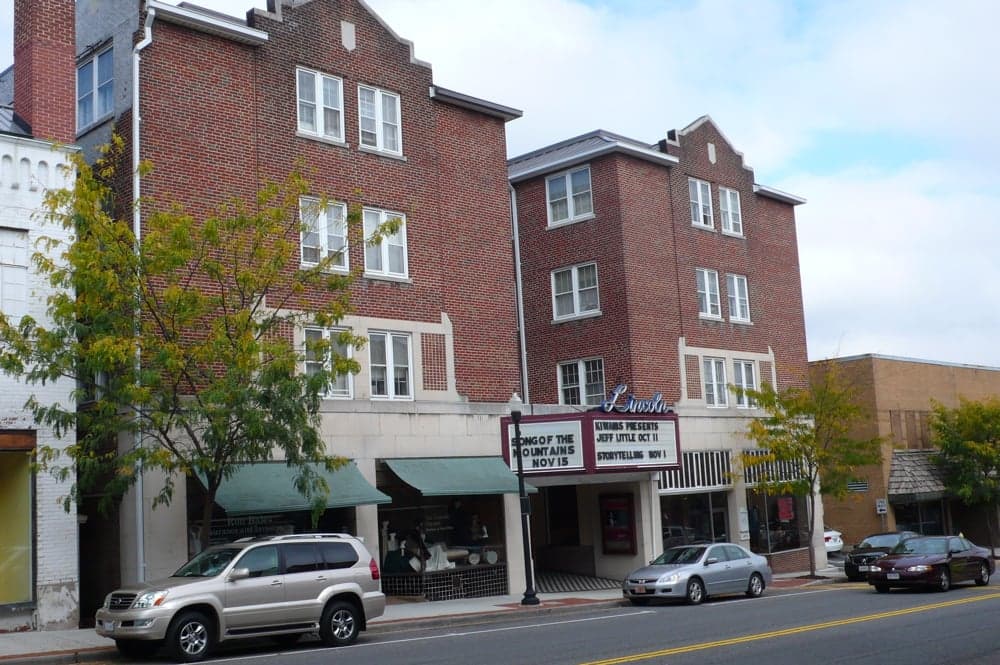
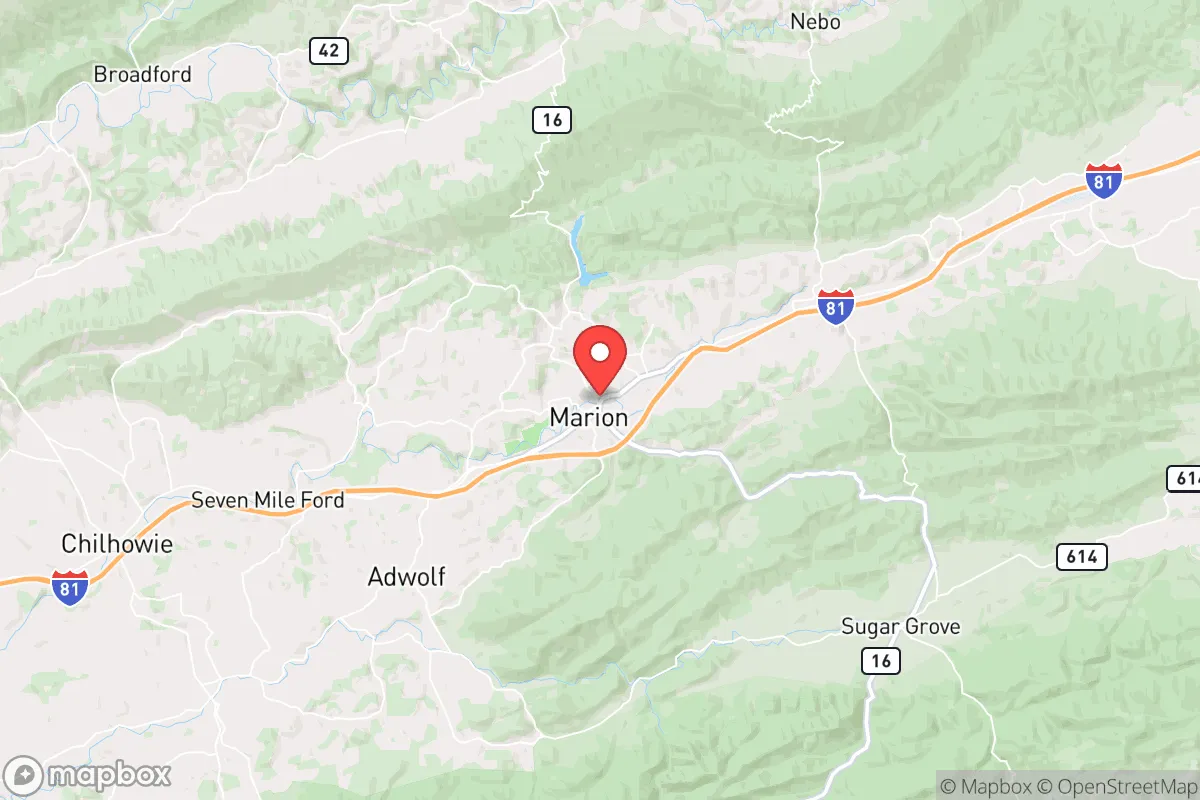

Photo: Wikipedia
Political ClimatePolitical Climate in Marion, VA
District shown is the primary district for this city’s centroid. Cities may span multiple districts.
Local Political AnalysisPolitical Analysis of Marion, VA
Marion, Virginia, sits in a deeply conservative pocket of the state, with a Cook Partisan Voting Index (PVI) of R+22 — meaning the area consistently votes about 22 points more Republican than the national average. That’s a stark contrast to the state of Virginia as a whole, which has shifted to a D+4 PVI in recent cycles, driven largely by the explosive growth of Northern Virginia and the Richmond suburbs. If you’ve lived here a while, you’ve seen the change: Marion and Smyth County have stayed reliably red for decades, while the rest of the state has become a purple-to-blue battleground. The gap between local and state politics has only widened since the 2020 election, and it shows no sign of narrowing.
How it compares
To understand Marion’s political climate, you have to look at the surrounding region. Smyth County voted over 70% for Donald Trump in 2020, while Virginia overall went for Joe Biden by about 10 points. That’s a 30-point swing between the county and the state — a chasm that’s common in Southwest Virginia but almost unheard of in the D.C. suburbs. Drive 45 minutes east to Wytheville, and you’ll find a similar R+18 vibe. But head two hours northeast to Roanoke, and the political landscape flips: Roanoke City is D+15, a blue island in a red sea. Even closer, the college town of Radford (about an hour north) leans slightly Democratic, thanks to its student population. Marion, by contrast, is surrounded by small towns like Chilhowie and Saltville that share its conservative bent. The real contrast isn’t with nearby towns — it’s with the state capital. Richmond and the Tidewater region are now solidly blue, and the state legislature has passed laws on gun control, abortion access, and renewable energy that would never get a hearing in Smyth County.
What this means for residents
For conservative residents, Marion feels like a stronghold. Local elections are dominated by Republicans, and the county board of supervisors, school board, and sheriff’s office all lean right. You can expect lower taxes and fewer regulations than in blue-leaning parts of the state — property taxes in Smyth County are about 0.48% of assessed value, compared to 1.0% or higher in Northern Virginia. Gun rights are widely respected, and the Second Amendment sanctuary movement that swept Virginia in 2019-2020 had strong support here. For liberal residents, life can be more isolating. There’s no local Democratic Party infrastructure to speak of, and progressive candidates rarely bother to campaign here. That said, Marion is a small town where personal relationships often trump politics — your neighbor might have a Trump flag in the yard but still help you shovel snow. The practical impact is that state-level policies on things like marijuana legalization (which passed in 2021) or minimum wage increases are implemented here, but often with local resistance or slower rollout. The area’s economy, heavily tied to manufacturing and healthcare, doesn’t see the same benefits from state investment that the D.C. suburbs do.
Culturally, Marion’s conservative lean shapes daily life in subtle ways. Churches — especially Baptist and Methodist — are central to community life, and events like the annual Wayne C. Henderson Music Festival and the Hungry Mother State Park gatherings feel distinctly Appalachian. There’s less visible diversity than in Virginia’s urban centers, and conversations about race or LGBTQ+ rights are more cautious. But there’s also a strong sense of self-reliance and neighborliness that transcends politics. The biggest policy distinction from the rest of Virginia is probably in education: Smyth County’s school board has resisted state mandates on critical race theory and LGBTQ+ curriculum, and the local public schools emphasize traditional values. For anyone moving here, the key takeaway is that Marion offers a stable, conservative community where your vote aligns with your neighbors — but if you’re used to the political diversity of Richmond or Northern Virginia, you’ll notice the difference every election night.

State Political ClimatePolitical Climate in Virginia
State Political AnalysisPolitical Environment in the State
Virginia is a D+4 state by Cook PVI, meaning it leans about four points more Democratic than the national average, but that number masks a deeply polarized and rapidly shifting political landscape. Over the past 20 years, the state has moved from a reliably purple swing state—voting for George W. Bush in 2004—to a solidly blue stronghold in presidential elections, driven almost entirely by the explosive growth of Northern Virginia suburbs like Arlington, Alexandria, and Loudoun County. However, the rest of the state, particularly the rural Southside and Shenandoah Valley, has swung hard in the opposite direction, creating a political geography that feels like two different countries sharing a border.
Urban vs. rural divide
The political map of Virginia is a textbook case of the urban-rural chasm. The Democratic majority is built on a narrow but dense corridor: the D.C. suburbs (Fairfax, Prince William, Loudoun) plus the cities of Richmond, Norfolk, and Virginia Beach. These areas account for over 60% of the state’s vote and have grown more Democratic with each cycle. Meanwhile, the rest of the state—from the coal country of Wise County in the southwest to the farmlands of Halifax County on the North Carolina border—votes Republican by margins of 30 to 50 points. The divide is so stark that a Democrat can win statewide without setting foot west of Interstate 95. A telling example: in 2020, Joe Biden won Loudoun County by 25 points, while Donald Trump won Carroll County (in the southwest) by 52 points. The result is a state government that often feels like it’s governing two separate constituencies.
Policy environment
Virginia’s policy environment is a mixed bag that reflects its split personality. The state has a flat income tax rate of 5.75% and a sales tax of 5.3% (higher in some localities), which is moderate by national standards. Property taxes are set locally and vary widely—Loudoun County levies about $1.13 per $100 of assessed value, while Wise County is around $0.50. The regulatory posture is business-friendly in many respects: Virginia is a right-to-work state, and its corporate tax rate of 6% is competitive. However, the state has moved left on social policy: it expanded Medicaid under the Affordable Care Act in 2018, and the General Assembly has passed laws protecting abortion access up to fetal viability, with a 2023 law shielding providers from out-of-state lawsuits. Education policy is a flashpoint: the state has a universal school choice program (the Education Improvement Scholarships Tax Credit) but also mandates transgender-inclusive policies in public schools, which has sparked fierce local battles. Election laws are moderately restrictive: Virginia requires a photo ID to vote, but also offers no-excuse absentee voting and same-day registration during early voting. The state does not have a voter ID law as strict as some Southern states, but it also doesn’t have automatic voter registration.
Recent policy direction
Over the past five years, Virginia has lurched leftward on several fronts, but with significant pushback. In 2020, the Democratic-controlled General Assembly passed a sweeping gun control package that included universal background checks, a red flag law, and a one-handgun-per-month limit. This was a direct response to the 2019 Virginia Beach mass shooting, but it also galvanized a massive Second Amendment sanctuary movement in rural counties—over 100 localities passed resolutions vowing not to enforce the new laws. On education, the 2021 repeal of the state’s ban on sanctuary cities (localities that limit cooperation with federal immigration enforcement) was a symbolic win for the left, but no major city has actually declared itself a sanctuary. On parental rights, the 2022 election saw Governor Glenn Youngkin win on a platform that included a “Parents’ Bill of Rights,” which was signed into law in 2023, requiring school districts to notify parents of curriculum changes and allowing them to opt their children out of sexually explicit content. On privacy and surveillance, Virginia passed the Consumer Data Protection Act in 2021, one of the strongest state-level privacy laws in the country, giving residents the right to access, correct, and delete personal data held by companies. On medical autonomy, the state has protected abortion access but has not expanded it—there is no law requiring insurance to cover IVF or contraception. On property rights, Virginia is a “Dillon Rule” state, meaning local governments only have powers explicitly granted by the state, which limits local zoning experiments but also prevents extreme local overreach. On voting, the state has moved toward convenience: no-excuse absentee voting was made permanent in 2020, and early voting centers are now common in urban areas.
Civil unrest & political movements
Virginia has been a flashpoint for political movements on both sides. The 2017 Unite the Right rally in Charlottesville remains a national symbol of far-right extremism, and the city has since become a battleground over Confederate monument removal. The 2020 protests following George Floyd’s murder were particularly intense in Richmond, where protesters toppled a statue of Jefferson Davis on Monument Avenue. On the right, the Second Amendment sanctuary movement of 2019-2020 was one of the largest grassroots mobilizations in state history, with tens of thousands of gun owners attending rallies at the state capitol. Immigration politics are less volatile than in border states, but the issue flares up periodically: in 2023, a bill to ban sanctuary cities failed in the Republican-controlled House of Delegates. Election integrity controversies have been muted compared to other swing states, but the 2020 election saw Trump’s legal team file a lawsuit in Fairfax County alleging irregularities, which was quickly dismissed. The most visible flashpoint for a new resident would likely be the school board meetings—particularly in Loudoun County, which became a national symbol of the culture war over critical race theory and transgender policies in 2021.
Projection
Over the next 5-10 years, Virginia is likely to continue its slow drift leftward at the statewide level, but with increasing volatility. The key demographic driver is the continued growth of Northern Virginia, which is adding tens of thousands of new residents each year, most of them young, college-educated, and left-leaning. This will make it increasingly difficult for Republicans to win statewide races—Youngkin’s 2021 victory was an anomaly driven by a backlash to COVID school closures and a weak Democratic candidate. However, the rural-urban divide will only deepen, and the state’s legislative districts are likely to become more polarized. A new resident moving to Arlington in 2026 can expect to live in a solidly Democratic environment with progressive policies on guns, abortion, and education. Someone moving to Roanoke or Lynchburg will find a more conservative community, but one that is increasingly at odds with the state government in Richmond. The wild card is the 2030 census and redistricting, which could shift the balance of power in the General Assembly. If Democrats gain full control, expect further leftward moves on taxes (a possible graduated income tax), energy (a clean electricity standard), and housing (statewide zoning reform). If Republicans hold the governor’s mansion or the legislature, expect more fights over school choice, gun rights, and abortion restrictions.
Bottom line for a new resident: Virginia is a state where your political experience will depend almost entirely on where you live. If you’re a conservative moving to Fairfax County, you’ll be in a blue bubble with high taxes and progressive school policies—but you’ll also have access to a strong network of conservative churches and private schools. If you’re a liberal moving to Franklin County, you’ll be in a red sea with limited services and a different cultural rhythm. The state government will continue to swing between the two poles, so expect policy whiplash every two to four years. The practical takeaway: choose your locality carefully, because in Virginia, the county you live in matters more than the state you live in.
* Values derived from national, state, county, city and local statistics and may differ in a specific area. Last updated: 2026-10-24T15:51:45.000Z
Narrative content on this page is AI-generated and may contain mistakes. Verify any details that matter before acting on them.
ReloMaps may earn a commission from affiliate links at no extra cost to you.

