Photo: Wikipedia
Demographics of Hancock County
Affluence Level in Hancock County
A middle-class area roughly in line with national averages across income, home values, education, and employment.
People of Hancock County
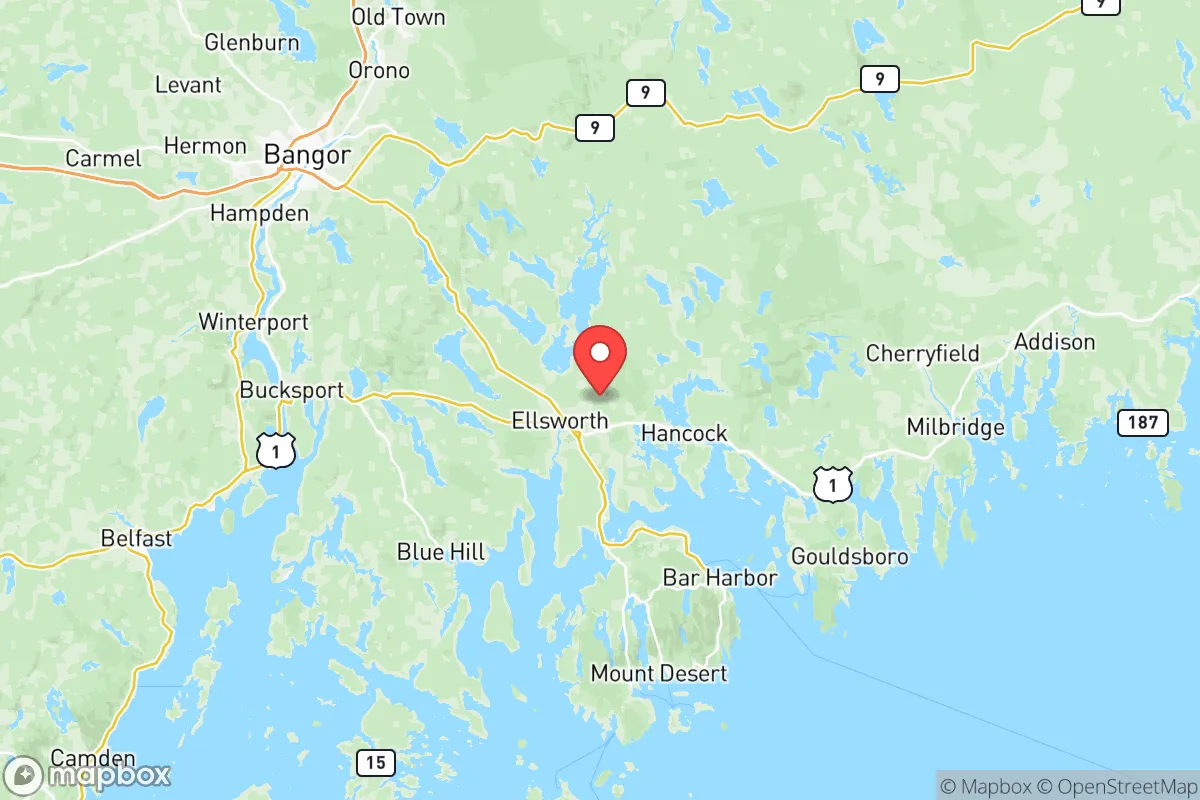
Hancock County, Maine, is a predominantly white, rural coastal county of 56,084 residents where 93.2% of the population identifies as non-Hispanic white, giving it a demographic profile far less diverse than the national average. The county’s character is shaped by its deep Yankee and Maritime Canadian roots, a strong seasonal tourism economy centered on Acadia National Park and Bar Harbor, and a growing population of remote workers and retirees drawn to the natural landscape. With a foreign-born population of just 1.4% and a college attainment rate of 39.2%, Hancock County is an educated but ethnically homogeneous region where the primary demographic change is domestic in-migration rather than international diversity.
Settlement & growth (pre-1960)
The Wabanaki Confederacy, particularly the Penobscot and Passamaquoddy nations, inhabited the Hancock County coast and islands for thousands of years before European contact, relying on the region’s abundant fisheries and forests. French explorers and Jesuit missionaries established seasonal trading posts along the coast in the early 1600s, but permanent European settlement did not begin in earnest until after the French and Indian War. English-speaking settlers from Massachusetts and New Hampshire arrived in the 1760s and 1770s, founding the towns of Ellsworth (the county seat), Blue Hill, and Castine, drawn by timber, shipbuilding, and the cod fishery. A second wave of English-descended Yankees from downeast Maine and the Maritime Provinces of Canada (Nova Scotia and New Brunswick) pushed into Bar Harbor, Mount Desert Island, and Deer Isle during the 19th century, building a thriving economy based on granite quarrying, lobster fishing, and coastal shipping. The arrival of the railroad in the 1880s brought wealthy summer “rusticators” from Boston and New York to Bar Harbor and Northeast Harbor, transforming the local economy toward tourism and seasonal hospitality. Irish immigrants came to work on the railroad and in the granite quarries of Stonington during the 1840s–1880s, while a small number of Swedish and Finnish families settled in the inland farming communities of Otis and Mariaville around the same period. The county’s population remained overwhelmingly Yankee Protestant and Irish Catholic through the 1950s, with virtually no Black or Asian presence.
Modern era (post-1965)
The 1965 Hart-Cellar Act had minimal direct impact on Hancock County’s demographics, as the region never developed the industrial or agricultural job base that attracted post-1965 immigrants to other parts of the United States. The county’s foreign-born share remains at 1.4%, and the East/Southeast Asian population (0.7%) and Indian-subcontinent population (0.2%) are both tiny, concentrated almost entirely among medical professionals and researchers affiliated with the Jackson Laboratory in Bar Harbor and the College of the Atlantic. The Hispanic population (1.8%) and Black population (0.9%) are similarly small, with most Hispanic residents working in seasonal hospitality and construction in Bar Harbor and Ellsworth. The dominant demographic shift since the 1970s has been domestic: an influx of retirees, second-home buyers, and remote workers from Massachusetts, New York, and Connecticut, who have driven up housing prices in coastal towns like Bar Harbor, Southwest Harbor, and Blue Hill. This migration accelerated after 2020, as COVID-era remote work policies allowed urban professionals to relocate permanently. The county has also seen modest growth in the number of year-round residents of French-Canadian and Acadian descent moving from northern Maine and New Brunswick into Ellsworth and Bucksport.
The future
Hancock County is projected to become slightly older and slightly more diverse over the next two decades, but the changes will be incremental rather than transformative. The county’s population grew by roughly 6% between 2010 and 2020, driven entirely by domestic in-migration, and that trend is expected to continue as coastal Maine remains a top destination for remote workers and retirees fleeing higher-cost states. The Hispanic and Asian populations will likely grow from a very low base as service-industry workers fill labor gaps in hospitality and healthcare, particularly in Bar Harbor and Ellsworth. However, the county’s high housing costs and limited rental stock will constrain significant demographic change, and the population will remain overwhelmingly white and native-born for the foreseeable future. The most notable cultural shift is the tension between longtime fishing and working-class families and newly arrived affluent transplants, a dynamic playing out in zoning debates and housing affordability discussions across Mount Desert Island and the Blue Hill Peninsula.
For someone moving to Hancock County now, the region offers a stable, safe, and scenically beautiful environment with a strong sense of local tradition, but it is not a place of rapid demographic change or ethnic diversity. The county is becoming more expensive, more educated, and more oriented toward tourism and remote work, while its historic fishing and quarrying communities shrink. New arrivals will find a welcoming but insular culture where integration requires genuine engagement with year-round residents and respect for the area’s deep Yankee and Maritime heritage.

* Values derived from national, state, county, city and local statistics and may differ in a specific area. Last updated: 2026-07-10T22:35:32.000Z
Narrative content on this page is AI-generated and may contain mistakes. Verify any details that matter before acting on them.
ReloMaps may earn a commission from affiliate links at no extra cost to you.

