Political ClimatePolitical Climate in Locust Grove, VA
District shown is the primary district for this city’s centroid. Cities may span multiple districts.
Inherited from parent state — no local data available.
Local Political AnalysisPolitical Analysis of Locust Grove, VA
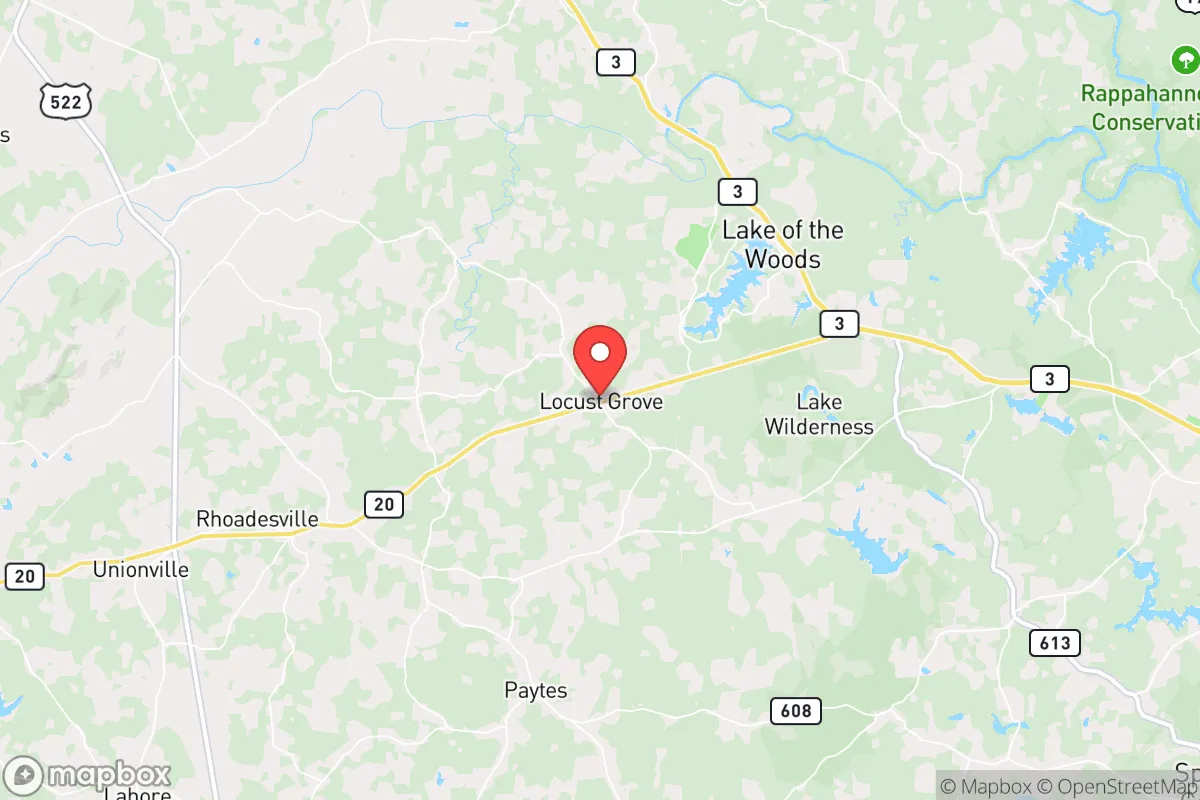
Locust Grove sits in a political sweet spot that's shifted noticeably over the past decade. The area's Cook Partisan Voting Index (PVI) of D+2 means it leans slightly Democratic, but that's a relatively recent development—as recently as 2016, this part of Orange County was more of a toss-up, with local races often decided by a few hundred votes. The trajectory is clearly trending leftward, driven by newcomers from the D.C. suburbs and Northern Virginia who've been buying up land and commuting remotely. Still, Locust Grove isn't a deep-blue stronghold; it's a place where a Republican candidate can win a county commission seat if they knock on enough doors, and where the local Democratic committee and GOP chapter both hold monthly breakfasts at the same diner.
How it compares
Virginia as a whole carries a Cook PVI of D+4, meaning Locust Grove is about two points more conservative than the state average. That gap matters: in statewide races, Locust Grove voters tend to split more evenly than the rest of the commonwealth. For example, in the 2021 gubernatorial race, Orange County went for Republican Glenn Youngkin by about 3 points, even as the state overall elected him by a similar margin—but the county's suburban precincts around Locust Grove were closer to a 50-50 split. Compare that to nearby Charlottesville (D+15) or Culpeper (R+8), and Locust Grove's middle-ground character becomes clear. It's not as liberal as the college towns to the west, nor as conservative as the rural counties to the south. The real contrast is with Fredericksburg (D+6) to the east, which has swung harder blue due to its commuter-heavy population; Locust Grove's mix of long-time farmers, winery owners, and telecommuters keeps it more balanced.
What this means for residents
For conservative residents, the D+2 lean means they're still competitive in local elections but need to work harder than they did a decade ago. The Orange County Board of Supervisors remains majority-Republican, but the margin has narrowed, and school board races are now regularly contested by both parties. Liberal residents, meanwhile, find that their votes matter more here than in a deep-blue district—a single precinct can swing a countywide race. The practical effect is that policy debates tend to be moderate: zoning changes for new housing get hashed out in long public meetings, and the county's budget priorities (roads, schools, emergency services) rarely break along strict party lines. Gun rights and development regulations are the two issues that reliably draw partisan crowds to the county courthouse.
Culturally, Locust Grove's political middle ground shows up in everyday life. You'll see Harris-Walz yard signs next to Trump-Vance signs on the same rural route, and the local farmers market has both a booth for the Democratic Women's Club and one for the Republican Party. The biggest policy distinction from the rest of Virginia is probably land use: Orange County has resisted the kind of dense development that's reshaped Loudoun and Prince William counties, so Locust Grove retains a semi-rural feel even as its politics shift. That's likely to continue—new residents tend to be moderate professionals who want the area's quiet character preserved, which keeps both parties' extremes at bay. If you're moving here, expect to have neighbors who disagree with you politically but will still lend you a chainsaw after a storm. That's the Locust Grove way.

State Political ClimatePolitical Climate in Virginia
State Political AnalysisPolitical Environment in the State
Virginia is a classic swing state that has shifted decisively blue over the past two decades, now carrying a Cook PVI of D+4, but it remains a deeply contested battleground where the margins are razor-thin and the political geography is starkly divided. The dominant coalition is a mix of suburban professionals, federal workers, and minority voters in the northern Virginia suburbs of Washington, D.C., combined with college towns like Charlottesville and the Hampton Roads military-and-port corridor. This coalition has powered Democrats to wins in every presidential election since 2008 and control of the governorship for 12 of the last 16 years, but the state legislature has flipped back and forth, and Republicans still hold a strong grip on the rural south and west, as well as the Roanoke Valley and the Shenandoah Valley.
Urban vs. rural divide
The political map of Virginia is essentially a tale of two commonwealths. The blue stronghold is Northern Virginia—Arlington, Alexandria, Fairfax, Loudoun, and Prince William counties—which alone accounts for over a third of the state’s vote and delivers margins of 60-70% for Democrats. Richmond and its inner suburbs (Henrico, Chesterfield) have also trended blue, while Hampton Roads (Norfolk, Virginia Beach, Chesapeake) is a genuine swing region where military families and port workers split nearly evenly. The red strongholds are the rural Southside (Danville, Martinsville) and the Southwest (Bristol, Abingdon, Wise), where Trump won some counties by 40-50 points. The Roanoke Valley and Shenandoah Valley (Harrisonburg, Staunton) are more purple but lean Republican outside the college towns. The key suburban battlegrounds are Loudoun County—once ruby red, now solidly blue—and Chesterfield County, which flipped from red to purple in 2020 and is now a top target for both parties.
Policy environment
Virginia’s policy environment is a mixed bag that reflects its purple status. The state income tax is a flat 5.75% (one of the highest flat rates in the South), and the sales tax is 5.3% (plus local add-ons up to 7%). Property taxes are set locally and vary widely—Loudoun County has rates around $1.20 per $100 of assessed value, while Bristol is under $0.80. There is no statewide homestead exemption, but localities can offer tax relief for seniors and disabled veterans. Education policy is decentralized: school funding is roughly 50% state, 40% local, and 10% federal, and the state has a right-to-work law that bans union security agreements. Healthcare is a bright spot—Virginia expanded Medicaid under the Affordable Care Act in 2019, covering about 400,000 low-income adults. Election laws are moderately restrictive: voters must show a photo ID (though student IDs and expired IDs are accepted), and there is no-excuse absentee voting by mail, but same-day registration is not allowed. The state has a Democratic trifecta as of 2024 (governor, House, Senate), but the governor is a moderate Republican, Glenn Youngkin, who has vetoed several Democratic bills, creating a tense divided government.
Recent policy direction
Virginia has lurched left on social issues while staying centrist on economics. In 2020, Democrats passed a sweeping gun control package that included universal background checks, a red-flag law, a one-handgun-per-month limit, and a ban on assault weapons for those under 21. Youngkin has blocked further restrictions, but the existing laws remain on the books. On abortion, Virginia is an outlier in the South: abortion is legal up to 26 weeks, with a 24-hour waiting period and parental consent for minors, but no ban on later-term procedures. In 2024, Democrats failed to pass a constitutional amendment enshrining abortion rights, but they did repeal the mandatory ultrasound law. On parental rights, Youngkin signed a bill in 2023 requiring schools to notify parents if a child requests a name or pronoun change, but Democrats blocked a broader “Parents’ Bill of Rights.” On voting, Democrats passed no-excuse absentee voting and automatic voter registration in 2020, but Republicans have resisted efforts to add same-day registration. On marijuana, Virginia legalized possession and home cultivation in 2021, but retail sales remain stalled due to a political standoff over licensing. On property rights, the state has strong eminent domain protections after a 2006 Supreme Court case (Kelo) prompted a state constitutional amendment limiting takings for private economic development. On privacy, Virginia passed a comprehensive data privacy law in 2021 (the Virginia Consumer Data Protection Act), one of the strongest in the country, giving residents the right to access, correct, and delete personal data held by companies.
Civil unrest & political movements
Virginia has been a flashpoint for political violence and activism. The 2017 Unite the Right rally in Charlottesville, which turned deadly, remains the most infamous event, leading to a statewide ban on firearms at public demonstrations and a push to remove Confederate monuments. Since then, left-leaning groups like Indivisible and SURJ have been highly active in Northern Virginia and Richmond, while conservative groups like the Virginia Citizens Defense League (gun rights) and Moms for Liberty (parental rights) have mobilized in the suburbs. Immigration politics are tense: Prince William County and Fairfax County have declared themselves “sanctuary” jurisdictions limiting cooperation with ICE, while Culpeper County and Loudoun County (under a Republican sheriff) have pushed back. Election integrity remains a hot-button issue: after the 2020 election, Trump’s legal team filed multiple lawsuits in Virginia (all dismissed), and Youngkin created an “Election Integrity Unit” in 2022 that has investigated a handful of cases but found no widespread fraud. The state has also seen a surge in school board protests over critical race theory and LGBTQ+ policies, particularly in Loudoun County, where a 2021 sexual assault case at a high school became a national flashpoint.
Projection
Over the next 5-10 years, Virginia will likely continue its slow drift leftward, driven by the relentless growth of Northern Virginia and the in-migration of educated professionals from other blue states. The 2020 census showed that 90% of the state’s population growth came from Northern Virginia, and that trend is accelerating. The rural red areas are losing population, which means their electoral weight is shrinking. However, the state is not becoming a deep-blue lock like Maryland or California—the margins are still tight enough that a Republican like Youngkin can win statewide by appealing to suburban moderates on economic and education issues. The key wildcard is the 2025 gubernatorial election, which will test whether Democrats can hold the governorship or whether the GOP can build a coalition of rural voters, military families, and suburban independents. If Democrats win, expect further leftward movement on abortion, gun control, and voting access. If Republicans win, expect a push for school choice, tax cuts, and restrictions on transgender athletes. For a new resident, the practical takeaway is that Virginia will remain a politically competitive state where your vote matters, but the cultural and policy center of gravity will continue to shift toward the D.C. suburbs.
For a conservative relocating to Virginia, the bottom line is that you will find a strong and vocal conservative community in the rural areas and some suburbs, but you will be living under a state government that is increasingly controlled by Democrats, with a tax burden that is higher than most Southern states and a regulatory environment that is more aligned with the Northeast. For a liberal relocating, you will find a state that is broadly friendly to your values in the cities and suburbs, but you will have to contend with a Republican governor who can veto your priorities and a rural population that is deeply skeptical of progressive policies. The best advice is to pick your location carefully: if you want a red enclave, look at Roanoke or the Shenandoah Valley; if you want a blue bubble, head to Arlington or Richmond; if you want a true swing district where your vote will matter most, consider Chesterfield or Virginia Beach.
* Values derived from national, state, county, city and local statistics and may differ in a specific area. Last updated: 2026-09-10T03:06:51.000Z
Narrative content on this page is AI-generated and may contain mistakes. Verify any details that matter before acting on them.
ReloMaps may earn a commission from affiliate links at no extra cost to you.

