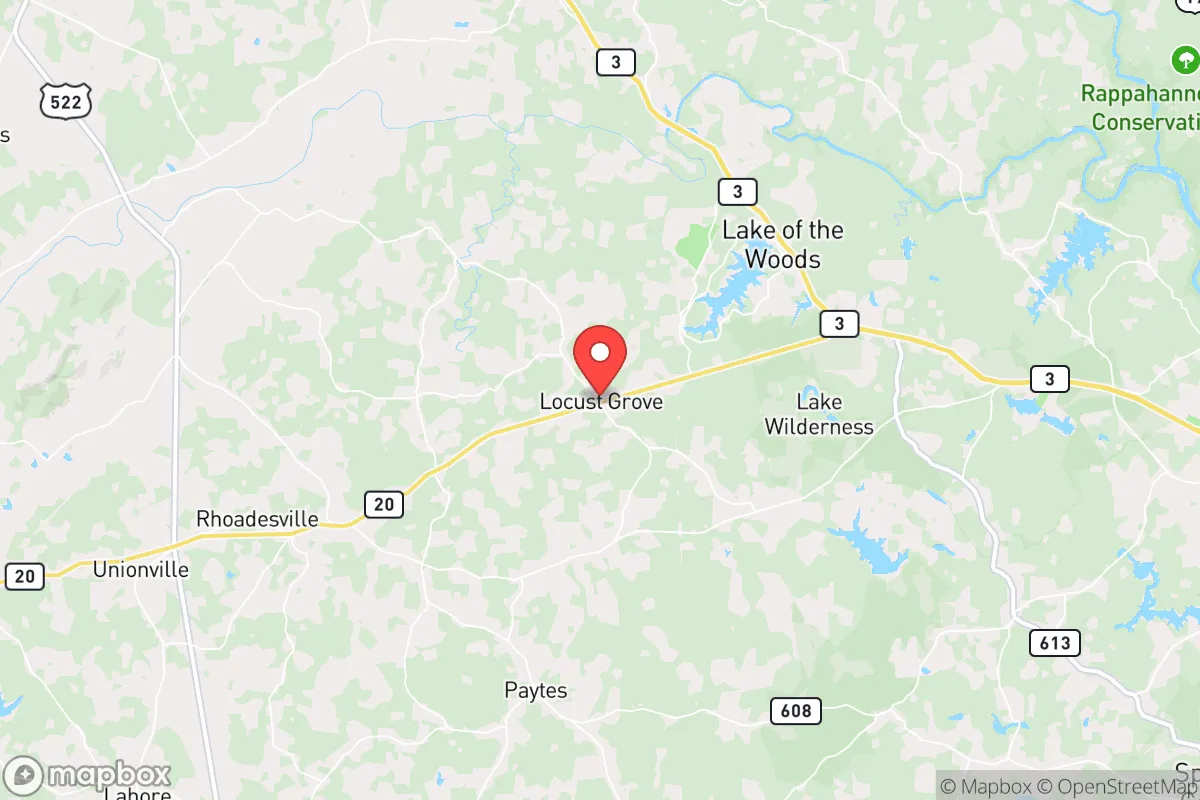
Personal Sovereignty in Locust Grove, VA
Viable for self-reliance. Generally workable, though some barriers may limit total independence.
What does Personal Sovereignty tell us?
Personal Sovereignty measures your capacity for self-reliance and independence with minimal government friction. Higher scores mean fewer barriers between you and the way you want to live... but it assumes you have the space you need and good neighbors.
What does this tell us?
Personal Sovereignty measures your capacity for self-reliance and independence with minimal government friction. Higher scores mean fewer barriers between you and the way you want to live... but it assumes you have the space you need and good neighbors.
State Policy
Energy independence: Importer (20% of energy produced in-state)
Personal Liberty
Homesteading

Personal Liberty Analysis
Locust Grove, Virginia, offers a notably high degree of personal sovereignty, rooted in Virginia’s status as a Dillon Rule state with a strong tradition of local control and a relatively light regulatory touch in rural Orange County. For individuals and families prioritizing autonomy, the area provides a practical environment where self-reliance is not just a philosophy but a daily reality, supported by low property taxes, permissive gun laws, and ample space for independent living. While not as libertarian-leaning as some western states, Locust Grove’s blend of low-density zoning, minimal business interference, and strong Second Amendment protections creates a solid foundation for those seeking to maximize personal freedom within a stable, family-oriented community.
Tax burden and regulatory posture: How light is the government footprint?
Orange County’s tax and regulatory environment is notably favorable for those seeking to minimize government overhead. The county’s real property tax rate is $0.73 per $100 of assessed value, well below the Virginia state average of roughly $1.11, and there is no local personal property tax on vehicles or business equipment—a significant advantage for families with multiple cars or home-based enterprises. Virginia’s state income tax is a flat 5.75%, and sales tax in Orange County is 5.3% (state plus local), which is moderate. The regulatory posture is best described as light-touch but not absent. As a Dillon Rule state, localities only have powers explicitly granted by the state, which limits Orange County’s ability to impose novel regulations. Building permits are required for new construction, but the county’s zoning is generally permissive in rural areas, with no countywide rental inspection program or overly burdensome business licensing. The county’s comprehensive plan emphasizes preserving agricultural and rural character, which translates to fewer restrictions on land use compared to more urbanized counties in Northern Virginia. For a family or individual, this means less bureaucratic friction when starting a home-based business, adding a shed, or keeping livestock.
Self-defense and gun law specifics: What are the rules for carrying and owning firearms?
Virginia is a shall-issue state for concealed carry permits, meaning that if a resident passes a background check and completes a state-approved training course, the sheriff’s office must issue the permit. Orange County’s Sheriff’s Office processes these applications efficiently, with typical turnaround times of 30-45 days. Open carry of handguns is legal without a permit for anyone 18 or older who can legally possess a firearm. There is no state-level assault weapons ban, no magazine capacity limit, and no red flag law as of 2026, though local ordinances cannot preempt state law. Stand-your-ground principles apply: Virginia law does not impose a duty to retreat before using deadly force in self-defense if the person is lawfully present and reasonably believes force is necessary to prevent imminent death or great bodily harm. For homeowners, the Castle Doctrine is strong—there is no duty to retreat in one’s own dwelling. The county has no additional firearm-specific regulations beyond state law, and the local culture is overwhelmingly supportive of gun ownership. Shooting ranges, including the private Rapidan Sportsmen’s Club, are accessible within a 20-minute drive. For a family, this means the legal framework fully supports responsible firearm ownership for self-defense, hunting, and sport shooting without excessive administrative hurdles.
Self-reliance and homesteading viability: Lot sizes, zoning, and off-grid feasibility
Locust Grove’s rural zoning makes it one of the more viable areas in central Virginia for homesteading and off-grid living. The minimum lot size in the Agricultural (A-1) district is 3 acres, and many parcels in the area range from 5 to 20 acres, providing ample space for gardens, orchards, and small livestock. The county allows keeping chickens, goats, and up to two horses on parcels of 3 acres or more without special permits; larger livestock like cattle require a minimum of 5 acres. Beekeeping is permitted on any parcel over 1 acre. Off-grid feasibility is moderate: while the county requires connection to an approved water source (well or public), there is no mandate for grid-tied electricity. Solar panels, rainwater collection (for non-potable uses), and composting toilets are all legal, though a septic system must be permitted and inspected. The county’s building code follows the Virginia Uniform Statewide Building Code, which is less restrictive than many urban jurisdictions—for example, owner-builders can act as their own general contractor with proper permits. Wood stoves and outdoor boilers are common and regulated only by state air quality rules. For a family seeking to reduce reliance on utilities or grow a significant portion of their own food, Locust Grove’s zoning and code enforcement are among the most accommodating in the region, with no homeowner association (HOA) restrictions on most rural properties.
Personal liberties: Parental rights, medical autonomy, speech, and property
Virginia law generally respects parental rights in education and healthcare decisions. The state has a strong parental notification law for minors’ medical procedures, and parents have the right to opt their children out of specific instructional materials or activities. Homeschooling is straightforward: parents must file a notice of intent with the local school division and provide evidence of a curriculum, but there is no state-mandated testing requirement for homeschooled students beyond a basic annual assessment. Medical autonomy is less robust than in some western states: Virginia does not have a broad medical freedom law, but there are no state-level vaccine mandates for adults, and religious exemptions for school immunizations are available. The state’s certificate of public need (COPN) laws limit the number of healthcare facilities, which can reduce competition, but Orange County’s proximity to Charlottesville (UVA Health) provides access to high-quality care without local monopolies. Free speech is fully protected under the First Amendment, and Orange County has no local ordinances restricting political signage or public assembly beyond standard time-place-manner rules. Property rights are strong: Virginia is a right-to-farm state, meaning that agricultural operations are protected from nuisance lawsuits if they predate nearby residential development. Eminent domain is limited to public projects, and the county has no rent control or landlord licensing. For a family, this means the legal environment supports traditional values of parental authority, property ownership, and personal medical choice without significant state overreach.
Overall, Locust Grove offers a personal sovereignty profile that is strongly favorable for conservative-leaning families when compared to other parts of Virginia and the Mid-Atlantic. The combination of low taxes, permissive gun laws, homesteading-friendly zoning, and respect for parental rights places it in the top tier of Virginia localities for autonomy. While it lacks the extreme libertarian policies of states like New Hampshire or Alaska, it provides a practical, stable environment where self-reliance is the norm rather than the exception. For a family moving from a high-regulation state like California or New York, the difference in daily freedom—from building a chicken coop to carrying a concealed firearm—will be immediately tangible. Locust Grove is not a frontier; it is a well-ordered, low-friction community where personal sovereignty is assumed, not negotiated.

* Values derived from national, state, county, city and local statistics and may differ in a specific area. Last updated: 2026-09-10T03:06:51.000Z
Narrative content on this page is AI-generated and may contain mistakes. Verify any details that matter before acting on them.
ReloMaps may earn a commission from affiliate links at no extra cost to you.

