Demographics of Locust Grove, VA
Historical data isn't available for Locust Grove, VA. Trends shown are for Orange County, VA.
Affluence Level in Locust Grove, VA
A middle-class area roughly in line with national averages across income, home values, education, and employment.
People of Locust Grove, VA
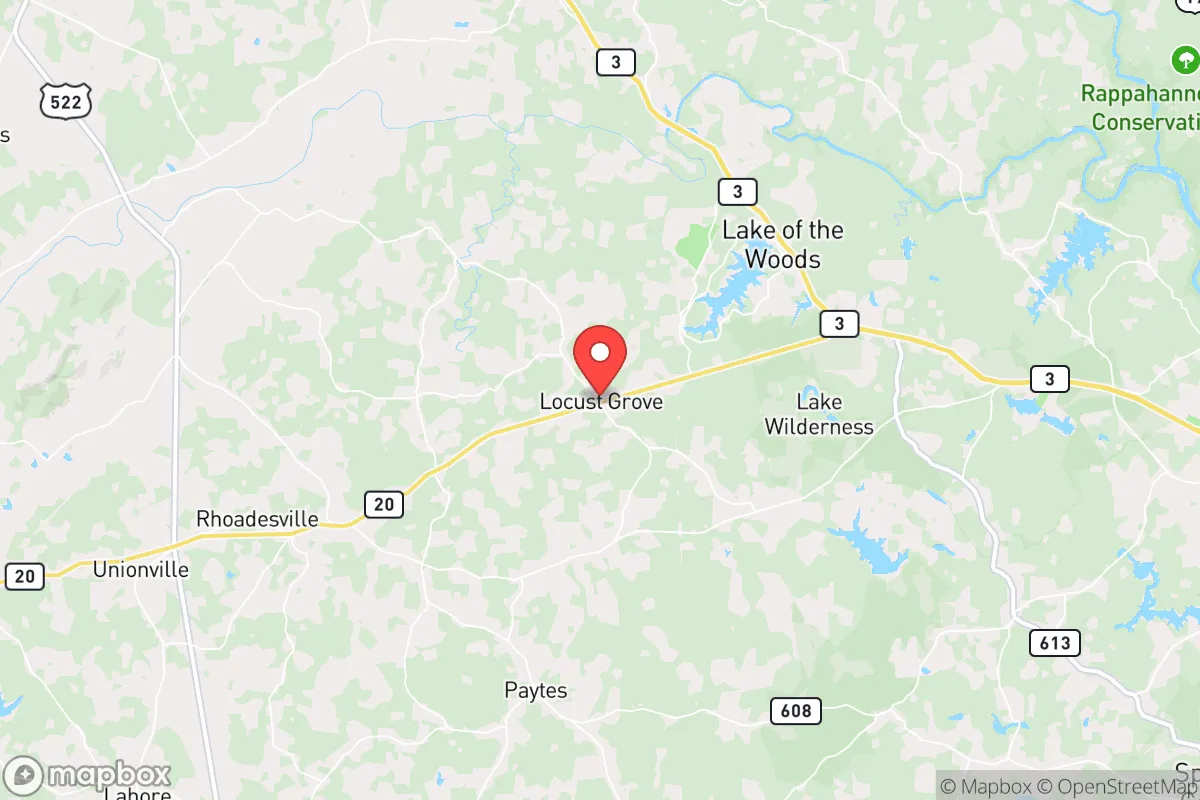
Today, Locust Grove, Virginia, is a small, tightly-knit community of 169 residents where the population is entirely White and non-Hispanic, with zero foreign-born residents. Located in Orange County, this rural enclave is characterized by its low density, strong family-oriented character, and a population that has remained remarkably homogeneous over time. The community’s identity is rooted in deep generational ties to the land, with a social fabric woven from longstanding local families and a lifestyle centered on privacy, outdoor recreation, and proximity to Lake of the Woods.
How the city was settled and grew
Locust Grove’s settlement history is tied to the agricultural expansion of Piedmont Virginia in the 18th and 19th centuries. The area was originally part of large land grants awarded to prominent Virginia families, including the Spotswood and Madison families, who established tobacco plantations worked by enslaved labor. After the Civil War, the region transitioned to mixed farming and timber, with small crossroads communities emerging to serve rural households. The historic Old Locust Grove district, centered near the intersection of State Routes 20 and 611, became a modest hub for general stores and churches. The Wilderness Corner area, named for the nearby Civil War battlefield, saw a small influx of families in the early 1900s who worked the land as tenant farmers and sharecroppers. By the mid-20th century, the population remained sparse and overwhelmingly White, with most residents tracing their roots to English, Scottish, and German settlers who had arrived in the 1700s.
Modern era (post-1965)
After the 1965 Immigration and Nationality Act, Locust Grove experienced virtually no demographic change, as the area lacked the industrial or service-sector jobs that drew immigrants to larger Virginia cities. The most significant modern development was the creation of the Lake of the Woods planned community in the 1970s, a gated residential and golf-course development that attracted domestic in-migrants—primarily White retirees and second-home buyers from Northern Virginia and the Washington, D.C., metro area. This wave settled almost exclusively within the Lake of the Woods gates, while the Wilderness Shores subdivision, built in the 1980s, drew younger families seeking affordable rural lots. The Locust Grove Village area, near the intersection of Route 3 and Route 20, saw modest commercial growth with a grocery store and gas station, but residential expansion remained limited. The 2020 Census confirmed that the population remained 100% White and 0.0% foreign-born, with no measurable Hispanic, Black, Asian, or Indian subcontinent populations. This stability reflects both the area’s lack of rental housing stock and its distance from major employment corridors.
The future
Locust Grove’s population is projected to remain small and demographically stable over the next 10–20 years. The area’s zoning is predominantly agricultural and low-density residential, with no large-scale planned developments on the horizon. The aging of the Lake of the Woods community may lead to a gradual turnover of homes to new retirees or remote workers, but these buyers are likely to mirror the existing demographic profile. The Prospect Heights area, a cluster of older farmsteads east of town, may see infill construction as Orange County’s comprehensive plan allows for limited rural subdivisions. However, without significant job growth or affordable rental options, Locust Grove will not attract the diversity seen in nearby Fredericksburg or Charlottesville. The cultural identity will remain rooted in conservative, family-oriented values, with a strong emphasis on land stewardship and local church communities.
For someone moving in now, Locust Grove offers a stable, predictable environment where the population is unlikely to change dramatically. It is a place for those seeking a quiet, rural lifestyle with deep local roots, minimal turnover, and a community where neighbors are likely to have known each other for decades. The trade-off is a lack of demographic diversity and limited social or economic dynamism—but for families and individuals prioritizing privacy and continuity, that stability is precisely the draw.

* Values derived from national, state, county, city and local statistics and may differ in a specific area. Last updated: 2026-09-10T03:06:51.000Z
Narrative content on this page is AI-generated and may contain mistakes. Verify any details that matter before acting on them.
ReloMaps may earn a commission from affiliate links at no extra cost to you.

