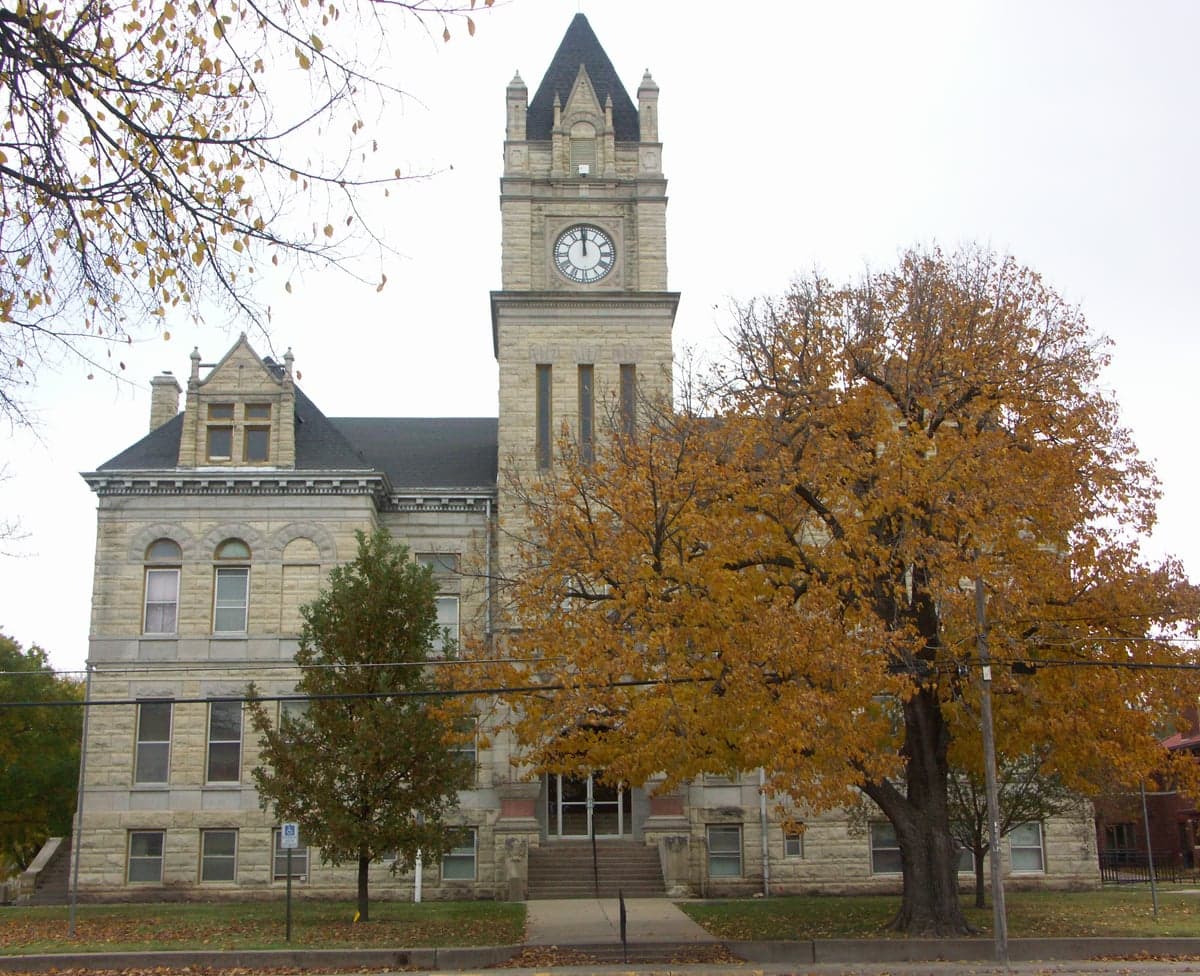
Photo: Wikipedia
Political ClimatePolitical Climate in Marion County
Showing county-level results — no local-only data available.
Lean and PVI are calculated from this county’s 2020 and 2024 presidential results, Cook-style.
Political rankings in Kansas
- Most Conservative Cities in Kansas
- Most Liberal Cities in Kansas
- Best Liberal-Leaning Towns in the Midwest
- Safest Liberal-Leaning Towns in the Midwest
- Safest Conservative-Leaning Towns in the Midwest
- Affordable Small Towns for Conservatives
- Most Affordable Liberal-Leaning Small Towns in the U.S.
- Safest Conservative-Leaning Cities in the U.S.
- Most Conservative Counties in Kansas
- Most Liberal Counties in Kansas
Local Political AnalysisPolitical Analysis of Marion County
Marion County, Kansas, is a deeply conservative area where Republicans have held a commanding grip on local politics for decades, and the 2024 election results only reinforced that trend. With a Cook Partisan Voting Index (PVI) of R+26, the county is significantly more Republican than the state of Kansas as a whole, which sits at R+9. This isn't a recent shift—it's a long-standing reality rooted in the county's agricultural economy, strong religious communities, and a general skepticism of federal intervention. If you're moving here, you should know that conservative values aren't just a preference; they're the baseline for most public discourse and policy.
How it compares
The gap between Marion County and the rest of Kansas is stark. While the state as a whole has trended slightly more Republican over the past decade—driven by suburban and rural areas alike—Marion County has stayed rock-solid. In the 2024 presidential race, Donald Trump likely carried the county by a margin close to 70-30, while statewide he won by a more modest 56-42 split. This means that a Republican candidate in Marion County can expect to win by roughly 26 points more than they would statewide. The political variation within the county itself is minimal but worth noting. The city of Marion, the county seat, is the most moderate area, with a small but consistent Democratic vote—usually around 25-30% in presidential elections—driven by a mix of state employees and a handful of retired professionals. In contrast, Hillsboro and Peabody are reliably deep red, with GOP support often exceeding 80%. The swing precincts are essentially nonexistent; even in the most competitive local races, the Republican candidate typically wins by double digits. The only real variation comes in low-turnout primaries, where a more conservative challenger might edge out a moderate incumbent.
What this means for residents
For conservative residents, Marion County is a comfortable environment where their views are the norm. Local government, school boards, and law enforcement are all reliably Republican, and policy decisions—from tax levies to land-use regulations—tend to reflect that. For liberal residents, the reality is more isolating. You can still participate in local politics, but you'll be a clear minority. There's no organized Democratic party presence in the county, and progressive candidates rarely even file to run. That said, the community is generally polite and neighborly; political disagreements rarely turn hostile in person, but they can feel like a constant undercurrent. The practical impact is that social services, public funding for arts, and environmental initiatives often face an uphill battle, while gun rights, agricultural subsidies, and low property taxes are prioritized.
Culturally, Marion County stands apart from the more urban and suburban parts of Kansas. You won't find the same diversity of viewpoints you'd see in Johnson County or even Wichita. The local newspaper, the Marion County Record, is a rare independent voice that occasionally publishes critical pieces, but it's the exception. The county's strong Mennonite and Lutheran heritage also shapes its politics, emphasizing self-reliance and community charity over government programs. For anyone moving here, the key takeaway is simple: if you're conservative, you'll feel right at home. If you're not, you'll need to be comfortable being in the minority, but you'll also find that most folks are more interested in your character than your ballot.

State Political ClimatePolitical Climate in Kansas
State Political AnalysisPolitical Environment in the State
Kansas has been a reliably Republican state for decades, with a Cook Partisan Voting Index of R+9, meaning it votes about nine points more Republican than the nation as a whole. The dominant coalition is a mix of rural conservatives, suburban moderates, and a growing libertarian-leaning wing, but the state’s politics have been anything but static over the last 15 years. After a brutal experiment with deep tax cuts under Governor Sam Brownback in the 2010s, which led to budget crises and school funding lawsuits, voters swung back toward a more pragmatic Republicanism, and the state has since settled into a stable but internally contested conservative governance.
Urban vs. rural divide
The political map of Kansas is a textbook study in the urban-rural split. The two major population centers—Johnson County (suburban Kansas City) and Sedgwick County (Wichita)—are the state’s political battlegrounds. Johnson County, once a Republican stronghold, has been trending purple for a decade; in 2020, Joe Biden won it by about 6 points, and it now sends a mix of moderate Republicans and Democrats to the legislature. Wichita itself leans Democratic, but the surrounding Sedgwick County suburbs remain reliably red. The rest of the state is deeply Republican: western Kansas counties like Garden City and Dodge City routinely vote 75-80% Republican, while the Flint Hills and southeastern Kansas—places like Emporia and Pittsburg—are solidly conservative but with a populist streak. The only reliably blue areas outside Johnson County are Lawrence (home to the University of Kansas) and Manhattan (Kansas State University), both of which are small but politically active college towns. The divide isn’t just about party—it’s about worldview: rural Kansans tend to prioritize agriculture, gun rights, and local control, while urbanites focus on education funding, healthcare access, and social services.
Policy environment
Kansas’s policy environment is broadly conservative but with notable exceptions. The state has a flat income tax of 5.7% (after the Brownback-era cuts were partially rolled back), no tax on Social Security benefits, and a relatively low property tax burden compared to neighboring Missouri. Sales taxes are high, often exceeding 9% in cities like Topeka and Wichita, which hits low-income residents hardest. Education policy is a perennial flashpoint: the state constitution requires adequate funding for public schools, and the Kansas Supreme Court has repeatedly ordered the legislature to increase spending, leading to a tense relationship between the judicial and legislative branches. On social issues, Kansas is conservative: abortion is restricted after 22 weeks, and a 2022 constitutional amendment to remove abortion protections failed by a wide margin, surprising many. Gun laws are among the most permissive in the country—constitutional carry (no permit needed) has been law since 2015, and there are no state-level restrictions on magazine capacity or assault weapons. Election laws are moderately restrictive: voter ID is required, but same-day registration is not allowed, and the state has a 20-day advance voting period.
Recent policy direction
The last five years have seen Kansas move in a distinctly conservative direction on several fronts, but with a pragmatic brake on extremes. In 2023, the legislature passed a sweeping parental rights bill (HB 2238) that requires schools to notify parents of any curriculum involving sexuality or gender identity and allows parents to opt their children out. The same year, a law banning transgender athletes from female sports (SB 160) was enacted. On gun rights, the state expanded stand-your-ground protections in 2022 (HB 2595), removing the duty to retreat in any place where a person is lawfully present. Property rights were strengthened with a 2021 law limiting eminent domain for carbon pipelines, a direct response to the controversial TC Energy pipeline project. On taxation, the state accelerated income tax rate cuts in 2024, aiming to drop the flat rate to 5.5% by 2027. Medical marijuana remains illegal, though a limited CBD program exists, and there is no recreational cannabis. Voting access has been tightened slightly: the 2021 election integrity law (SB 4) added a signature verification requirement for mail ballots and banned ballot harvesting. The overall direction is toward individual liberty in economic and self-defense matters, with a strong tilt toward parental authority and traditional social values.
Civil unrest & political movements
Kansas has not seen the large-scale protests common in coastal states, but there have been notable flashpoints. The 2022 abortion amendment campaign drew massive grassroots organizing on both sides, with pro-choice groups turning out unexpectedly high numbers in Johnson County and Lawrence. The 2020 Black Lives Matter protests in Wichita and Kansas City were relatively small but drew counter-protests from armed militia groups, including the Kansas Freedom Fighters and the III% Security Force. Immigration politics are less heated than in border states, but Garden City and Dodge City have seen tensions over meatpacking plant labor—many workers are immigrants, both documented and undocumented—and local law enforcement generally does not cooperate with federal immigration enforcement beyond what is legally required. There is no sanctuary city policy anywhere in the state. Election integrity remains a live issue: the 2020 election saw Trump win Kansas by 15 points, but a small but vocal group of activists continues to push for hand-counting ballots and paper-only voting, leading to a 2024 law requiring all voting machines to produce a paper trail. The state’s libertarian streak is visible in the Free State Project-style rhetoric in rural areas, but actual secession talk is limited to occasional grumbling in far-western counties about being ignored by Topeka.
Projection
Over the next 5-10 years, Kansas is likely to remain solidly Republican but with a growing libertarian and moderate suburban influence. The key demographic shift is the continued growth of Johnson County, which is becoming more diverse and more educated—this will push the state’s politics toward a more pragmatic, business-friendly conservatism rather than the culture-war-heavy style of the rural west. In-migration is modest but steady, mostly from other Midwestern states and California, and these newcomers tend to settle in the Kansas City suburbs, further diluting the rural conservative base. The state’s fiscal trajectory is stable: the income tax cuts will continue, but the legislature is unlikely to repeat the Brownback experiment because the memory of the budget crisis is still fresh. Social issues will remain contested, especially around transgender rights and abortion, but the 2022 amendment defeat showed that Kansans are wary of outright bans. A new resident moving in now should expect a state that is reliably conservative on taxes, guns, and education, but with a live political debate in the suburbs that can produce surprises—like the 2022 abortion vote or the occasional election of a Democratic governor (Laura Kelly, elected in 2018 and 2022).
For a new resident, the bottom line is this: Kansas offers a low-tax, high-gun-rights environment with a strong public school system (if you’re in Johnson County or a good rural district) and a stable, if sometimes contentious, political culture. Conservatives will find a welcoming policy landscape, especially on self-defense and parental rights. Liberals will find safe havens in Lawrence, Manhattan, and parts of Johnson County, but will need to accept that state-level policy will lean right for the foreseeable future. The state is not a political monoculture—the urban-rural divide is real and visible—but it is a place where the center of gravity is firmly center-right, and where the most intense political fights are about how conservative, not whether.
* Values derived from national, state, county, city and local statistics and may differ in a specific area. Last updated: 2026-11-16T09:14:25.000Z
Narrative content on this page is AI-generated and may contain mistakes. Verify any details that matter before acting on them.
ReloMaps may earn a commission from affiliate links at no extra cost to you.

