
Photo: Wikipedia
Personal Sovereignty in Marion County
Viable for self-reliance. Generally workable, though some barriers may limit total independence.
What does Personal Sovereignty tell us?
Personal Sovereignty measures your capacity for self-reliance and independence with minimal government friction. Higher scores mean fewer barriers between you and the way you want to live... but it assumes you have the space you need and good neighbors.
What does this tell us?
Personal Sovereignty measures your capacity for self-reliance and independence with minimal government friction. Higher scores mean fewer barriers between you and the way you want to live... but it assumes you have the space you need and good neighbors.
State Policy
Energy independence: Importer (62% of energy produced in-state)
Personal Liberty
Homesteading

Personal Liberty Analysis
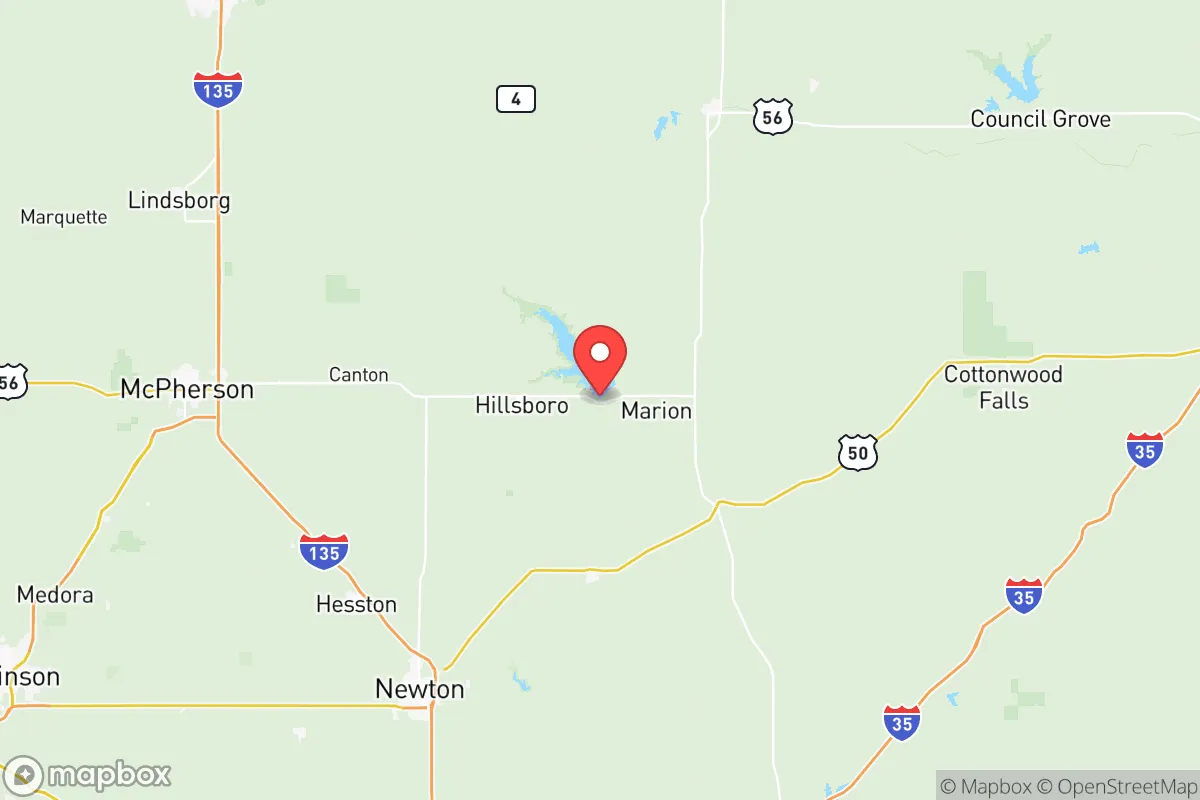
Marion County, Kansas, offers a notably high degree of personal sovereignty, grounded in a state-level legal framework that prioritizes individual autonomy, low taxation, and minimal regulatory interference. For those seeking to live with fewer government constraints—whether through self-defense, homesteading, or parental control—this rural county in the Flint Hills region presents a compelling environment. The county’s small towns, including Marion, Hillsboro, Peabody, Florence, and Goessel, each offer distinct flavors of this freedom, from the agricultural self-reliance of the countryside to the tight-knit, low-regulation communities in the towns themselves.
Tax burden and regulatory posture: How light is the government footprint?
Kansas is a low-tax state, and Marion County reflects that posture. The state’s income tax is a flat rate of 5.7% (as of 2026), with no local income tax, and the state sales tax is 6.5%, though local options can push it slightly higher. Property taxes in Marion County are among the lowest in the state, with an effective rate around 1.1% of assessed value—significantly lower than in Johnson County or the Kansas City metro. This light tax burden is paired with a regulatory environment that is generally permissive. Zoning is minimal outside of the incorporated towns; in unincorporated areas, there are no county-wide building codes or permit requirements for most residential structures, though septic system permits are required through the Kansas Department of Health and Environment. In towns like Hillsboro and Marion, zoning exists but is not onerous—typically focused on lot setbacks and use classifications rather than aesthetic controls. For a reader prioritizing autonomy, the key takeaway is that Marion County’s government footprint is small, with few layers of bureaucracy between a resident and their property decisions.
Self-defense and gun law specifics: What the Second Amendment looks like on the ground
Kansas is a constitutional carry state, meaning no permit is required to carry a concealed firearm for anyone legally allowed to possess one. This applies across Marion County, including in the towns of Peabody, Florence, and Goessel. There is no state-level waiting period, no firearm registration, and no magazine capacity restrictions. The state also has a strong “stand your ground” law, codified in K.S.A. 21-5231, which removes any duty to retreat before using deadly force in self-defense. Local law enforcement in Marion County is generally supportive of gun rights; the Marion County Sheriff’s Office, based in Marion, does not impose additional restrictions beyond state law. For those who prefer a permit for reciprocity purposes, Kansas issues a concealed carry license (CCL) with a simple background check and a $50 fee. The gun culture here is deeply ingrained—shooting ranges, hunting, and sport shooting are common, and the county’s rural nature means many residents practice on their own land. For a freedom-oriented reader, this is one of the most permissive self-defense environments in the Midwest.
Self-reliance and homesteading viability: Lot sizes, zoning, and off-grid feasibility
Marion County is a strong candidate for homesteading and off-grid living, particularly in its unincorporated areas. Minimum lot sizes in the county’s rural zones are typically 5 to 10 acres, though smaller parcels exist near towns. In the countryside around Hillsboro and Marion, many properties already operate with private wells, septic systems, and alternative energy sources. Off-grid living is legally feasible: there are no county ordinances prohibiting solar panels, rainwater collection, or composting toilets, though a septic permit is required for any wastewater system. The county does not enforce building codes outside city limits, so owner-built homes, tiny houses, and even yurts or RVs as primary residences are permissible, provided they meet basic health and safety standards. In towns like Peabody and Florence, zoning is more restrictive—typically requiring a permanent foundation and connection to municipal water and sewer—but still far less burdensome than in suburban or urban Kansas. For those seeking true self-reliance, the rural areas of Marion County offer a low-barrier entry point, with affordable land prices (often under $3,000 per acre) and a community that values independence.
Personal liberties: Parental rights, medical autonomy, speech, and property
Kansas law provides strong protections for personal liberties that resonate with a conservative-leaning audience. Parental rights are explicitly protected under state law; parents have the authority to direct their children’s education, including homeschooling without state-mandated curriculum oversight, and to opt out of school vaccinations. Medical autonomy is similarly broad: Kansas does not have a state-level vaccine mandate, and there are no restrictions on the use of alternative or complementary medicine. In Marion County, the local school districts—Marion-Florence USD 408, Hillsboro USD 410, and Peabody-Burns USD 398—are generally responsive to parental concerns, with school boards that lean conservative. Free speech is robust, with no local ordinances restricting political expression or signage beyond standard time-place-manner rules. Property rights are well-protected; eminent domain is rarely used, and there are no county-level rent control or landlord licensing laws. For a reader who values the ability to make personal decisions without government interference, Marion County’s legal environment is permissive across the board.
Overall, Marion County ranks among the more sovereignty-friendly areas in Kansas, especially when compared to the regulatory density of the Kansas City metro or even Wichita. The combination of low taxes, constitutional carry, minimal zoning, and strong personal liberties creates an environment where self-reliance is not just possible but culturally expected. For individuals and families seeking a place where the government’s role is limited and personal autonomy is the default, this county offers a practical, affordable, and legally supportive foundation.

* Values derived from national, state, county, city and local statistics and may differ in a specific area. Last updated: 2026-11-16T09:14:25.000Z
Narrative content on this page is AI-generated and may contain mistakes. Verify any details that matter before acting on them.
ReloMaps may earn a commission from affiliate links at no extra cost to you.

