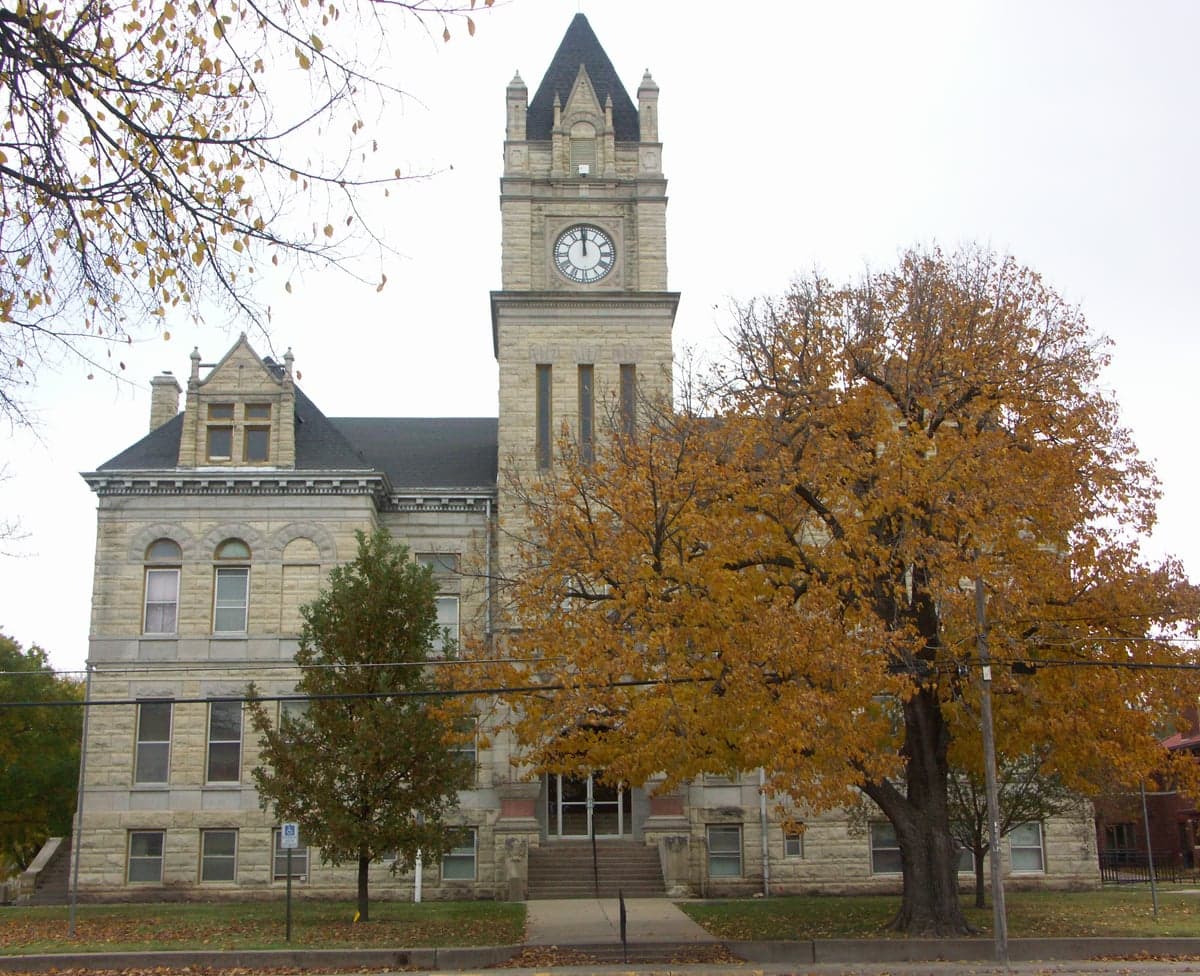
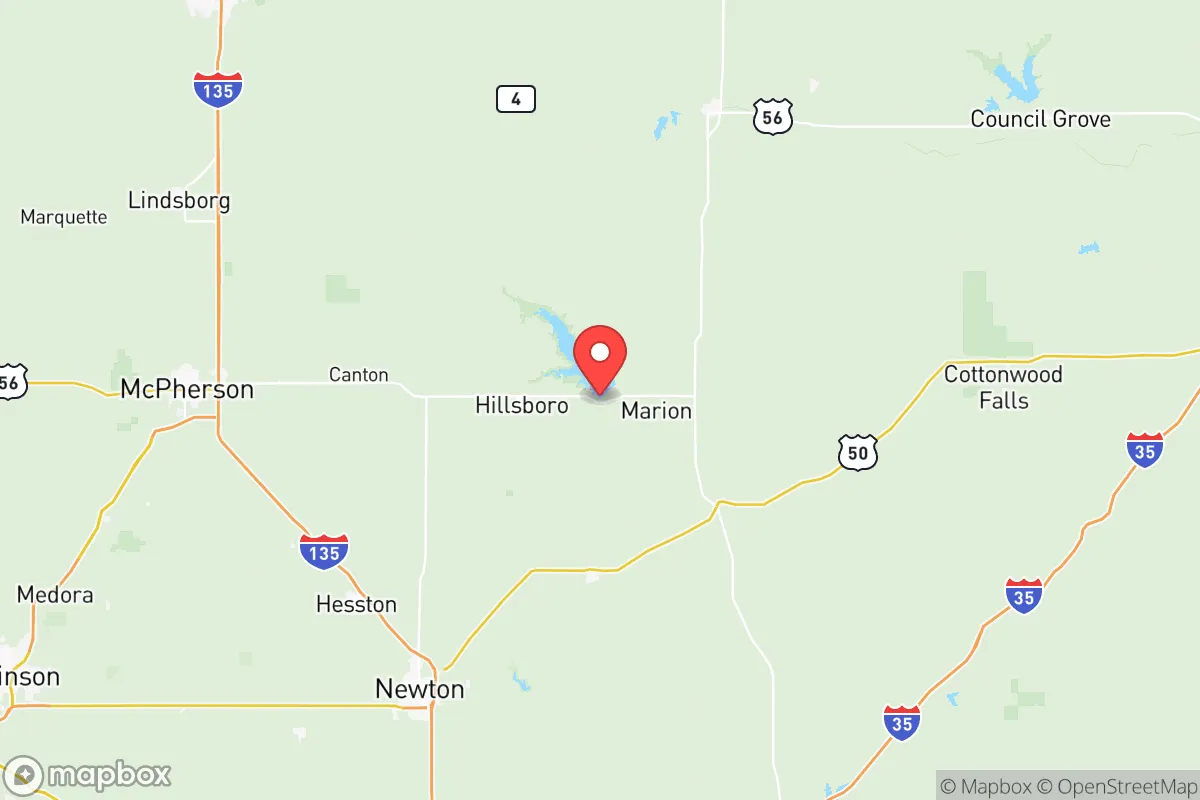
Photo: Wikipedia
Demographics of Marion County
Affluence Level in Marion County
A middle-class area roughly in line with national averages across income, home values, education, and employment.
People of Marion County
Marion County, Kansas, is a deeply rooted, predominantly white, rural community of 11,795 residents where the population is older, more homogenous, and more stable than nearly any other part of the state. With 91.4% of residents identifying as white and a foreign-born population of just 0.4%, the county’s character is defined by the descendants of 19th-century European settlers, particularly German Mennonites and Swiss immigrants, who shaped its agricultural economy and small-town culture. The county seat, Marion, and the city of Hillsboro serve as the cultural and economic anchors, while the surrounding unincorporated areas and smaller towns like Peabody and Goessel retain a strong sense of heritage. This is a place where family history runs deep, church attendance is high, and the pace of life is deliberately slow—a profile that appeals to those seeking a conservative, agrarian lifestyle but presents challenges for attracting new, diverse populations.
Settlement & growth (pre-1960)
Before American settlement, the land that is now Marion County was part of the traditional territory of the Kaw (Kansa) and Osage nations, who used the region for hunting bison along the Cottonwood River and its tributaries. The U.S. government forcibly removed these tribes to reservations in present-day Oklahoma through a series of treaties in the 1820s and 1830s, opening the area to Euro-American homesteaders. The first white settlers arrived in the 1850s, primarily from the Upper South and Ohio Valley, drawn by the promise of cheap land under the Preemption Act of 1841 and later the Homestead Act of 1862. These early pioneers—mostly of English, Scots-Irish, and German stock—established the first permanent settlements along the Cottonwood River, including the town of Marion (founded 1860) and the nearby community of Florence (founded 1871).
The defining demographic wave came in the 1870s and 1880s, when German-speaking Mennonites from the Russian Empire (present-day Ukraine) began arriving in large numbers. Fleeing religious persecution and the loss of their exemption from military service under Tsar Alexander II, these immigrants were recruited by railroad companies and land agents to settle the Kansas prairie. They brought with them a prized commodity: Turkey Red wheat, a hardy winter wheat variety that would transform Kansas into the nation's breadbasket. The Mennonites concentrated in the northern and central parts of the county, founding the towns of Hillsboro (1879), Goessel (1886), and Lehigh (1874). Their communal farming practices, strong religious identity, and commitment to pacifism created tight-knit enclaves that remain distinct today. A smaller but significant wave of Swiss immigrants arrived in the same period, settling near Burns (1872) and Peabody (1871), where they established dairy farms and cheese-making operations.
By 1900, the county's population had peaked at roughly 14,000, supported by wheat farming, cattle ranching, and the arrival of the Atchison, Topeka and Santa Fe Railway. The railroad spurred growth in Florence, which briefly became a regional shipping hub for grain and livestock. The Dust Bowl of the 1930s hit Marion County hard, causing a significant out-migration of tenant farmers and sharecroppers, many of whom joined the broader "Okie" exodus to California. World War II accelerated the decline of small family farms, as young men left for military service or defense jobs in Wichita and never returned. The county's population fell to around 10,000 by 1950, a trend that would continue for decades as agricultural consolidation reduced the need for farm labor.
Modern era (post-1965)
The post-1965 period, shaped by the Hart-Cellar Act's elimination of national-origin quotas, had almost no impact on Marion County's demographics. Unlike urban Kansas or the Sun Belt, the county received virtually no new immigration from Asia, Latin America, or Africa. The foreign-born population remains at 0.4%, and the Hispanic share—4.1%—is the only non-white group to show any measurable presence, largely concentrated in Marion and Hillsboro, where a small number of Mexican-American families work in meatpacking and agricultural processing. The Black population (1.1%) is almost entirely composed of descendants of the Great Migration-era families who came to work on the railroad in Florence and Peabody in the 1910s–1940s; these communities have shrunk dramatically as younger generations moved to Wichita or Kansas City for better opportunities.
The most significant demographic shift since 1965 has been domestic out-migration of young adults and the corresponding aging of the population. The county's median age is now over 45, well above the national average. The college-educated share (28.8%) is slightly below the Kansas state average, reflecting the limited white-collar job market. The Mennonite and Swiss communities have maintained their cultural institutions—including Tabor College in Hillsboro, a private Mennonite liberal arts school—but have seen their own youth leave for urban centers. Suburbanization has not occurred in any meaningful way; there are no bedroom communities for Wichita (45 miles southwest) or Salina (50 miles northwest), as the county lacks the highway connectivity and housing stock to attract commuters.
The future
Marion County's population is projected to continue its slow decline, with the Kansas State Data Center estimating a drop to roughly 11,000 by 2040. The county is becoming less diverse in relative terms, as the small Hispanic and Black populations age out and are not replaced by new arrivals. The white population is also shrinking, but at a slower rate, meaning the county's racial composition will remain overwhelmingly white (above 90%) for the foreseeable future. The most likely growth areas are Hillsboro and Marion, which benefit from having the county's only hospitals, schools, and grocery stores; the smaller towns like Florence, Burns, and Lehigh face continued population loss and potential depopulation.
Cultural identity is evolving slowly, driven by the tension between the traditional Mennonite values of pacifism, simplicity, and community service and the broader conservative political culture of rural Kansas. The county voted heavily Republican in 2024, with Donald Trump winning over 75% of the vote, reflecting a population that is culturally and politically conservative. However, the Mennonite influence has moderated some social policies; for example, the county has historically been more welcoming to refugees than neighboring areas, though the actual number of resettled families remains tiny. The next 10–20 years will likely see further consolidation of services into Marion and Hillsboro, a continued exodus of young adults, and a growing reliance on tourism—particularly to the Marion County Lake and the Cottonwood River—as an economic lifeline.
For someone moving in now, Marion County offers a stable, safe, and deeply traditional community where neighbors know each other, crime is low, and the cost of living is well below the national average. But it is not a place of demographic dynamism or rapid change. The population is aging, shrinking, and becoming more homogenous, and newcomers—especially those from outside the Midwest or without family ties—will find a community that is welcoming but insular. The county's future is one of preservation rather than growth, a quiet rural life for those who value continuity over change.

* Values derived from national, state, county, city and local statistics and may differ in a specific area. Last updated: 2026-11-16T09:14:25.000Z
Narrative content on this page is AI-generated and may contain mistakes. Verify any details that matter before acting on them.
ReloMaps may earn a commission from affiliate links at no extra cost to you.

