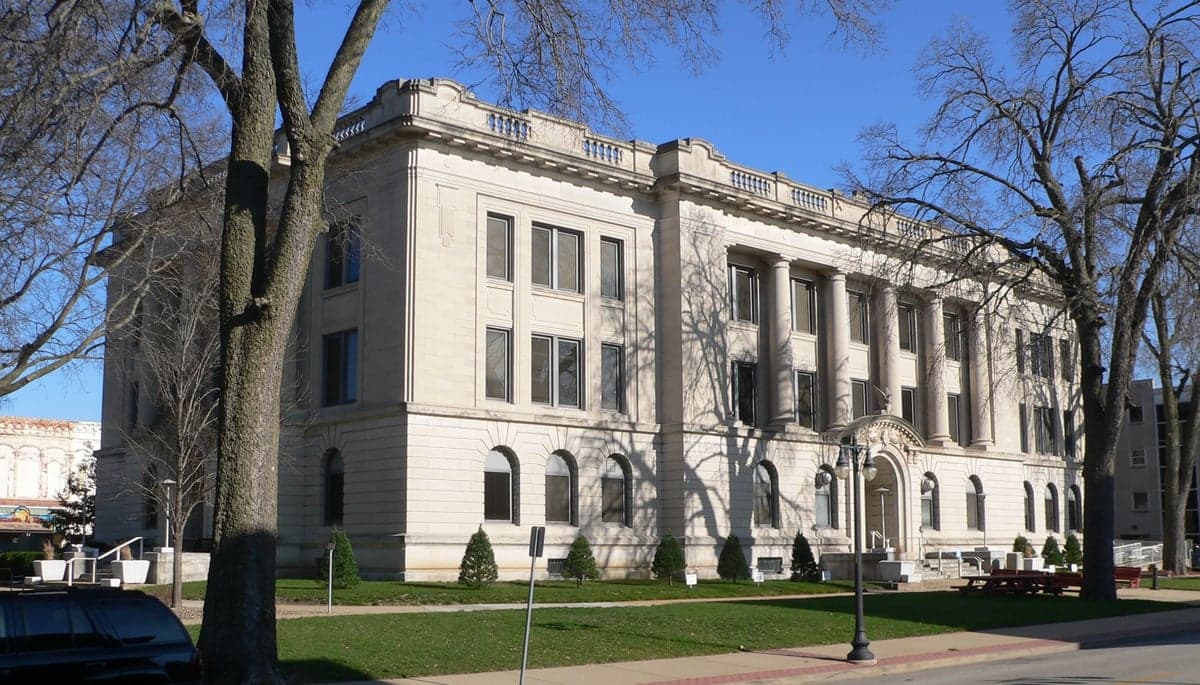
Photo: Wikipedia
Political ClimatePolitical Climate in Tazewell County
Showing county-level results — no local-only data available.
Lean and PVI are calculated from this county’s 2020 and 2024 presidential results, Cook-style.
Political rankings in Illinois
- Most Conservative Cities in Illinois
- Most Liberal Cities in Illinois
- Best Liberal-Leaning Towns in the Midwest
- Safest Liberal-Leaning Towns in the Midwest
- Safest Conservative-Leaning Towns in the Midwest
- Affordable Small Towns for Conservatives
- Most Affordable Liberal-Leaning Small Towns in the U.S.
- Safest Conservative-Leaning Cities in the U.S.
- Most Conservative Counties in Illinois
- Most Liberal Counties in Illinois
Local Political AnalysisPolitical Analysis of Tazewell County
Tazewell County sits solidly in the red column of Illinois politics, carrying a Cook Political Report Partisan Voter Index of R+11. That means the county votes about 11 points more Republican than the national average, a stark contrast to the state of Illinois as a whole, which leans Democratic at D+7. The gap is roughly 18 points, and it’s not a new development—this has been the lay of the land for decades, though the margins have shifted in interesting ways depending on the town and the election cycle.
How it compares
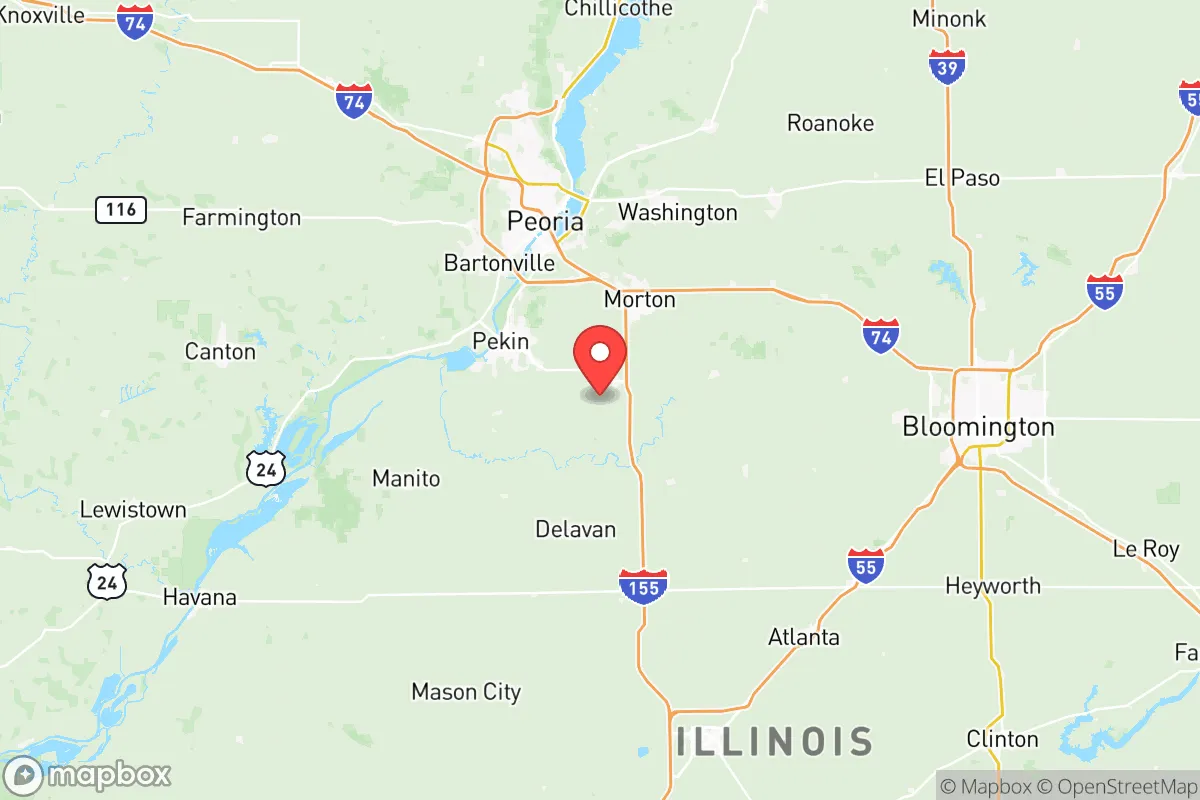
To understand Tazewell County, you have to look at the split between its two biggest population centers: Pekin and East Peoria. Pekin is the conservative anchor of the county, reliably turning out heavy Republican majorities in presidential, gubernatorial, and even local races. East Peoria leans Republican too, but it’s a bit more moderate, with a working-class base that has shown it will split tickets when a Democrat speaks to economic anxiety. The swing precincts are mostly in the unincorporated areas between the two cities and down toward Morton. Morton is the wildcard—historically a GOP stronghold, but its growing professional class has made it more competitive in recent cycles, with some precincts flipping to Democratic in 2020 and 2022. The southern part of the county, around Delavan and Hopedale, is deeply conservative, while the northern fringe near Creve Coeur and Marquette Heights trends more mixed, reflecting the blue-collar river towns’ occasional Democratic leanings.
Statewide, Illinois is dominated by Chicago and its collar counties, which is why the state tilts D+7. Tazewell County’s R+11 is a reminder that downstate Illinois is a different political universe. In 2020, Donald Trump carried the county by roughly 20 points, while Joe Biden won Illinois by 17. That’s a 37-point spread between county and state—one of the largest in the region. The county has voted Republican in every presidential election since 2000, but the margins have tightened in suburban areas like Morton, while Pekin has only gotten redder.
What this means for residents
For conservative residents, living in Tazewell County means your vote carries weight locally but gets drowned out statewide. You’re in the majority when it comes to county board races, sheriff elections, and state legislative districts that lean GOP. However, on statewide issues—governor, attorney general, ballot referenda—you’re on the losing side more often than not. That creates a sense of being governed from afar, which is a common refrain in Pekin and Delavan. For liberal residents, it’s the opposite. You’re a clear minority, but not an invisible one. Morton and parts of East Peoria have active Democratic precinct committees, and local races are often decided by a few hundred votes, so your participation genuinely matters. The practical effect is that both sides tend to be more civil in person—you can’t avoid your neighbors at the grocery store or the high school football game, so political arguments stay measured.
Cultural and policy distinctions
Culturally, Tazewell County is a place where the Second Amendment is a given, property taxes are a constant gripe, and the phrase “Chicago politics” is used as a pejorative. The county has resisted some of the state’s more progressive mandates, particularly around gun control and energy policy, with local officials often passing symbolic resolutions against Springfield’s laws. That said, the area isn’t monolithic—Morton’s pumpkin festival and its growing tech sector have brought in younger, more diverse residents who are shifting the conversation. Looking ahead, the county’s R+11 lean is likely to hold, but the internal geography is changing. If Morton keeps trending purple and East Peoria’s riverfront development attracts new residents, the county could become a more competitive battleground in the next decade. For now, though, it remains a reliable Republican outpost in a blue state, and that’s a fact of life both sides have learned to navigate.

State Political ClimatePolitical Climate in Illinois
State Political AnalysisPolitical Environment in the State
Illinois is a solidly Democratic state, with a Cook PVI of D+7, but that number flatters the statewide consensus more than the reality on the ground. The state is a tale of two political universes: a massive, vote-rich Chicago metro that dominates every statewide election, and a vast, deeply conservative downstate region that has been losing population and influence for decades. Over the last 20 years, the Democratic coalition has consolidated its grip on the governor’s mansion and the legislature, moving the state’s policy sharply left, while the Republican base has been pushed further into rural enclaves, making the partisan geography more extreme than at any point in recent memory.
Urban vs. rural divide
The political map of Illinois is essentially a battle between Cook County and the rest of the state. Chicago and its inner suburbs — places like Evanston, Oak Park, and Naperville — are the engine of the Democratic machine, delivering margins that make the statewide outcome a foregone conclusion. In 2022, Governor J.B. Pritzker won re-election by 12 points, but he lost 95 of the state’s 102 counties. The entire downstate region, from Rockford in the north to Carbondale in the south, is now a Republican stronghold, with counties like Williamson and Effingham routinely voting 70-75% Republican. The shift has been dramatic: as recently as the 1990s, downstate Democrats held a swath of seats in the legislature, but those "Blue Dog" districts have vanished. The collar counties around Chicago — DuPage, Lake, and Kane — have flipped from reliable Republican suburbs to competitive or lean-Democratic territory, driven by college-educated voters and a growing immigrant population. The result is a state where your political experience depends almost entirely on your zip code: a conservative in Chicago feels like a minority in their own neighborhood, while a liberal in Peoria or Springfield often feels similarly isolated.
Policy environment
Illinois’s policy environment is defined by its fiscal reality and its progressive legal framework. The state has the second-highest property tax burden in the nation, with an average effective rate around 2.1%, and a flat income tax of 4.95% that is scheduled to rise to 4.99% in 2025. The state’s pension debt, estimated at over $140 billion, is the worst in the country and drives a persistent structural deficit. On the regulatory side, Illinois is a union stronghold, with prevailing wage laws and a minimum wage of $15 an hour that is indexed to inflation. Education policy is centralized in Springfield, with a school funding formula that heavily redistributes state aid to Chicago Public Schools, a perennial source of downstate resentment. Healthcare is a mixed bag: the state expanded Medicaid under the Affordable Care Act and has some of the strongest patient protections in the Midwest, but rural hospital closures have been a persistent problem, with several downstate facilities shuttering in the last decade. Election law is notably liberal — Illinois has automatic voter registration, same-day registration, and no-excuse mail-in voting — which Republicans argue invites fraud, though no systemic issues have been proven.
Recent policy direction
The last five years have seen Illinois move decisively left on nearly every front. The most consequential change was the 2020 passage of the SAFE-T Act, which eliminated cash bail statewide — a first in the nation — and overhauled police training and use-of-force standards. The law became a lightning rod, with downstate sheriffs and state’s attorneys loudly opposing it, and it remains a central issue in every rural election. On guns, Illinois is the opposite of its neighbors: it banned assault weapons and high-capacity magazines in 2023, and Cook County has some of the strictest firearm regulations in the country, including a county-wide handgun ban that was upheld after the Supreme Court’s Bruen decision. On education, the state eliminated the requirement for standardized testing as a graduation condition and has expanded funding for early childhood programs, while parental rights advocates have clashed with school boards over library books and gender identity policies. On abortion, Illinois is a regional sanctuary, with the Reproductive Health Act of 2019 guaranteeing access, and the state has become a destination for women from Missouri, Wisconsin, and Indiana. Property rights are weaker than in most states — Illinois has no statewide preemption on local zoning, and municipalities like Chicago have enacted rent control and eviction protections that landlords argue are confiscatory. On taxes, the state’s failure to pass a graduated income tax in 2020 means the wealthy still pay the same flat rate as everyone else, a rare win for fiscal conservatives.
Civil unrest & political movements
Illinois has a long history of political volatility, and recent years have been no exception. The George Floyd protests in 2020 were particularly intense in Chicago, with looting in the Loop and the Magnificent Mile, and the city’s response — a mix of curfews and progressive police reform — became a national flashpoint. The state has also been a center of the immigration debate: Chicago is a designated sanctuary city, and the influx of over 30,000 migrants sent by Texas Governor Greg Abbott since 2022 has strained city resources and created a visible political crisis, with Mayor Brandon Johnson clashing with suburban mayors over where to house newcomers. On the right, the "constitutional sheriff" movement has gained traction downstate, with several counties passing resolutions declaring themselves "sanctuary counties" for gun owners and refusing to enforce parts of the SAFE-T Act. There have also been periodic calls for Chicago to secede from Illinois or for downstate to form a new state, though these efforts remain fringe. Election integrity is a live issue: Republicans have filed numerous lawsuits over ballot access and mail-in voting procedures, and the 2022 primary saw a contentious recount in a downstate congressional race. A new resident will notice the tension most acutely in the state capitol, Springfield, where the political culture is openly adversarial, and in the starkly different signage and rhetoric at protests in Chicago versus those in smaller towns like Marion or Ottawa.
Projection
Looking ahead five to ten years, Illinois’s political trajectory is likely to continue on its current path, but with increasing friction. The demographic trends are clear: Chicago and its suburbs are growing modestly, while downstate continues to lose population, which means the Democratic majority will likely grow in raw numbers. However, the state’s fiscal crisis is a ticking clock — if pension costs continue to crowd out spending, even the Democratic supermajority will face pressure to cut services or raise taxes, which could trigger a suburban backlash. The in-migration pattern is also notable: Illinois loses more residents to other states than any state except California, and those leaving are disproportionately conservative-leaning families heading to Indiana, Tennessee, and Florida. That self-selection means the state will likely become more liberal over time, but also more economically stratified, as wealthier residents leave and are replaced by lower-income migrants from other states. The SAFE-T Act and the gun ban are unlikely to be repealed, but court challenges may chip away at their edges. A conservative moving to Illinois today should expect to live in a state where their political views are a minority position, but where downstate communities still offer a cohesive, like-minded social environment. A liberal moving in will find a state that aligns with their values on most social issues, but will have to contend with the practical consequences of high taxes and strained public services.
For a new resident, the bottom line is that Illinois is a state where politics is inescapable. If you are conservative, you will find your tribe in the rural counties and smaller cities like Quincy, Effingham, or Mount Vernon, but you will be voting against the statewide tide and watching your tax dollars flow to Chicago. If you are liberal, you will find a welcoming policy environment in Chicago and the collar counties, but you will pay for it with some of the highest taxes in the nation and a state government that struggles to deliver basic services efficiently. The practical advice is to choose your community carefully — the political climate in Naperville is genuinely different from that in Danville, and the quality of life you experience will depend far more on your local municipality than on the state as a whole. Illinois is not a state that hides its political divisions; it wears them on its sleeve, and anyone moving here should be prepared to engage with that reality from day one.
* Values derived from national, state, county, city and local statistics and may differ in a specific area. Last updated: 2026-10-27T12:21:43.000Z
Narrative content on this page is AI-generated and may contain mistakes. Verify any details that matter before acting on them.
ReloMaps may earn a commission from affiliate links at no extra cost to you.

