
Photo: Wikipedia
Personal Sovereignty in Tazewell County
Viable for self-reliance. Generally workable, though some barriers may limit total independence.
What does Personal Sovereignty tell us?
Personal Sovereignty measures your capacity for self-reliance and independence with minimal government friction. Higher scores mean fewer barriers between you and the way you want to live... but it assumes you have the space you need and good neighbors.
What does this tell us?
Personal Sovereignty measures your capacity for self-reliance and independence with minimal government friction. Higher scores mean fewer barriers between you and the way you want to live... but it assumes you have the space you need and good neighbors.
State Policy
Energy independence: Importer (63% of energy produced in-state)
Personal Liberty
Homesteading

Personal Liberty Analysis
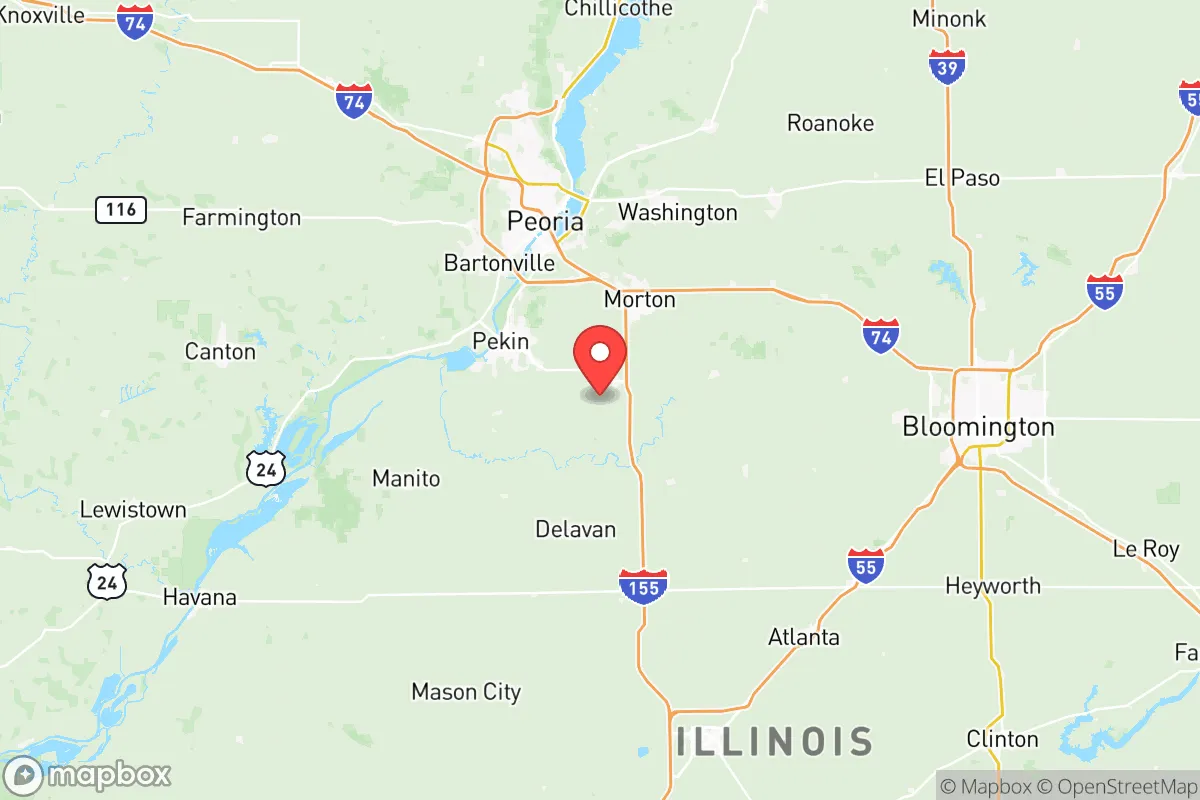
Tazewell County, Illinois, offers a distinctly mixed environment for personal sovereignty — one where a relatively light-touch rural regulatory culture meets the heavy hand of state-level mandates from Springfield. For individuals and families weighing independence, the county delivers on self-defense rights and homesteading space, but taxes and state preemption laws create real friction. The practical autonomy you experience here depends heavily on which of the county’s municipalities you call home, from the county seat of Pekin to the smaller towns of Washington, Morton, and East Peoria.
How the tax burden and regulatory posture compare to the rest of Illinois
Illinois is a high-tax state, and Tazewell County sits squarely within that framework. The state’s flat income tax rate of 4.95% applies to all residents, and the combined state and local sales tax in Tazewell County lands around 8.25% in most municipalities. Property taxes are the heavier lift: the statewide average effective property tax rate is roughly 2.07% of home value, and Tazewell County runs close to that figure, with Pekin and Washington seeing effective rates between 2.0% and 2.3% depending on school district boundaries. For a $250,000 home, that translates to roughly $5,000 to $5,750 annually — a significant recurring cost compared to neighboring Iowa or Indiana.
Regulatory posture at the county level is comparatively restrained. Tazewell County operates under a general county government structure with no county-wide zoning for unincorporated areas, meaning land use in rural parts of the county — around Green Valley, Hopedale, and Armington — is governed more by state environmental rules than local land-use boards. However, the incorporated towns are a different story. Morton and Washington maintain active zoning and building permit departments, and East Peoria enforces a full municipal code. The practical takeaway: if you want minimal regulatory interference, the unincorporated townships of Tazewell County — places like Deer Creek Township or Sand Prairie Township — offer far more latitude than the city limits of Pekin or Morton.
Self-defense and gun law specifics in Tazewell County
Illinois is a shall-issue state for concealed carry, and Tazewell County’s sheriff’s office processes Firearm Owner’s Identification (FOID) card applications and Concealed Carry License (CCL) permits in line with state statute. The county has a notably pro-Second Amendment culture, particularly in the rural townships and smaller communities like Tremont and Minier, where firearm ownership is a routine part of life. The Tazewell County Sheriff’s Office is known for efficient processing of FOID and CCL applications, though applicants still face the state-mandated 16 hours of training for a CCL and the FOID card requirement that has no equivalent in most other states.
One critical limitation: Illinois does not recognize concealed carry permits from other states, and there is no constitutional carry. This means a newcomer from a permitless-carry state like Missouri or Indiana must complete the full Illinois training and application process. Use of force law in Illinois is a Castle Doctrine state — there is no duty to retreat in your own home — but it stops short of a broad Stand Your Ground statute for public spaces. In Tazewell County, the practical enforcement posture is favorable: the county’s state’s attorney has not pursued aggressive prosecution of lawful self-defense cases, and the sheriff’s office publicly supports lawful carry. For a freedom-minded reader, the county is about as good as it gets in Illinois, but the state-level constraints remain a genuine limitation.
Self-reliance and homesteading viability across the county
Tazewell County’s agricultural character makes homesteading genuinely viable, but the feasibility varies sharply by location. The county is roughly 650 square miles of mostly prime Illinois farmland, with soil quality that supports serious vegetable production and livestock. In the unincorporated areas around Hopedale, Delavan, and Minier, you can find parcels of 5 to 40 acres at prices ranging from $8,000 to $12,000 per acre — significantly cheaper than the Chicago collar counties. Zoning in these townships is minimal, and the county does not impose a minimum lot size for agricultural use in unincorporated areas, so a 5-acre homestead with chickens, goats, and a large garden is entirely legal without special permits.
Off-grid feasibility is more complicated. Illinois has no statewide ban on rainwater harvesting, but the Illinois Plumbing Code requires a permit for any potable water system, and connecting to a well requires a licensed well driller. Solar panels are legal and net metering is available through Ameren Illinois, the county’s primary utility, but the permitting process runs through the local municipality for incorporated areas. In Pekin and Washington, you will need a building permit for a solar array and a separate electrical inspection. In unincorporated townships, the county requires only an electrical permit, and there is no zoning board to approve or deny your setup. Composting toilets are legal in unincorporated areas but face restrictions in Morton and East Peoria, which require connection to municipal sewer where available. For the most self-reliant setup, the townships around Green Valley and Armington offer the fewest hurdles.
Personal liberties: parental rights, medical autonomy, speech, and property
Illinois is a preemption state on many personal liberty fronts, which cuts both ways. On parental rights, the state mandates school vaccination requirements and has a comprehensive sex education law that applies to all public schools, including those in Tazewell County’s districts like Pekin Community High School and Washington Community High School. There is no parental opt-out for the sex ed curriculum, only for specific HIV/AIDS instruction. However, homeschooling is lightly regulated — Illinois requires no notice to the state, no standardized testing, and no teacher qualifications — making Tazewell County a strong choice for families who want to educate independently.
Medical autonomy is constrained at the state level. Illinois has no religious exemption from vaccination requirements for school attendance, and the state’s vaccine mandate for healthcare workers remains in effect. On the other hand, Illinois is a strong medical cannabis state, and Tazewell County has a dispensary in Pekin, with no county-level restrictions on patient access. Speech and property rights are more favorable: Tazewell County has no county-wide noise ordinances in unincorporated areas, no sign codes outside municipal limits, and the county sheriff’s office does not enforce federal firearms laws beyond state statute. Property rights are protected by the Illinois Eminent Domain Act, which requires a public hearing and just compensation, and Tazewell County has not pursued aggressive condemnation actions in recent years.
Overall, Tazewell County offers a moderate-to-strong sovereignty profile relative to the rest of Illinois, but a weak one compared to states like Texas, Tennessee, or Idaho. The county’s unincorporated townships — Hopedale, Minier, Green Valley, Armington — provide genuine homesteading freedom, low regulatory interference, and a gun-friendly culture that is rare in the state. But the tax burden is real, state preemption on education and medical mandates is binding, and the FOID card system remains a persistent annoyance. For a freedom-minded individual or family, the smart play is to locate in the rural townships, accept the state-level constraints as the cost of Illinois living, and leverage the county’s light-touch local governance to build the self-reliant life you want.

* Values derived from national, state, county, city and local statistics and may differ in a specific area. Last updated: 2026-10-27T12:21:43.000Z
Narrative content on this page is AI-generated and may contain mistakes. Verify any details that matter before acting on them.
ReloMaps may earn a commission from affiliate links at no extra cost to you.

