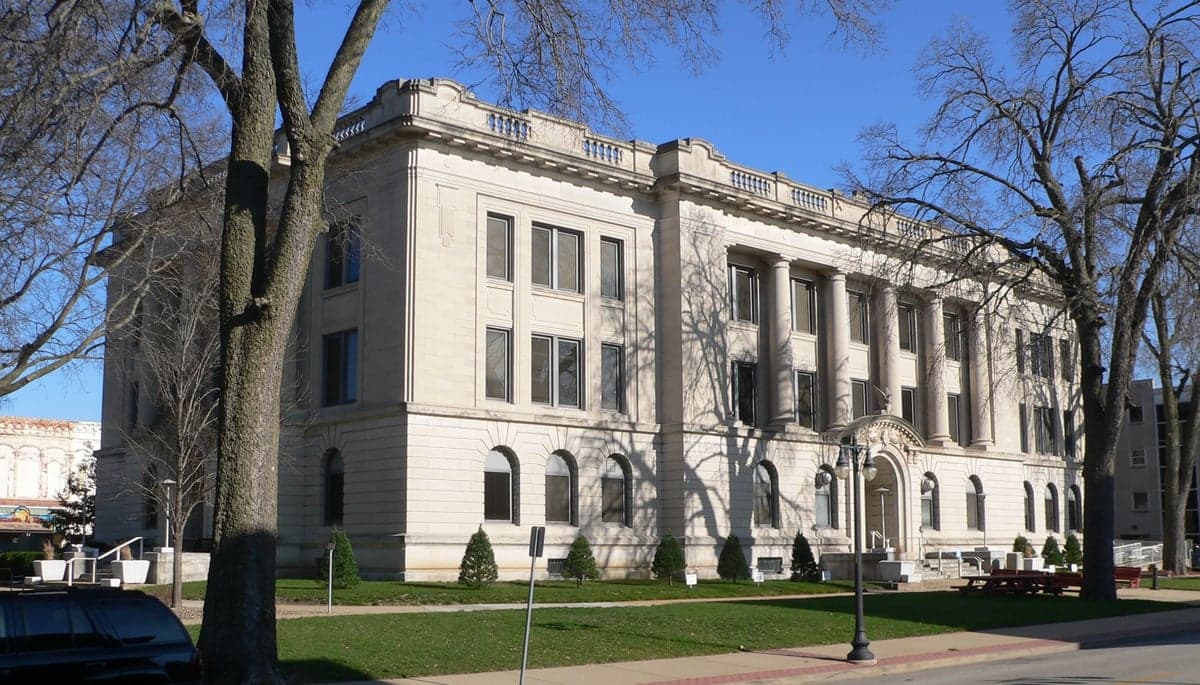
Photo: Wikipedia
Demographics of Tazewell County
Affluence Level in Tazewell County
A middle-class area roughly in line with national averages across income, home values, education, and employment.
People of Tazewell County
Tazewell County, Illinois, is home to roughly 130,555 residents, a population that remains overwhelmingly white (92.6%) and deeply rooted in its German and Yankee pioneer heritage. The county’s identity is defined by its historic Ohio River Valley settlement patterns, its long association with agriculture and heavy machinery manufacturing, and a demographic stability that sets it apart from the fast-growing suburbs of Chicago. With a foreign-born population of just 0.6%, this is one of the least ethnically diverse counties in the state, a place where family lineages often trace back to the same 19th-century homesteads.
Settlement & growth (pre-1960)
Before American settlers arrived, the region that would become Tazewell County was inhabited by the Kickapoo and Potawatomi peoples, who used the Illinois River valley as hunting and trading grounds. French explorers and traders passed through in the 17th and 18th centuries, but no permanent French settlements took root. The first permanent American presence came in the 1820s, when settlers from Kentucky, Virginia, and Tennessee pushed north along the Illinois River, drawn by the promise of rich, cheap prairie land.
The county was formally organized in 1827, named after Littleton Waller Tazewell, a Virginia senator. The earliest wave of settlers were predominantly of English and Scots-Irish stock, and they established the first permanent communities along the river. Pekin, the county seat, was founded in 1829 and quickly became the commercial hub, while Washington, settled in 1825, grew as an agricultural service town. These early settlers were largely subsistence farmers, but the completion of the Illinois-Michigan Canal in 1848 and the arrival of railroads in the 1850s transformed the county into a commercial agricultural powerhouse.
The most significant demographic wave came in the 1840s and 1850s, when German immigrants arrived in large numbers, fleeing political unrest and economic hardship in their homeland. These Germans were primarily farmers and skilled craftsmen, and they established tight-knit rural communities that persist to this day. Morton, incorporated in 1857, became the heart of German settlement in the county, earning a reputation as a center of truck farming and, later, pumpkin processing. The German influence is still visible in Morton’s annual Pumpkin Festival and in the Lutheran and Catholic churches that dot the countryside. East Peoria, which grew along the Illinois River, also attracted a significant German working-class population, many of whom found employment in the distilleries and packing houses that lined the waterfront.
The late 19th and early 20th centuries brought a smaller but notable wave of Irish and Italian immigrants, who settled primarily in Pekin and East Peoria, working on railroad construction and in the coal mines that operated in the southern part of the county. These groups remained relatively small, and by 1920 the county’s population was already overwhelmingly native-born white. The post-World War II era saw the rise of Caterpillar Inc. as the dominant employer, with its massive plants in East Peoria and Peoria drawing workers from across the Midwest. This industrial boom brought a modest influx of Appalachian migrants from Kentucky and Tennessee, who settled in working-class neighborhoods in East Peoria and Creve Coeur, a village founded in 1836 that became a classic company town.
Modern era (post-1965)
The 1965 Hart-Cellar Act, which fundamentally changed U.S. immigration policy, had almost no measurable impact on Tazewell County. Unlike the major metropolitan areas of the East and West Coasts, this county did not attract new immigrant communities. The foreign-born population today stands at just 0.6%, a figure that has remained essentially flat for decades. The county’s small Hispanic population (2.6%) is largely composed of Mexican-American families who arrived in the 1990s and 2000s, drawn by work in agriculture and meat processing, but they have not formed the concentrated ethnic enclaves seen in larger Illinois cities.
The more significant demographic story of the modern era has been domestic out-migration and suburbanization. Pekin and East Peoria have seen slow population decline since the 1970s, as manufacturing jobs have contracted and younger residents have left for larger metros. Meanwhile, Washington and Morton have experienced steady growth, transforming from farm towns into commuter suburbs for Peoria. These communities have become the county’s most desirable addresses, offering newer housing stock, strong school districts, and a safe, family-oriented atmosphere. The Black population (1.4%) and East/Southeast Asian population (0.8%) are concentrated almost entirely in Pekin and East Peoria, reflecting the historical pattern of minority settlement in the county’s older industrial centers.
Suburbanization has also reshaped the county’s economic geography. The construction of Interstate 74 in the 1960s and the subsequent development of the Shops at Grand Prairie retail complex in the 2000s shifted commercial activity away from downtown Pekin and toward the eastern edge of the county. This has reinforced the divide between the older river towns, which are aging and losing population, and the newer suburban communities, which are stable or growing.
The future
Demographic projections suggest Tazewell County will remain one of Illinois’ most demographically stable counties over the next two decades. The population is aging, with a median age well above the national average, and natural decrease (more deaths than births) is likely to become the norm. The county is not positioned to attract significant international immigration, and its domestic in-migration is likely to remain limited to retirees and a small number of remote workers drawn by lower housing costs.
The most likely scenario is continued slow decline in Pekin and East Peoria, modest growth in Washington and Morton, and a gradual increase in the Hispanic share of the population, perhaps reaching 4-5% by 2040. The county’s cultural identity will remain rooted in its German-American heritage, its agricultural traditions, and its connection to the manufacturing economy, even as that economy continues to shrink. The college-educated share of the population (28.4%) is below the national average, and this is unlikely to change dramatically without a major new employer entering the region.
For someone moving to Tazewell County today, the bottom line is this: you are choosing a place that values stability, tradition, and community over rapid change. The county offers affordable housing, low crime, and a strong sense of local identity, but it is not a place of demographic dynamism or cultural diversity. New residents will find a welcoming but insular environment, where the German-American heritage of Morton and the river-town history of Pekin remain the defining cultural touchstones.

* Values derived from national, state, county, city and local statistics and may differ in a specific area. Last updated: 2026-10-27T12:21:43.000Z
Narrative content on this page is AI-generated and may contain mistakes. Verify any details that matter before acting on them.
ReloMaps may earn a commission from affiliate links at no extra cost to you.

