
Photo: Wikipedia
Quality of Life in Peoria County
A livable area that tracks near national norms for affordability, walkability, and neighborhood health.
What does Quality of Life tell us?
Quality of Life measures an area by evaluating factors like cost of living, nearby amenities, country club access, airport proximity, socioeconomic signals and neighborhood character. For large states, this is a general average — quality of life can vary dramatically between metro areas, suburbs, and rural communities within the same state.
What does this tell us?
Quality of Life measures an area by evaluating factors like cost of living, nearby amenities, country club access, airport proximity, socioeconomic signals and neighborhood character. For large states, this is a general average — quality of life can vary dramatically between metro areas, suburbs, and rural communities within the same state.
Cost of Living
30% below national average
149%
The Real Cost of Living in Peoria County for 2026
| Tier | Individual | Family (4) |
|---|---|---|
| Survival | $15k | $28k |
| Comfortable | $30k | $44k |
| Luxury | $117k+ | $182k+ |
| Elite (Top 5%) | $154k+ | $239k+ |
Quality-of-Life Analysis
Peoria County, Illinois, offers a broad quality-of-life spectrum that ranges from the urban core of Peoria itself to quiet, unincorporated crossroads and working farmland, attracting everyone from young professionals and college students to retirees seeking low property taxes and families looking for affordable acreage. With a cost-of-living index of 70 (well below the U.S. average of 100), a median home value of $152,600, and a median rent of $946, the county provides tangible financial breathing room that varies noticeably depending on whether you choose a walkable city neighborhood, a riverfront suburb, or a rural township. The average commute of roughly 19 minutes is among the shortest for a Midwestern county of this size, meaning residents in the outer townships can still reach Peoria’s job centers without a long drive.
Largest town(s) & population centers
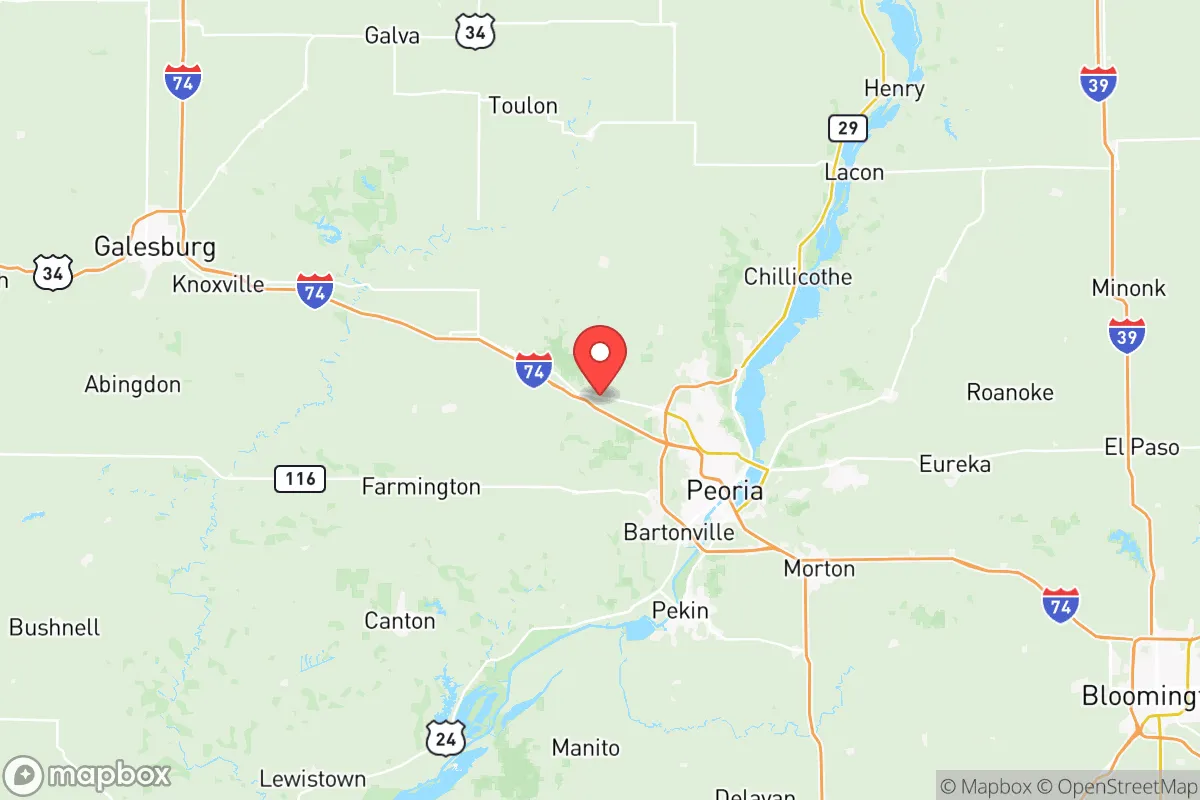
The county is anchored by the city of Peoria, the largest metro on the Illinois River between Chicago and St. Louis, with a population around 110,000. Daily life here centers on a revitalized riverfront district, the OSF HealthCare and UnityPoint Health medical campuses, and Caterpillar’s global headquarters. Downtown Peoria offers a mix of loft apartments, craft breweries, and the Peoria Civic Center, while the North Peoria and West Peoria neighborhoods feature older bungalows and mid-century ranch homes. Adjacent East Peoria (in Tazewell County but functionally part of the same metro) and Peoria Heights (a village within the county) provide more suburban-style living with quick access to the river and I-74. Chillicothe, about 12 miles north of Peoria, is a growing river town of roughly 6,000 residents that combines a historic downtown with new subdivisions popular with commuters who want a small-town feel without sacrificing proximity to the city’s hospitals and industrial employers.
Smaller towns & rural pockets
Beyond the main population corridor, Peoria County contains a string of smaller communities and unincorporated areas that offer distinctly quieter lifestyles. Dunlap, northwest of Peoria, has become a sought-after bedroom community thanks to its highly rated school district and large-lot subdivisions, though it retains a rural character with grain elevators and farm stands. Princeville (pop. ~1,700) and Elmwood (pop. ~2,000) are classic western Illinois farm towns with grain elevators, volunteer fire departments, and a slower pace; both have their own K–12 schools and are roughly 20–25 minutes from downtown Peoria. Brimfield (pop. ~900) and Hanna City (pop. ~1,200) are even smaller, with limited commercial services but very low housing costs and easy access to county parks and the Wildlife Prairie Park. Unincorporated areas such as Edwards, Laura, and Mossville consist of little more than a handful of homes and a church or post office, appealing to those who want true rural isolation while still being within a 30-minute drive of a major hospital.
Cost & lifestyle range
The cost-of-living spread across Peoria County is wide, even within a single ZIP code. At the upper end, newer subdivisions in Dunlap and the North Peoria neighborhoods near the Shoppes at Grand Prairie see home values well above the county median, often in the $250,000–$400,000 range, while rents for two-bedroom apartments in those areas can exceed $1,200. At the lower end, older homes in South Peoria and parts of West Peoria can be found for under $80,000, and rents in the city’s central neighborhoods frequently fall below the county median of $946. Rural townships such as Millbrook, Trivoli, and Kingston Mines offer the cheapest land per acre, with some properties selling for less than $10,000 per acre, but buyers should factor in well/septic maintenance and longer drives to grocery stores. Amenities shift accordingly: urban Peoria residents have walkable access to the Riverfront Museum, the Peoria Zoo, and multiple grocery stores, while rural residents rely on small-town hardware stores and weekly farmers markets in places like Elmwood and Princeville.
This county works best for people who value short commutes, low housing costs, and the ability to choose between an urban loft, a suburban cul-de-sac, or a farmhouse on a gravel road — all within the same school district or taxing body. Retirees on fixed incomes, first-time homebuyers priced out of larger metros, and remote workers who want a low-stress daily environment will find the most value here, while those seeking dense nightlife or high-end retail may find the options limited outside of Peoria’s downtown core.

Crime in Peoria County
Crime rates similar to the national median for U.S. locations.
Violent CrimeViolent Crime Analysis
Property CrimeProperty Crime Analysis
Crime Analysis
Peoria County, Illinois, presents a mixed safety picture that demands careful attention from potential residents. With a violent crime rate of 243.3 incidents per 100,000 residents and a property crime rate of 1,469.3 per 100,000, the county's overall risk profile sits above both state and national averages. These figures, however, mask significant variation between the urban core of Peoria and its surrounding communities, where safety outcomes differ markedly based on local law enforcement priorities and prosecutorial approaches within the 10th Judicial Circuit.
Crime in context
Peoria County's violent crime rate of 243.3 per 100,000 is roughly 30% higher than the national average of approximately 185 per 100,000 and notably above the Illinois state average of about 220 per 100,000. The property crime rate of 1,469.3 per 100,000 similarly exceeds the national benchmark of roughly 1,200 per 100,000. These statistics place Peoria County among the higher-crime jurisdictions in central Illinois, though it remains below the most dangerous urban counties in the Chicago metropolitan area. The county's crime index is heavily weighted by incidents reported within the city of Peoria itself, which accounts for the majority of the county's population and the overwhelming share of its violent offenses.
What residents experience
Daily life in Peoria County varies dramatically by location. The city of Peoria, particularly its south side and near-east side neighborhoods, experiences the highest concentration of violent crime, including aggravated assault and robbery. Residents in these areas report frequent property crime incidents such as vehicle break-ins and residential burglaries. In contrast, the suburban communities of Dunlap, Chillicothe, and Germantown Hills enjoy substantially lower crime rates, with some neighborhoods recording violent crime rates below 100 per 100,000. The disparity is largely attributable to differences in policing density, community engagement, and — critically — the prosecutorial environment. Peoria County's elected State's Attorney has pursued policies that prioritize diversion programs and reduced sentencing for non-violent offenders, a progressive approach that critics argue has contributed to recidivism and emboldened property criminals. Residents in the county's more conservative-leaning towns frequently express frustration that the justice system's leniency toward offenders undermines public safety and victim rights.
Neighborhood-level variation and safety strategies
Prospective residents should understand that Peoria County is not uniformly dangerous. The safest areas include West Peoria, Bartonville, and the northern portions of Peoria near the Grandview Drive corridor, where violent crime is rare and property crime rates are manageable. The most challenging areas remain the South Peoria and East Bluff neighborhoods, where poverty, gang activity, and under-resourced policing create persistent safety concerns. For those considering relocation, choosing a home in the Dunlap or Chillicothe school districts offers a statistically safer environment, while properties within Peoria city limits require careful street-by-street evaluation. The county's liberal judicial philosophy — including a State's Attorney who has publicly emphasized rehabilitation over incarceration — means that even arrested offenders often face minimal consequences, a factor that directly impacts property crime trends. Residents in safer suburbs report that proactive neighborhood watch programs and private security measures provide meaningful protection, but the overarching concern remains that the county's progressive criminal justice policies create conditions where crime can flourish unchecked in vulnerable communities.
* Values derived from national, state, county, city and local statistics and may differ in a specific area. Last updated: 2026-07-17T15:52:30.000Z
Narrative content on this page is AI-generated and may contain mistakes. Verify any details that matter before acting on them.
ReloMaps may earn a commission from affiliate links at no extra cost to you.

