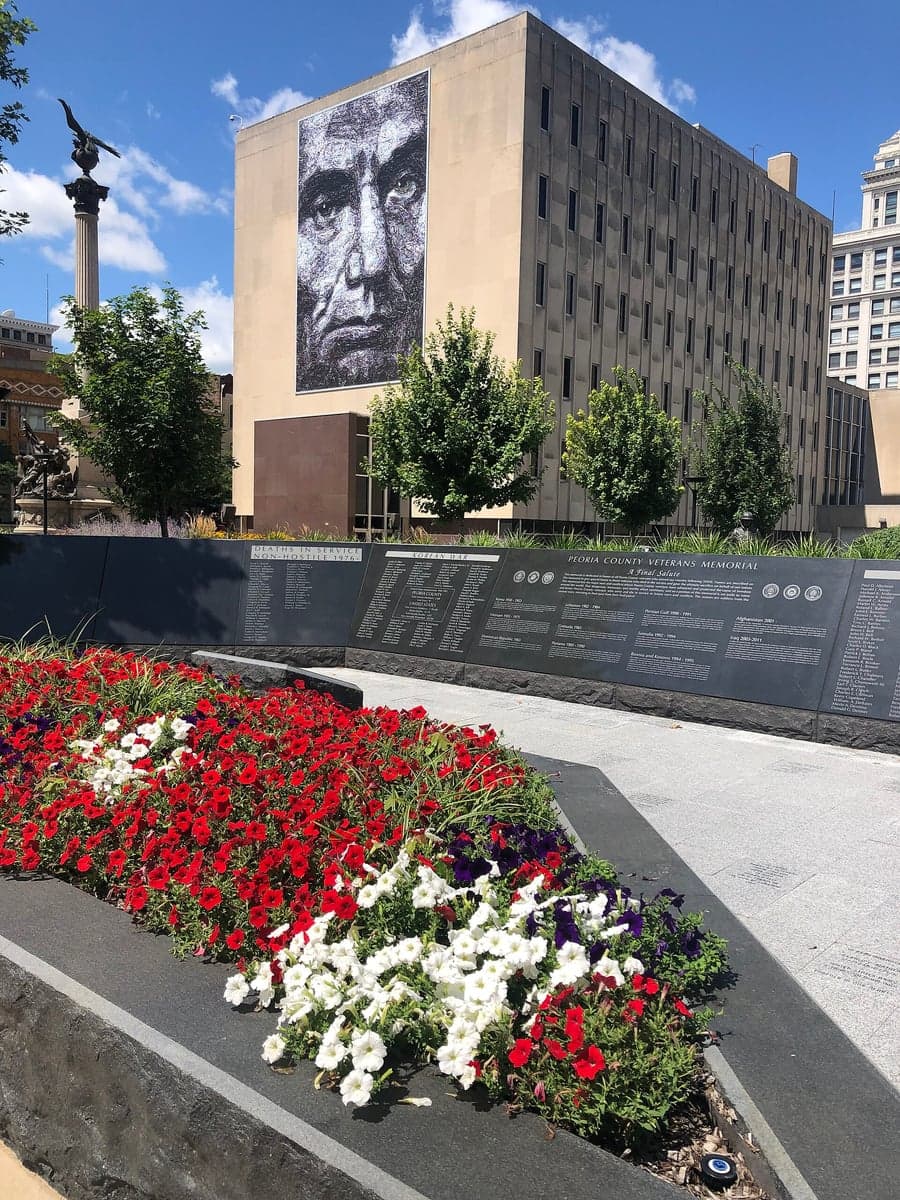
Photo: Wikipedia
Demographics of Peoria County
Affluence Level in Peoria County
A below-average socioeconomic profile. Incomes, home values, and educational attainment trail the U.S., with higher poverty and unemployment.
People of Peoria County
Peoria County, Illinois, is home to 179,831 residents, a population shaped by a deep history of industrial migration and more recent suburban shifts. The county is notably less diverse than the national average, with a population that is 67.0% White, 17.5% Black, 5.8% Hispanic, 2.3% East/Southeast Asian, and 2.2% Indian (subcontinent). While the city of Peoria itself retains a strong urban core identity, the county’s character is increasingly defined by its stable, family-oriented suburbs and a relatively low foreign-born share of just 4.1%.
Settlement & growth (pre-1960)
The area now known as Peoria County was originally inhabited by the Illiniwek (Illinois) Confederacy, particularly the Peoria tribe, for whom the city and county are named. French explorers and fur traders, including Jacques Marquette and Louis Jolliet, arrived in the late 17th century, establishing a small but persistent French presence along the Illinois River. This early European contact was limited to trading posts and missions, with no large-scale settlement until after the War of 1812.
American settlement began in earnest in the 1820s and 1830s, driven by the promise of fertile farmland and the strategic location of the Illinois River. The earliest waves were primarily settlers of Scots-Irish and English descent moving west from Kentucky, Tennessee, and Ohio. They founded the county seat of Peoria (established 1825) and smaller farming communities like Elmwood (1835) and Princeville (1837). These early settlers were largely subsistence farmers and small-scale merchants.
The defining demographic event for Peoria County was the industrial boom of the late 19th and early 20th centuries. The establishment of the R.G. LeTourneau earthmoving equipment company and, most critically, the Caterpillar Tractor Company (relocated to Peoria in 1925) transformed the region into a manufacturing powerhouse. This industrial growth pulled in massive waves of European immigrants. German immigrants arrived in large numbers from the 1850s through the 1890s, settling in Peoria's South Side and in the farming communities of Dunlap and Brimfield. Irish immigrants followed, working on the railroads and in the distilleries that once dotted the riverfront. Italian and Polish communities formed in the 1900s-1920s, concentrating in Peoria's near-south and east-side neighborhoods, often in tight-knit ethnic parishes.
The Great Migration of African Americans from the rural South to northern industrial cities brought a significant Black population to Peoria between 1910 and 1960. Drawn by jobs at Caterpillar and other factories, Black families settled primarily in Peoria's south-central and east bluff neighborhoods, establishing a vibrant cultural and business district along South Adams Street. This wave is the direct origin of the county's current 17.5% Black population share.
Modern era (post-1965)
The post-1965 era in Peoria County has been defined not by new international immigration but by domestic suburbanization and population stagnation. The 1965 Hart-Cellar Act, which reshaped immigration nationwide, had a relatively muted effect here. The county's foreign-born population remains low at 4.1%, far below the national average. The small East/Southeast Asian community (2.3%) and Indian community (2.2%) are largely the result of professional migration tied to Caterpillar's global operations and the presence of OSF HealthCare and UnityPoint Health, attracting engineers, doctors, and IT specialists from the 1980s onward. These groups are dispersed rather than concentrated in a single ethnic enclave, though a modest cluster of Asian-owned businesses exists near the intersection of War Memorial Drive and Knoxville Avenue in Peoria.
The most significant demographic shift since 1965 has been White flight to the suburbs and exurbs. As the city of Peoria's population declined from its 1950s peak of over 100,000 to roughly 110,000 today (a decline that has since stabilized), the surrounding towns grew. Dunlap (population ~1,500 in 1990 to over 4,000 today) and Chillicothe (population ~6,000) have become popular destinations for families seeking newer housing and top-rated school districts. Germantown Hills and Metamora have also seen steady growth as bedroom communities. This suburbanization has made the county whiter in its outer rings while the urban core has become more diverse, a pattern common across the Midwest.
The Hispanic population (5.8%) has grown steadily since the 1990s, driven by labor demand in construction, agriculture, and food processing. This community is most visible in Peoria's South Side and in the farming town of Princeville, where a smaller but established Hispanic workforce has taken root. Unlike in many Sun Belt regions, this growth has been gradual and has not triggered significant cultural or political backlash, reflecting the county's Midwestern pragmatism.
The future
Peoria County's population is projected to remain relatively flat or decline slightly over the next 10-20 years, mirroring broader trends across downstate Illinois. The county is becoming modestly more diverse, driven primarily by the growth of the Hispanic population and a slow increase in the Asian and Indian professional classes. The White population share (67.0%) is expected to continue its gradual decline, but the county will remain majority-White for the foreseeable future.
The most dynamic growth will likely occur in the Dunlap and Germantown Hills corridor, where new housing developments continue to attract families from within the county and from other parts of Illinois. The city of Peoria itself is seeing a modest urban revival, with new apartments and condos drawing young professionals and empty-nesters to the Warehouse District and riverfront. However, the county is unlikely to attract large new immigrant waves due to its relatively weak population growth and the absence of a major immigration gateway city.
Culturally, Peoria County is evolving from a blue-collar manufacturing identity toward a more healthcare-and-education-driven economy, anchored by OSF HealthCare, UnityPoint Health, and Bradley University. This shift is slowly raising the college-educated share (currently 34.5%) and attracting a more politically moderate, family-oriented population. The county's cultural identity remains distinctly Midwestern—pragmatic, community-focused, and skeptical of rapid change—but is gradually becoming more open to diversity.
For someone moving in now, Peoria County offers a stable, affordable, and safe environment with a strong sense of place. The population is older and less diverse than the national average, but the suburban school districts are excellent, the cost of living is low, and the job market in healthcare and manufacturing is steady. It is a place where the past—heavy industry, ethnic neighborhoods, and small-town farming—still shapes the present, but where the future is quietly being built in the suburbs and along the riverfront.

* Values derived from national, state, county, city and local statistics and may differ in a specific area. Last updated: 2026-07-17T15:52:30.000Z
Narrative content on this page is AI-generated and may contain mistakes. Verify any details that matter before acting on them.
ReloMaps may earn a commission from affiliate links at no extra cost to you.

