
Photo: Wikipedia
Political ClimatePolitical Climate in Peoria County
Showing district-level results — no local-only data available.
Local Political AnalysisPolitical Analysis of Peoria County
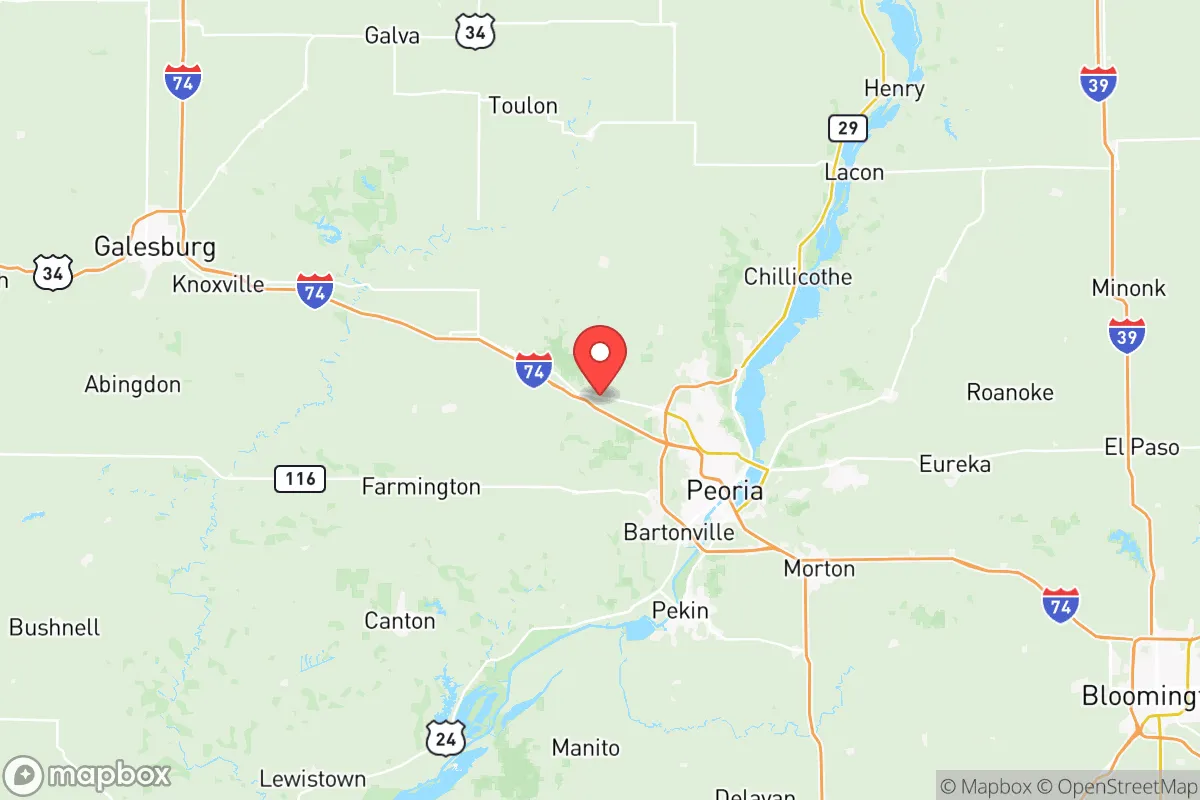
Peoria County has been a reliable Republican stronghold for decades, with a Cook PVI of R+11 that places it firmly in the red column compared to the rest of Illinois, which leans D+7 overall. The county has voted Republican in every presidential election since 2000, though the margins have tightened slightly in recent cycles—Donald Trump won it by 12 points in 2020, down from 18 in 2016. That said, the county's political identity isn't monolithic; you'll find real variation between the urban core of Peoria city proper and the surrounding townships.
How it compares
The R+11 PVI means Peoria County is about 18 points more Republican than the state as a whole, which is a D+7 lean. That gap is driven largely by the collar counties around Chicago pulling Illinois blue, while downstate counties like Peoria hold the line for the GOP. Inside the county, the city of Peoria itself is a Democratic island—precincts near the downtown, Bradley University, and the south side lean blue, often by 10-15 points. Meanwhile, towns like Dunlap, Chillicothe, and Germantown Hills are deep red, routinely voting 65-70% Republican. The swing precincts are in the unincorporated areas and smaller villages like Hanna City and Brimfield, where races for county board and state legislature can flip by a few hundred votes. In the 2022 gubernatorial race, Peoria County went for Republican Darren Bailey by 8 points, while the state as a whole reelected Democrat J.B. Pritzker by 12—a 20-point spread that shows how out of step the county is with statewide trends.
What this means for residents
For conservative residents, Peoria County feels like a comfortable place to live politically. Local offices—county board, sheriff, state's attorney—are reliably held by Republicans, and the county GOP is well-organized with active precinct committees in places like Dunlap and Chillicothe. You'll see Trump signs in yards year-round, and conservative viewpoints are the default in most social and business settings outside the city limits. For liberal residents, the reality is more mixed. The city of Peoria provides a blue bubble with progressive city council members and a vocal Democratic party, but countywide votes on issues like tax referendums or school board races often tilt conservative. The county's Republican lean means that statewide Democratic policies—like the 2021 energy bill or the 2023 assault weapons ban—are deeply unpopular here, and local officials frequently pass resolutions opposing them. That creates a tension where residents live under state laws they didn't vote for, which fuels ongoing debates about home rule and local control.
One cultural distinction that stands out is the county's relationship with organized labor. Peoria is the home of Caterpillar Inc., and the union presence—especially the UAW and operating engineers—has historically given Democrats a foothold even in a red county. But that's shifting: many union members voted for Trump in 2016 and 2020, and the county's working-class precincts in Bartonville and Bellevue are now swing areas that both parties target heavily. The result is a political climate that feels more pragmatic than ideological—people here care about jobs, taxes, and schools more than national culture wars. If you're moving to Peoria County, expect a place where your neighbors will know your party affiliation, but it won't define your relationships. The county's trajectory is slowly trending purple as Peoria city grows more diverse and younger, but for the foreseeable future, it remains a solid red anchor in a blue state.

State Political ClimatePolitical Climate in Illinois
State Political AnalysisPolitical Environment in the State
Illinois is a solidly Democratic state at the statewide level, carrying a Cook PVI of D+7, but that number masks a deep and growing urban-rural chasm. The state’s political engine is the Chicago metropolitan area, which alone accounts for roughly two-thirds of the population and reliably delivers massive Democratic margins. Over the past 10-20 years, the state has shifted leftward on social and fiscal policy, driven by a dominant Chicago coalition, while downstate and many suburban areas have trended Republican. For a conservative-leaning relocator, the reality is that you’re moving into a state where your vote for president or U.S. Senate will almost certainly be outmatched, but where local control and county-level politics can still give you a strong voice — especially if you choose your town carefully.
Urban vs. rural divide
The political map of Illinois is a tale of two worlds. The city of Chicago and its inner suburbs — places like Evanston, Oak Park, and Naperville — vote overwhelmingly Democratic, often by margins of 70-80% in presidential races. Cook County is the Democratic stronghold, but the collar counties (DuPage, Lake, Kane, Will, and McHenry) have become more competitive. McHenry County, for instance, has remained reliably Republican, while DuPage and Lake have shifted left in recent cycles, especially in more affluent, educated precincts. Downstate, the picture flips: rural counties like Effingham, Macoupin, and Williamson vote Republican by 60-70% or more. The metro areas of Peoria, Rockford, and Champaign-Urbana are more mixed — Peoria leans Republican but has a Democratic-leaning urban core, while Champaign-Urbana, home to the University of Illinois, is a blue island in a red sea. The divide is stark: drive 90 minutes southwest of Chicago and you’re in deep-red territory where conservative values dominate local government and social life.
Policy environment
Illinois has a progressive tax structure — a flat income tax rate of 4.95% — but property taxes are among the highest in the nation, averaging around 2.1% of home value statewide, with Cook County often exceeding 2.5%. The state’s regulatory posture is generally business-friendly in some sectors (agriculture, manufacturing) but heavily regulated in others (energy, labor, and environmental). Education policy is centralized: the state funds schools through a formula that favors districts with higher poverty, which means wealthier suburbs often see higher local property tax levies. Healthcare is broadly accessible, with Illinois expanding Medicaid under the ACA and maintaining a state-based insurance exchange. Election laws are among the most liberal in the country: no-excuse mail-in voting, automatic voter registration, and same-day registration are all in place. For conservatives, the policy environment can feel like swimming upstream on fiscal and cultural issues, but local governments in red counties often push back — for example, many downstate counties have passed resolutions opposing state gun laws.
Recent policy direction
The last five years have seen a flurry of legislation that has moved Illinois decisively leftward. On gun rights, the state passed the Protect Illinois Communities Act in 2023, banning the sale of assault weapons and high-capacity magazines — a law that has sparked lawsuits and a federal court challenge. Self-defense law remains a mixed bag: Illinois is a shall-issue state for concealed carry, but with a preemption statute that prevents local governments from enacting their own restrictions. On education and parental rights, the state passed a law in 2021 requiring schools to include LGBTQ+ history in curricula, and in 2023, it banned book bans in public libraries. Parental notification for abortion was repealed in 2022, and Illinois has become a sanctuary for out-of-state abortion seekers. On privacy and surveillance, the state passed the Biometric Information Privacy Act (BIPA), one of the strictest in the nation, but also expanded police surveillance powers in some areas. Property rights are generally strong, but the state’s high property taxes and a recent law allowing localities to implement rent control in some cases have raised concerns. Voting access has been expanded with the 2023 Elections Omnibus Bill, which codified mail-in voting and early voting periods. For a conservative relocator, the takeaway is that Illinois is actively moving in a direction that may conflict with your values on guns, education, and taxes — but the state’s legal framework still allows for significant local variation.
Civil unrest & political movements
Illinois has seen its share of political flashpoints. The 2020 George Floyd protests in Chicago were large and sometimes violent, leading to looting and property damage that reshaped downtown retail. Since then, organized activist movements on the left have focused on police reform, rent control, and environmental justice. On the right, there is a growing movement of county-level “sanctuary county” resolutions against state gun laws — over 70 counties have passed symbolic resolutions opposing the assault weapons ban. Immigration politics are a major fault line: Chicago is a sanctuary city, and the state has poured resources into welcoming migrants, while downstate communities have pushed back against state-funded resettlement. Election integrity controversies have been relatively muted compared to other states, but some rural counties have called for audits of the 2020 election. A new resident would notice the political tension most in the contrast between Chicago’s progressive activism and the conservative culture of places like Effingham or Quincy, where “We Support the Second Amendment” signs are common.
Projection
Over the next 5-10 years, Illinois’s political trajectory is likely to continue its leftward drift, driven by demographic trends: Chicago’s population is slowly declining, but the suburbs are growing and becoming more diverse and Democratic-leaning. Downstate population is stagnant or shrinking, which means the state’s political center of gravity will remain in the Chicago metro. In-migration is modest — Illinois loses more residents to other states than it gains, with many leaving for Texas, Florida, and Indiana — but those who move in tend to be younger and more liberal, especially in the collar counties. For a conservative moving in now, expect to see continued expansion of gun control, higher property taxes to fund pension obligations, and a state government that is unlikely to shift rightward. However, local control in red counties will remain strong, and you can find communities where your vote matters in local races. The state’s fiscal challenges — a massive unfunded pension liability — will likely force tax increases or service cuts, which could accelerate out-migration of conservatives.
Bottom line: If you’re a conservative considering Illinois, you need to be realistic about the statewide political climate. Your vote for president or Senate won’t count much, but you can find a home in a red county like McHenry, Effingham, or Williamson where local government aligns with your values, property taxes are lower than in Cook County, and the culture is more traditional. The trade-off is that you’ll be living under state laws you may disagree with on guns, taxes, and education. For families who prioritize local community and are willing to engage in local politics, Illinois offers a mix of urban opportunity and rural conservatism — but it’s not a state where conservatives will feel politically dominant.
* Values derived from national, state, county, city and local statistics and may differ in a specific area. Last updated: 2026-07-17T15:52:30.000Z
Narrative content on this page is AI-generated and may contain mistakes. Verify any details that matter before acting on them.
ReloMaps may earn a commission from affiliate links at no extra cost to you.

