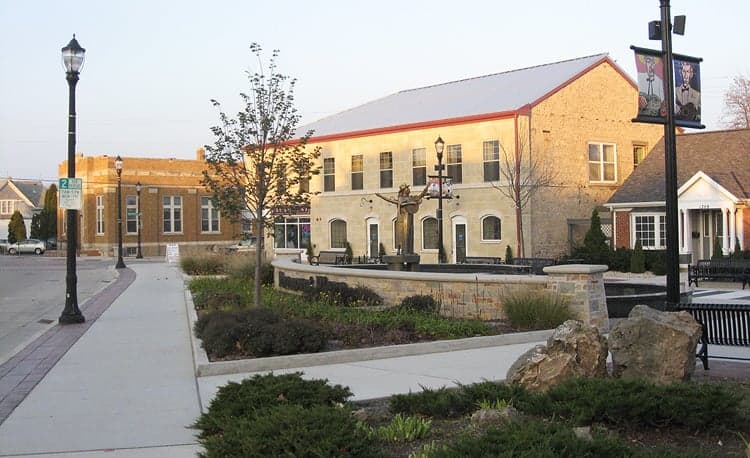
Photo: Wikipedia
Political ClimatePolitical Climate in Grafton, WI
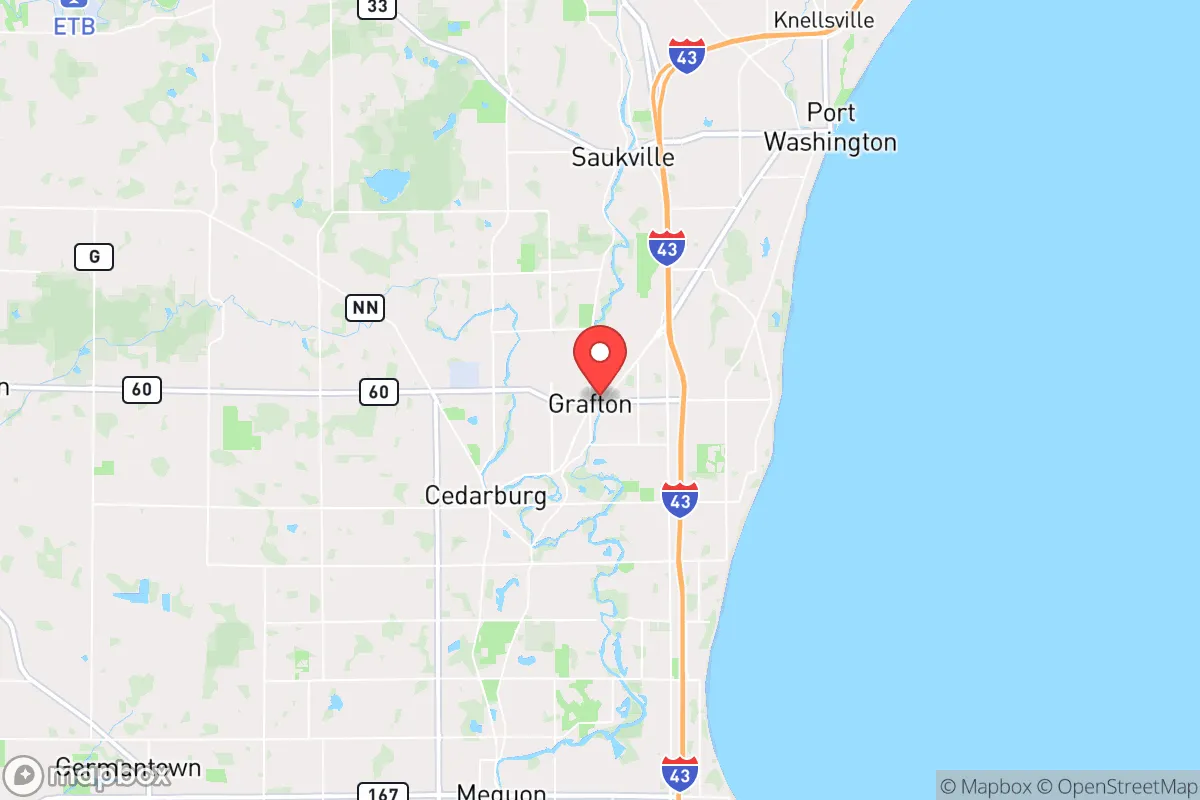
District shown is the primary district for this city’s centroid. Cities may span multiple districts.
Local Political AnalysisPolitical Analysis of Grafton, WI
Grafton leans solidly Republican, with a Cook PVI of R+8, making it noticeably more conservative than Wisconsin as a whole, which sits at EVEN. That gap isn't just a stat on a page—it shapes everything from local school board races to how neighbors talk about state politics over the fence. The village has been trending this way for a while, and while it's not a deep-red stronghold like some of the rural towns further west, it's a place where Republican candidates can generally expect to win comfortably.
How it compares
The contrast between Grafton and the rest of Wisconsin is stark when you look at the broader map. The state's EVEN PVI reflects a genuine purple status—think of the razor-thin margins in recent presidential elections, where the state flipped between parties. Grafton, however, sits in Ozaukee County, which has been a reliable Republican anchor in southeastern Wisconsin for decades. Drive a few miles south to Milwaukee County and you'll find a heavily Democratic urban core, while heading west toward Washington County reveals an even more conservative electorate. Grafton sits in that suburban middle—conservative, but not as hard-edged as some of its neighbors. The village's politics tend to be more about fiscal restraint and local control than the culture-war intensity you might see in more rural parts of the state.
What this means for residents
For conservative residents, living in Grafton means your vote carries weight locally. School board meetings, village board elections, and county races are generally won by candidates who align with Republican priorities, and there's a sense that local government reflects the majority's values. You'll see Republican signs on lawns during election season, and conservative viewpoints are the default in casual conversation. For liberal residents, the reality is different—you're likely in the minority, and that can feel isolating at times. But it's not hostile. Grafton is a community where people know their neighbors, and political differences rarely get in the way of a friendly wave at the grocery store or a chat at the soccer game. The practical effect is that liberal residents often find their energy goes into state-level races or volunteer work in nearby Milwaukee, where their votes and voices have more impact. It's a live-and-let-live atmosphere, but the political gravity is unmistakably right-leaning.
What sets Grafton apart from some other conservative suburbs is its relative moderation on certain issues. The village has invested in its downtown and parks, and there's a pragmatic streak that values quality of life over ideological purity. You won't see the kind of hardline stances on things like library funding or public services that you might find in more rural, more isolated conservative areas. The trajectory seems stable—Grafton is likely to remain R+8 or similar for the foreseeable future, as the demographic makeup of the village hasn't shifted dramatically. New development is bringing in families, but they're largely drawn to the area for the schools and safety, not for political reasons. If anything, the area's conservatism is a quiet, steady force rather than a loud one. For anyone moving here, the takeaway is simple: it's a comfortable, safe, and politically predictable place to live, where the conservative majority sets the tone but doesn't make life difficult for those who disagree.

State Political ClimatePolitical Climate in Wisconsin
State Political AnalysisPolitical Environment in the State
Wisconsin is the definition of a battleground state — its Cook PVI sits at EVEN, meaning it votes almost exactly with the national average, and the last two presidential elections were decided by margins under one point (Biden by 0.6% in 2020, Trump by 0.9% in 2024). The state has flipped between parties in four of the last six presidential cycles, and its political identity is split between a heavily Democratic urban crescent along Lake Michigan and a deeply Republican rural and exurban interior. For a relocator, that means your experience of Wisconsin politics depends almost entirely on which of the state’s 72 counties you land in.
Urban vs. rural divide
The political map of Wisconsin is a tale of two geographies. The Democratic base is anchored by Milwaukee (which delivered roughly 60% of the party’s statewide margin in 2024), Madison (Dane County, which voted 75% Democratic and is the state’s fastest-growing urban center), and the smaller college towns of Eau Claire and La Crosse in the west. These four metros are the engine of the Democratic coalition, powered by union households, university faculty, and a growing professional class. The Republican base is everything else — the vast rural and exurban expanse from Wausau and Green Bay in the north to Kenosha and Racine along the Illinois border. The WOW counties (Waukesha, Ozaukee, Washington) ringing Milwaukee are the single most Republican suburban bloc in the Upper Midwest, routinely voting 60-65% GOP and serving as the counterweight to the city itself. The 2024 election saw the GOP make inroads in the previously competitive Brown County (Green Bay) and Outagamie County (Appleton), while Democrats held the line in Dane and Milwaukee. The swing territory that decides the state is the "WOW belt" exurbs and the western Wisconsin driftless region — areas where a few thousand votes in either direction tip the whole state.
Policy environment
Wisconsin’s policy posture is a study in divided government. The state has a flat 4.4% individual income tax (reduced from 7.65% in 2011) and a 5% corporate rate, with no estate tax. Property taxes are above the national median but capped by state levy limits. The regulatory climate is moderate — Wisconsin is a "right-to-work" state (passed in 2015), which weakened unions in the private sector, but public-sector unions remain active, especially in education and local government. Education policy is a flashpoint: the state has a robust school choice program (the Milwaukee Parental Choice Program is the nation’s oldest, dating to 1990), and the 2023-25 budget expanded voucher eligibility to middle-income families. Healthcare is a mixed bag — Wisconsin did not expand Medicaid under the Affordable Care Act, but it has a unique "BadgerCare Plus" program that covers childless adults up to 100% of the federal poverty level, a compromise that has kept the uninsured rate below 6%. Election law is notable: Wisconsin has no automatic voter registration, requires a photo ID, and allows same-day registration — a combination that makes it both one of the most accessible and most scrutinized voting systems in the country.
Recent policy direction
The last five years have seen Wisconsin lurch between vetoes and overrides. Governor Tony Evers (D) has vetoed over 100 Republican bills since 2019, including a 2023 bill that would have banned abortion at 14 weeks (the state’s 1849 law was struck down by the courts in 2023, leaving abortion legal up to 20 weeks). On guns, Wisconsin is a shall-issue state for concealed carry (since 2011), has no assault weapons ban, and in 2024 the legislature passed a bill allowing permitless carry — which Evers vetoed. The state has a "castle doctrine" but no "stand your ground" law. On parental rights, the 2023-25 budget included a $1,000 per-child tax credit and expanded school choice, but a 2023 bill requiring schools to notify parents of a student’s gender identity change was vetoed. Property rights are strong — Wisconsin has no statewide zoning mandate, and rural counties are largely unincorporated. On privacy, the state has no comprehensive data privacy law, and a 2024 bill restricting warrantless cell-site tracking died in committee. The clearest recent trend is fiscal: the state ended 2024 with a $4.6 billion surplus, and the GOP legislature has pushed for a 3.5% flat income tax (down from 4.4%), which Evers has so far blocked. The 2024 election gave Republicans a two-thirds supermajority in the state Senate and a near-supermajority in the Assembly, setting up a potential override dynamic in 2025-26.
Civil unrest & political movements
Wisconsin has a visible history of political flashpoints. The 2011 Act 10 protests in Madison drew over 100,000 people to the Capitol and sparked a failed recall of Governor Scott Walker — a moment that defined the state’s modern partisan divide. The 2020 Kenosha unrest, following the shooting of Jacob Blake, saw two nights of rioting and the killing of two protesters by Kyle Rittenhouse, whose acquittal in 2021 became a national touchstone for self-defense law. The state has an active right-wing movement centered on the Waukesha County GOP and the "Wisconsin Patriots" network, which organized election-integrity efforts after 2020. On the left, the Democratic Socialists of America have a strong Milwaukee chapter, and Madison hosts one of the largest annual Pride parades in the Midwest. Immigration is a quieter issue — Wisconsin has no sanctuary cities (Milwaukee’s "welcoming city" ordinance is largely symbolic), and the state’s foreign-born population is only 5.4%, well below the national average. The most visible ongoing flashpoint is election administration: the Wisconsin Elections Commission has been the target of repeated GOP audits and a 2022 Supreme Court ruling that banned most ballot drop boxes, a decision the newly liberal state court (flipped in 2023) is likely to revisit.
Projection
Over the next decade, Wisconsin is likely to remain a coin-flip state, but the underlying demographics are shifting. Dane County is growing at 1.5% annually, adding roughly 8,000 new residents per year — most of them young, college-educated, and Democratic. Meanwhile, the rural north and west are losing population, which concentrates GOP votes in fewer, denser counties. The 2023 state Supreme Court election, which flipped the court to a 4-3 liberal majority, has already led to the redrawing of legislative maps — the 2024 election under new maps produced a much more balanced Assembly (54-45 GOP) after a decade of Republican supermajorities. That court will also rule on abortion access, drop boxes, and possibly a new gerrymander challenge before 2030. In-migration is modest — Wisconsin ranks 30th in net domestic migration — but the retirees moving to Door County and the Wisconsin Dells area tend to be conservative, while the remote-work influx into Madison and Milwaukee skews liberal. The practical trajectory: expect continued divided government, with the governorship and legislature often in different hands, and expect the state to remain a top-tier presidential battleground through at least 2032.
For a new resident, the bottom line is that Wisconsin rewards political engagement rather than passive residence. If you’re conservative, you’ll find a state where your vote matters more than almost anywhere else — the WOW counties and the rural north give you a strong base, and the legislature is likely to remain at least competitive. If you’re liberal, you’ll find a state where your vote also matters — Dane and Milwaukee are growing, and the courts are currently trending your way. The taxes are moderate, the schools are decent, and the politics are intense but not violent. Just know that your neighbors will ask you who you voted for, and they’ll mean it.
* Values derived from national, state, county, city and local statistics and may differ in a specific area. Last updated: 2026-10-12T02:07:22.000Z
Narrative content on this page is AI-generated and may contain mistakes. Verify any details that matter before acting on them.
ReloMaps may earn a commission from affiliate links at no extra cost to you.

