Photo: Wikipedia
Demographics of Grafton, WI
Affluence Level in Grafton, WI
An upper-middle-class area. Household wealth, education levels, and homeownership run ahead of national benchmarks.
People of Grafton, WI
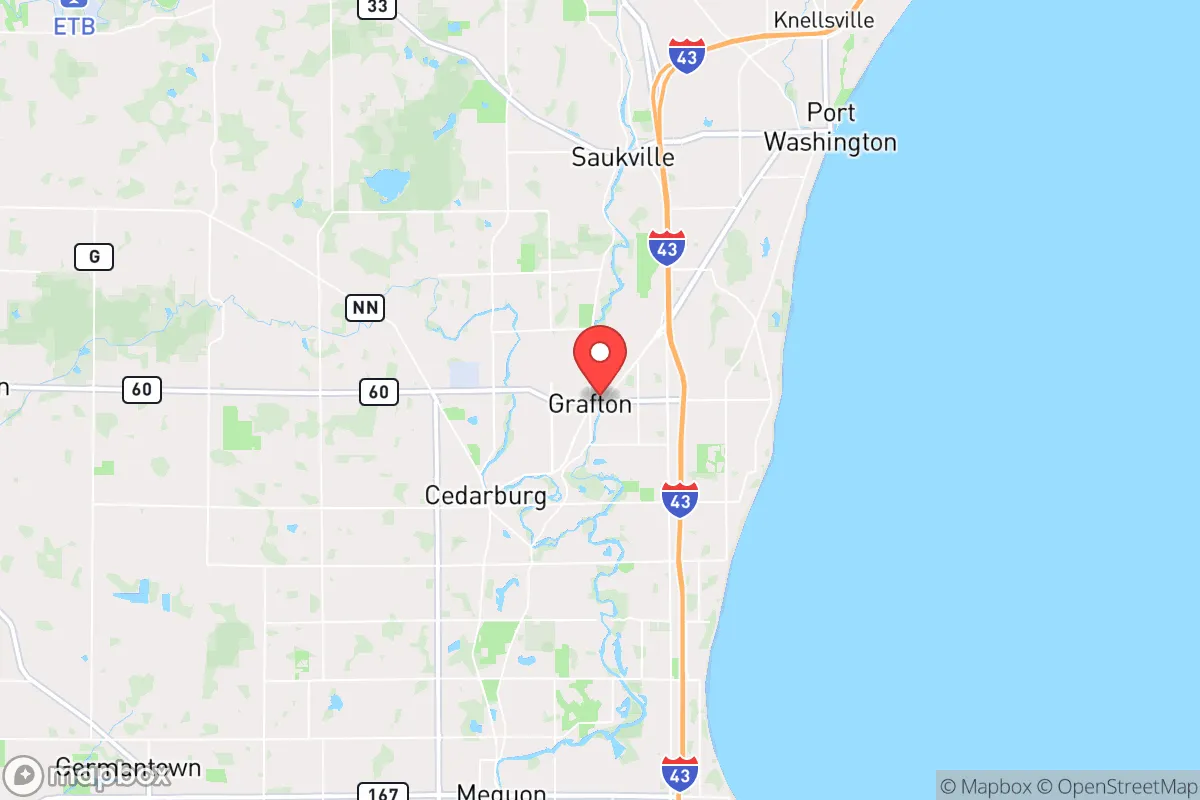
The people of Grafton, Wisconsin today number 12,274, forming a predominantly white, college-educated community (44.4% hold a bachelor's degree or higher) with a distinctly small-town character just 20 miles north of Milwaukee. The city's population is 89.6% white, with a Hispanic share of 3.2%, Black residents at 2.4%, East and Southeast Asian communities at 1.2%, and Indian-subcontinent residents at 0.7%. Foreign-born residents make up just 2.3% of the population, reflecting a community built overwhelmingly by domestic migration and multi-generational Wisconsin families rather than recent international arrivals.
How the city was settled and grew
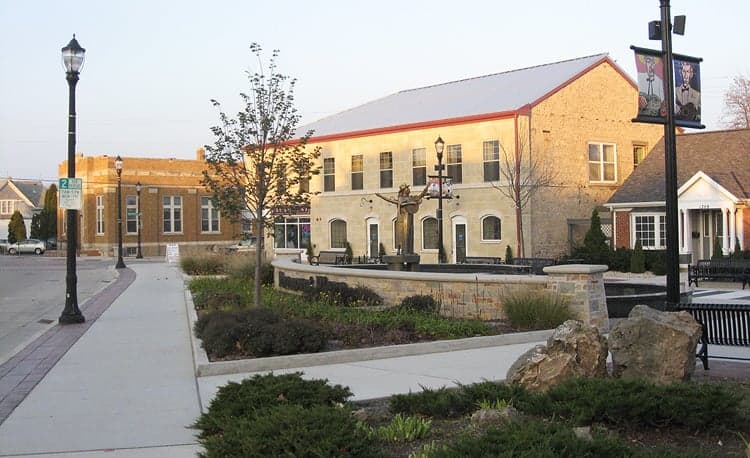
Grafton's human history begins with the Potawatomi and Menominee peoples who occupied the Milwaukee River valley before European settlement. The first permanent white settlers arrived in the 1830s and 1840s, drawn by the water power of the Milwaukee River and the dense hardwood forests. The village was platted in 1846 and incorporated in 1896, with its early economy anchored by sawmills, gristmills, and a tannery. The original Yankee and German settlers built their homes in what is now the Downtown Grafton Historic District, where many of the 19th-century commercial buildings and worker cottages still stand along Washington Street.
The defining demographic wave came with the German immigration of the 1840s through 1880s, which transformed Grafton into a heavily German-speaking community. These immigrants were farmers and craftsmen who settled the surrounding countryside and built the modest frame houses that still characterize the North Side neighborhood near the river. A smaller wave of Irish and Luxembourgish families arrived in the same period, settling along the bluffs east of the river in what became the Hilltop area. By 1900, Grafton was a classic German-American mill town, with the Ozaukee County courthouse in nearby Port Washington serving as the regional seat of government.
The early 20th century brought a second industrial wave. The Grafton State Bank building (1913) and the arrival of the Milwaukee Electric Railway & Light interurban line in 1908 connected the village to Milwaukee, attracting commuters and light manufacturers. The West Side neighborhood grew during this period, populated by second-generation German and Polish workers who found employment at the Grafton Shoe Factory and the Wisconsin Chair Company. The population remained overwhelmingly white and largely Protestant and Catholic German-American through the mid-20th century, with the 1950 census recording a population of just over 3,000.
Modern era (post-1965)
The post-1965 era brought suburbanization rather than international migration. The construction of Interstate 43 in the 1960s made Grafton a viable bedroom community for Milwaukee professionals, and the population more than doubled between 1960 and 1990. The Woodland Hills subdivision, developed in the 1970s and 1980s, absorbed much of this growth, attracting upper-middle-class white families with its large lots and proximity to the interstate. The River Bend development along the Milwaukee River followed in the 1990s, adding executive homes and townhouses.
Unlike many Milwaukee suburbs, Grafton's racial and ethnic diversification has been gradual and modest. The Hispanic population (3.2%) and Black population (2.4%) are concentrated primarily in the South Side rental stock and the older Downtown apartment buildings, reflecting service-sector workers employed at the Aurora Medical Center and local retail. The East and Southeast Asian community (1.2%) and Indian-subcontinent residents (0.7%) are largely professionals drawn to the area by engineering and healthcare jobs, dispersed throughout the newer subdivisions rather than clustered in any single neighborhood. The foreign-born share of 2.3% is roughly one-third the national average, indicating that Grafton remains a destination for domestic migrants rather than immigrants.
The future
Grafton's population is aging and slowly diversifying. The median age has crept upward as the large baby-boom cohort that moved in during the 1970s and 1980s ages in place, while younger families are drawn to newer developments like Prairie View on the city's western edge. The Hispanic and Asian shares are each projected to grow modestly over the next decade, driven by second-generation residents moving from Milwaukee and by continued professional hiring at the Aurora Medical Center and the nearby Rockwell Automation facility in Mequon. However, the foreign-born share is unlikely to rise dramatically, as Grafton lacks the rental housing stock and transit connections that typically attract new immigrant populations.
The next 10-20 years will likely see continued slow growth, with the population approaching 14,000 by 2040. The cultural identity is evolving from a purely German-American mill town into a more generic upper-middle-class Milwaukee suburb, with the historic German character preserved in the Downtown Historic District but diluted by newer residents with no local ancestry. The school district, which serves roughly 3,000 students, is becoming slightly more diverse each year, though it remains overwhelmingly white.
For someone moving to Grafton today, the city offers a stable, safe, and increasingly professional community where the old German-American character is visible in the architecture and festivals but no longer dominant in daily life. The population is modestly diversifying, well-educated, and economically secure, with the trade-off that this is not a place of rapid demographic change or cultural flux. New residents will find a welcoming but homogeneous community where the dominant identity is suburban Wisconsin rather than any particular ethnic heritage.

* Values derived from national, state, county, city and local statistics and may differ in a specific area. Last updated: 2026-10-12T02:07:22.000Z
Narrative content on this page is AI-generated and may contain mistakes. Verify any details that matter before acting on them.
ReloMaps may earn a commission from affiliate links at no extra cost to you.

