
Photo: Wikipedia
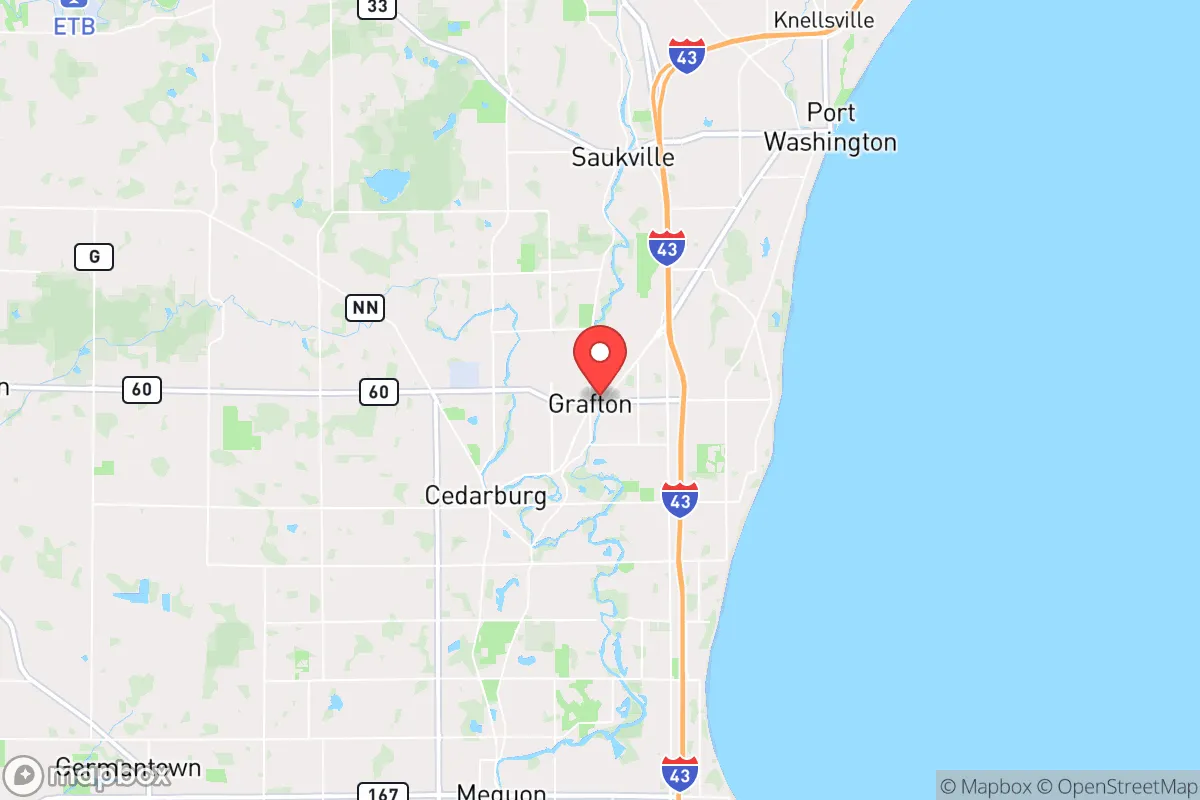
Personal Sovereignty in Grafton, WI
Moderate friction. Expect trade-offs in some aspect of personal liberty and independence.
What does Personal Sovereignty tell us?
Personal Sovereignty measures your capacity for self-reliance and independence with minimal government friction. Higher scores mean fewer barriers between you and the way you want to live... but it assumes you have the space you need and good neighbors.
What does this tell us?
Personal Sovereignty measures your capacity for self-reliance and independence with minimal government friction. Higher scores mean fewer barriers between you and the way you want to live... but it assumes you have the space you need and good neighbors.
State Policy
Energy independence: Importer (15% of energy produced in-state)
Personal Liberty
Homesteading

Personal Liberty Analysis
Grafton, Wisconsin, offers a notably high degree of personal sovereignty for a village of its size, anchored by a light-touch regulatory climate and a state legal framework that consistently favors individual autonomy over collective mandates. For families and single individuals weighing relocation, the practical question isn't whether Wisconsin is a free state — it's how Grafton specifically leverages that freedom. The answer: a tax burden that sits below the national average, a self-defense legal regime that respects the home as a castle, and a zoning code permissive enough to support meaningful self-reliance without requiring a rural retreat.
Tax burden and regulatory posture in Ozaukee County
Wisconsin's overall tax burden ranks in the middle of the pack nationally, but Grafton's local picture is more favorable than the state average suggests. The village's effective property tax rate lands around 1.8% of assessed home value, which is slightly below the national median and competitive with most of southeastern Wisconsin. Combined state and local sales tax is 5.6% — one of the lower rates in the Midwest, with no county-level add-on in Ozaukee County. Income tax is where Wisconsin takes a bigger bite, with a top marginal rate of 7.65%, but the state's married couple credit and retirement income exclusion meaningfully reduce the effective burden for families and retirees.
Regulatory posture is where Grafton shines for the autonomy-minded. The village operates under a classic Wisconsin general zoning code, but enforcement is complaint-driven rather than proactive. There is no mandatory composting, no plastic bag ban, no energy-efficiency retrofit mandates for existing homes, and no rent control. Building permits are required for structural changes, but minor repairs, sheds under 120 square feet, and most fencing projects proceed without paperwork. The state's right-to-farm law and its prohibition on local governments banning certain agricultural practices provide a baseline of protection that extends even into suburban-adjacent areas like Grafton.
Self-defense law and gun rights specifics
Wisconsin is a shall-issue state for concealed carry, and Grafton does not impose any local restrictions beyond state statute. That means no waiting periods, no assault weapons bans, and no magazine capacity limits — the village council has no authority to enact them under Wisconsin's state preemption statute, which explicitly reserves firearm regulation to the state legislature. For a resident, this translates to a predictable legal environment: a concealed carry permit requires an 8-hour training course and a background check, but issuance is mandatory if you meet the criteria.
Self-defense law in Wisconsin is among the most protective in the Upper Midwest. The state's castle doctrine creates a legal presumption that a person who uses deadly force against an unlawful intruder in their home, vehicle, or place of business reasonably feared imminent death or great bodily harm. There is no duty to retreat in any place where you are lawfully present — Wisconsin is a true stand-your-ground state, and Grafton's municipal code adds no additional restrictions. One practical note: Wisconsin does not recognize permitless carry, so a license is required for concealed carry, but open carry is legal without a permit for anyone 18 or older who can legally possess a firearm.
Self-reliance and homesteading viability in a village setting
Grafton's zoning code permits backyard chickens on lots as small as 10,000 square feet, with a cap of six hens and no roosters. Beekeeping is allowed with a simple registration, and compost bins are unrestricted. Vegetable gardens have no size limits, and the village does not regulate rainwater collection — a meaningful point, since some Wisconsin municipalities have attempted to restrict it. For those wanting more land, the unincorporated areas of the Town of Grafton, which surround the village, offer 2-to-5-acre parcels within a 10-minute drive of downtown, where the zoning is agricultural-residential and far more permissive.
Off-grid feasibility is realistic but not trivial. Wisconsin's net metering rules require utilities to credit solar generation at the retail rate, and Grafton's building code does not prohibit off-grid electrical systems, though a licensed electrician must perform the interconnection work. Rainwater cisterns for irrigation are legal, but potable water must come from a well or municipal supply — a state health code requirement. Wood burning is unrestricted in the village, though outdoor furnaces must be registered. The practical takeaway: full self-sufficiency within village limits is constrained, but 80% self-reliance — food, energy, and water for non-potable uses — is achievable without leaving the municipality.
Personal liberties: parental rights, medical autonomy, and property
Wisconsin's parental rights framework is among the strongest in the nation. The state's Parental Rights in Education statute requires schools to obtain written consent before administering any health survey or mental health screening, and parents have an explicit statutory right to direct their child's education, healthcare, and religious upbringing. Grafton's school district, part of the Northern Ozaukee School District, does not have a mask mandate policy on the books and follows state law on curriculum transparency — all instructional materials are available for parental review. Homeschooling is lightly regulated: parents need only file an annual enrollment form, with no testing requirements and no teacher certification mandates.
Medical autonomy is similarly protected. Wisconsin has no vaccine mandate for adults, and a 2023 state law prohibits employers from requiring COVID-19 vaccination as a condition of employment without a broad exemption process. The state's conscience clause allows healthcare providers to refuse participation in procedures they object to, and patients have broad rights to informed consent. On property rights, Wisconsin is a non-condemnation state for private economic development — eminent domain cannot be used to transfer property from one private owner to another for tax-revenue purposes, a protection that traces to a 2006 constitutional amendment. Grafton's municipal code does not regulate short-term rentals, political signage on private property, or home-based businesses beyond a simple home occupation permit.
Compared to neighboring states, Grafton's sovereignty profile is strongest on self-defense and parental rights, moderate on taxation, and weakest on energy independence — Wisconsin's utility monopoly structure limits third-party solar leasing. For a family or individual prioritizing personal freedom, the village offers a rare combination: the legal protections of a rural state with the practical amenities of a Milwaukee exurb, all within a regulatory environment that defaults to permission rather than prohibition.

* Values derived from national, state, county, city and local statistics and may differ in a specific area. Last updated: 2026-10-12T02:07:22.000Z
Narrative content on this page is AI-generated and may contain mistakes. Verify any details that matter before acting on them.
ReloMaps may earn a commission from affiliate links at no extra cost to you.

