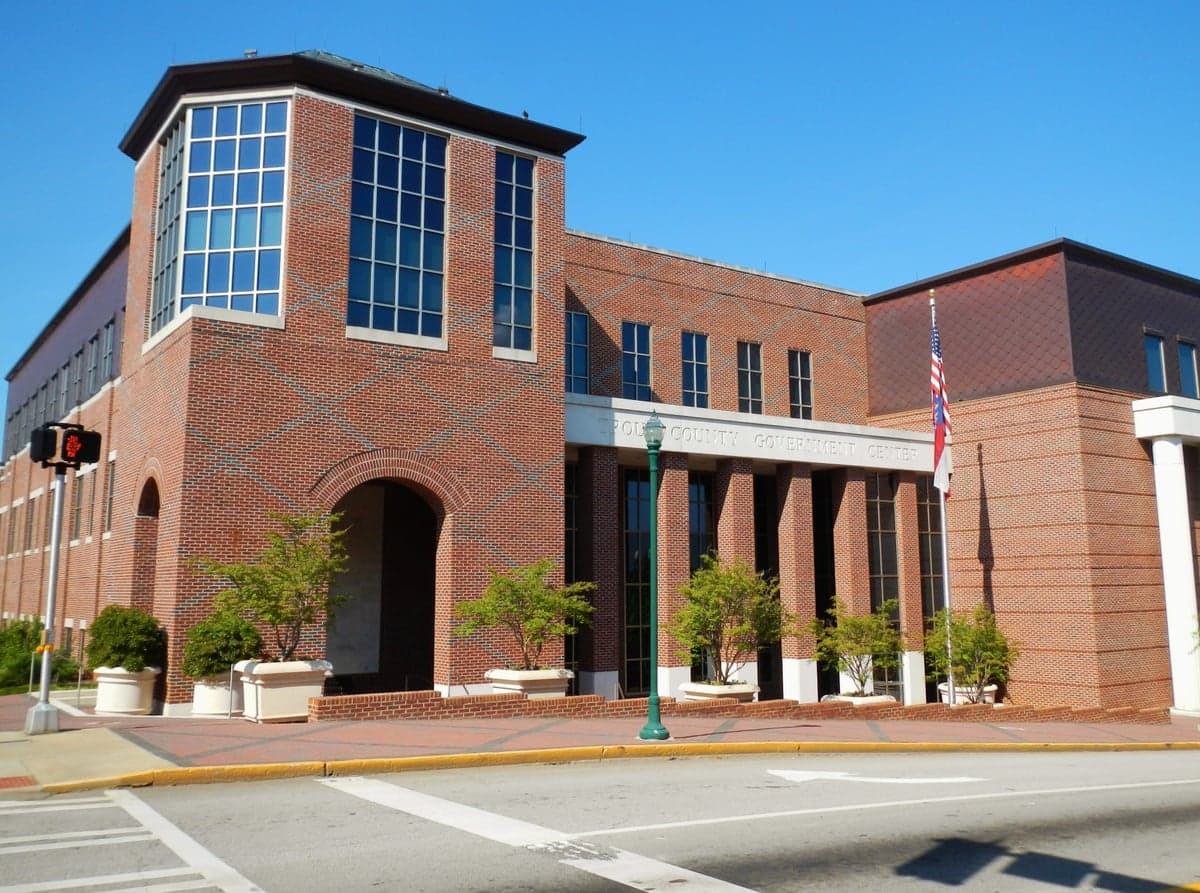
Photo: Wikipedia
Political ClimatePolitical Climate in Troup County
Showing district-level results — no local-only data available.
Local Political AnalysisPolitical Analysis of Troup County
Troup County, Georgia, is a reliably conservative area with a Cook Partisan Voting Index of R+15, meaning it votes about 15 points more Republican than the national average. This isn't a new development; the county has been a Republican stronghold for decades, though the margins have tightened slightly in recent years as the Atlanta suburbs creep southward. In the 2024 presidential election, Donald Trump carried the county with roughly 65% of the vote, down from 68% in 2020, reflecting a slow but real shift as new residents arrive from more competitive areas.
How it compares
Compared to the state of Georgia as a whole, Troup County is significantly more conservative. Georgia itself has become a true battleground state, with a Cook PVI of R+3 in 2024, meaning it leans only slightly Republican nationally. Troup County's R+15 rating places it firmly in the top tier of Georgia's most Republican counties, alongside neighbors like Harris County (R+20) and Meriwether County (R+18). The contrast is stark: while metro Atlanta counties like Fulton (D+30) and DeKalb (D+28) drive the state's Democratic performance, Troup County's votes help anchor the GOP's rural and exurban base. Within Troup County itself, there's variation. The city of LaGrange, the county seat and largest municipality, is the most moderate area, with precincts near the downtown and the LaGrange College campus occasionally voting within 5 points of the national average. In contrast, the smaller towns of Hogansville and West Point lean heavily Republican, often delivering 70% or more of their votes to GOP candidates. The rural precincts along the Alabama line are the most conservative in the county.
What this means for residents
For conservative residents, Troup County's political climate means their values are reflected in local governance. The county commission and school board are reliably Republican, and policy debates tend to center on tax rates, economic development, and infrastructure rather than social issues. For liberal residents, the reality is more nuanced. While they are a clear minority, they are not invisible. LaGrange has a small but active Democratic party organization, and the city's growing diversity — particularly its African American population, which makes up about 35% of the county — provides a natural base for progressive organizing. That said, liberal residents should expect to be outvoted on most county-level issues, and social gatherings or community events often carry a conservative tone. The practical impact is that property taxes remain low (the county's millage rate is among the lowest in the region), and business regulations are minimal, which appeals to the many manufacturing and logistics employers in the area.
Culturally, Troup County feels more like west Georgia than metro Atlanta. The presence of Kia Motors' massive assembly plant in West Point has brought a significant Korean-American community and a global economic outlook, but the area's social fabric remains rooted in Southern traditions — church attendance is high, gun ownership is common, and the pace of life is slower than in the capital. One notable policy distinction is the county's approach to development: Troup County has aggressively courted industrial investment, offering tax abatements and infrastructure support that have made it a logistics and manufacturing hub. This pro-business stance is broadly popular, even among residents who might disagree with the national GOP on other issues. For anyone moving here, the key takeaway is that Troup County is a place where conservative politics are the norm, but the community is pragmatic enough to welcome newcomers who contribute to its economic growth.

State Political ClimatePolitical Climate in Georgia
State Political AnalysisPolitical Environment in the State
Georgia has transformed from a reliably Republican stronghold into the nation’s premier political battleground, shifting from a +8-point GOP win in 2012 to a razor-thin Biden victory in 2020 and a near-tie in 2024. The state’s current lean is best described as a pure toss-up, driven by the explosive growth of the Atlanta metro, which now accounts for over 60% of the state’s population and pulls the state leftward, while the rest of Georgia remains deeply conservative. Over the last 20 years, the coalition has shifted from a solidly white, rural, and suburban Republican base to a multi-racial, urban-suburban Democratic coalition powered by Black voters, college-educated whites, and a growing Asian and Hispanic electorate.
Urban vs. rural divide
The political map of Georgia is a story of two Georgias. Metro Atlanta’s core counties—Fulton, DeKalb, Clayton, and Cobb—are the engine of the Democratic vote, with DeKalb and Clayton routinely delivering 80-85% Democratic margins. The northern Atlanta suburbs, particularly Gwinnett County, flipped from red to blue between 2016 and 2020, driven by an influx of Asian and Hispanic residents and college-educated professionals. Meanwhile, the rest of the state is overwhelmingly Republican. Rural south Georgia, from Valdosta to Waycross, votes 70-75% GOP, as do the exurban and small-town counties north of Atlanta like Pickens and Gilmer. The cities of Savannah (Chatham County) and Augusta (Richmond County) are blue islands in a sea of red, while Columbus (Muscogee County) leans Democratic but is more competitive. The key battlegrounds are the "collar counties" around Atlanta—Cherokee, Forsyth, and Henry—which are still red but trending purple as suburban sprawl continues.
Policy environment
Georgia’s policy environment is a mix of conservative governance and pragmatic moderation. The state has a flat income tax rate of 5.49%, which is being phased down to 4.99% by 2029, and a relatively low property tax burden compared to the national average. There is no state-level rent control, and zoning is largely local, though the "Georgia Planning Act" gives the state some oversight. On education, Georgia has a robust charter school system and a school voucher program (the "Georgia Promise Scholarship Act") that allows students in low-performing districts to use state funds for private school tuition. The state also has a "Parents’ Bill of Rights" that codifies parental access to curriculum and medical records. Healthcare policy is more mixed: Georgia did not expand Medicaid under the ACA, but it has a limited "Pathways to Coverage" program with work requirements. The state has some of the most restrictive abortion laws in the country, banning the procedure after six weeks (the "LIFE Act"), with exceptions for rape, incest, and medical emergencies. Election laws have been a flashpoint, with the 2021 "Election Integrity Act" (SB 202) adding voter ID requirements for absentee ballots, limiting drop boxes, and restricting third-party ballot collection.
Recent policy direction
The last five years have seen Georgia move decisively in a conservative direction on cultural and regulatory issues, even as the state’s electoral politics have become more competitive. On gun rights, Georgia is a "constitutional carry" state (HB 218, 2022), allowing permitless carry of firearms for anyone 21 or older. The state also has a "stand your ground" law and preempts local gun ordinances. On parental and education rights, the 2022 "Parents’ Bill of Rights" (SB 449) requires schools to notify parents of any medical or counseling services and prohibits instruction on "divisive concepts" related to race in schools. On speech and privacy, Georgia has a broad "right to farm" law protecting agricultural operations from nuisance lawsuits, and the state’s "Computer Crime Act" has been used to prosecute data scraping and online speech, though it is currently being challenged. On medical and bodily autonomy, the six-week abortion ban is the most restrictive in the Southeast, and the state has also passed a ban on gender-affirming care for minors (SB 140, 2023). Property rights are generally strong, with no statewide rent control and a "property rights" amendment to the state constitution. On voting and ballot access, SB 202 shortened the runoff election period from nine weeks to four, which some argue suppresses turnout, while others say it reduces voter fatigue. The state has also purged inactive voters from rolls, a practice upheld by courts.
Civil unrest & political movements
Georgia has been a focal point for political activism on both sides. The 2020 election cycle saw massive "Stop the Steal" protests in Atlanta and at the state capitol, culminating in the January 5, 2021 Senate runoff elections that flipped the chamber to Democrats. The "Fair Fight" movement, led by Stacey Abrams, has been a major force in voter registration and turnout, particularly among Black voters. On the right, the "Georgia Republican Assembly" and local "MAGA" groups are active in county GOP meetings, often clashing with more establishment Republicans. Immigration politics are heated but not as visible as in border states; Georgia passed a strict "show me your papers" law (HB 87) in 2011, but enforcement has been uneven. There are no sanctuary cities in Georgia, and several counties, including Gwinnett and Cobb, have passed resolutions opposing sanctuary policies. Election integrity remains a live issue, with ongoing audits and lawsuits over ballot drop boxes and absentee ballot deadlines. A new resident in Macon or Athens would notice the political polarization in yard signs and local news, but actual civil unrest is rare outside of organized protests at the capitol.
Projection
Over the next 5-10 years, Georgia is likely to remain a toss-up state, but the demographic trends favor a slow leftward drift. The Atlanta metro is adding 100,000 people a year, many of them from blue states and abroad, which will continue to turn purple suburbs like Forsyth and Henry blue. However, the rural and exurban areas are also growing, driven by domestic migration from the Midwest and Northeast, and they are voting even more Republican than before. The wild card is the Hispanic and Asian populations, which are growing rapidly but are not yet reliably Democratic—many are socially conservative and could shift the balance if Republicans make inroads. The state’s policy direction will likely remain conservative on cultural issues (abortion, guns, education) even as the electorate becomes more competitive, because the state legislature is heavily gerrymandered to favor rural and exurban Republicans. A new resident moving to Georgia in 2026 should expect a state that is politically divided, with a Republican-controlled legislature and governor’s office, but with Democratic gains in the Atlanta suburbs that could flip the state in presidential elections. The practical reality is that your vote will matter more here than in almost any other state.
For a new resident, the bottom line is that Georgia offers a conservative policy environment—low taxes, strong gun rights, school choice, and restrictive abortion laws—but with a political landscape that is genuinely competitive and changing fast. If you are a conservative, you will find your values reflected in state law, but you will also live in a state where the other side is growing and has real power in the cities and suburbs. If you are a liberal, you will find a vibrant and growing political community in Atlanta, Savannah, and Athens, but you will be living under a state government that is actively restricting abortion, limiting transgender rights, and tightening voting laws. Either way, Georgia is a state where politics is not abstract—it is in your neighborhood, your school board, and your ballot box every two years.
* Values derived from national, state, county, city and local statistics and may differ in a specific area. Last updated: 2026-07-03T14:54:38.000Z
Narrative content on this page is AI-generated and may contain mistakes. Verify any details that matter before acting on them.
ReloMaps may earn a commission from affiliate links at no extra cost to you.

