
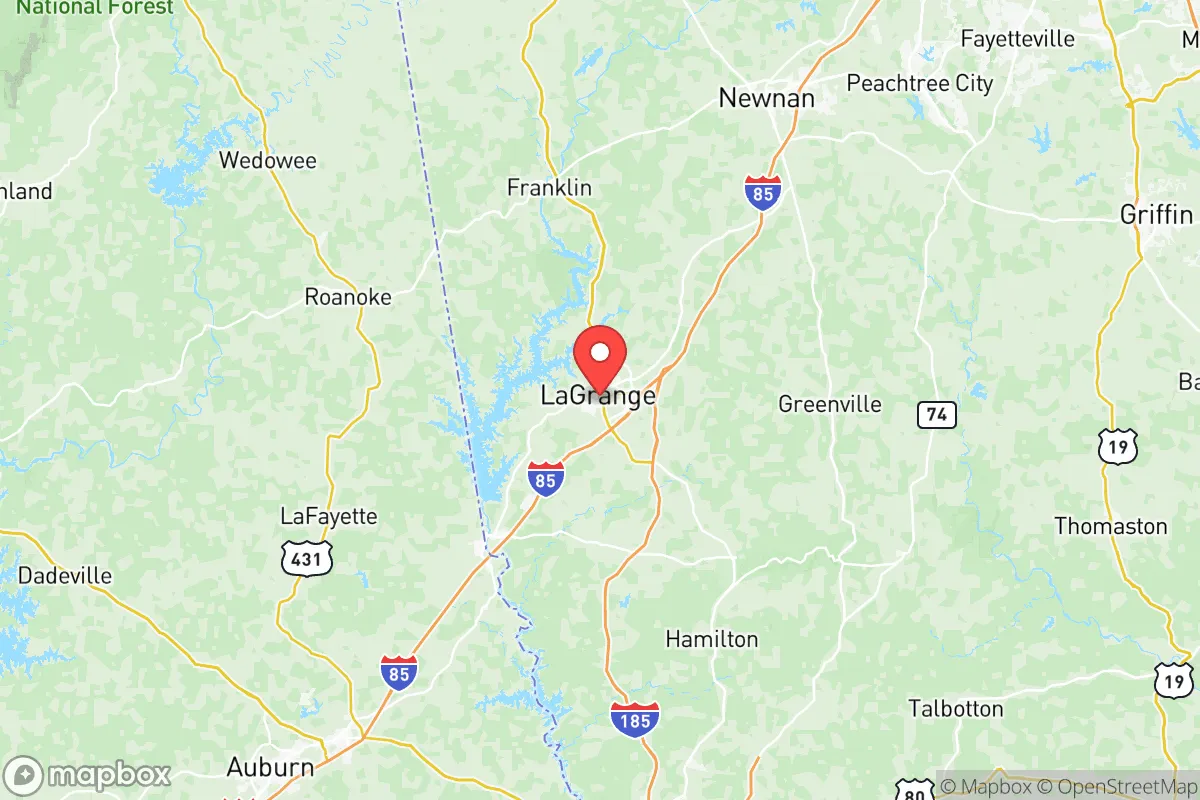
Photo: Wikipedia
Personal Sovereignty in Troup County
Viable for self-reliance. Generally workable, though some barriers may limit total independence.
What does Personal Sovereignty tell us?
Personal Sovereignty measures your capacity for self-reliance and independence with minimal government friction. Higher scores mean fewer barriers between you and the way you want to live... but it assumes you have the space you need and good neighbors.
What does this tell us?
Personal Sovereignty measures your capacity for self-reliance and independence with minimal government friction. Higher scores mean fewer barriers between you and the way you want to live... but it assumes you have the space you need and good neighbors.
State Policy
Energy independence: Importer (12% of energy produced in-state)
Personal Liberty
Homesteading

Personal Liberty Analysis
Troup County, Georgia, offers a notably high degree of personal sovereignty, grounded in Georgia’s broader constitutional and statutory framework that favors limited government and individual autonomy. The county’s regulatory posture is generally light-touch, with local governance in cities like LaGrange, Hogansville, West Point, and the unincorporated areas of Mountville and Pine Mountain Valley reflecting a pro-business, pro-property-rights ethos that appeals to those seeking to minimize government entanglement in daily life. For single individuals and families prioritizing independence, Troup County presents a balanced environment where state-level preemptions on firearms, property rights, and parental authority create a predictable legal landscape, while local zoning and tax policies offer tangible advantages over more heavily regulated metro Atlanta counties.
Tax burden and regulatory posture in Troup County
Georgia’s state-level tax structure is among the most favorable in the Southeast for those seeking to retain earnings and build wealth. There is no state estate or inheritance tax, and the state income tax is a flat 5.39% as of 2026, with ongoing legislative discussions about further reductions. Troup County’s property tax millage rate is competitive: the county-wide rate hovers around 12.5 mills, with the LaGrange city rate adding roughly 4 additional mills, resulting in an effective rate of about 1.1% of assessed value for a median-priced home. This is significantly lower than the 1.5–2.0% rates common in metro Atlanta counties like Fulton or DeKalb. Sales tax in Troup County is 8%, which includes a 1% Special Purpose Local Option Sales Tax (SPLOST) for infrastructure, but essential groceries are exempt. The regulatory environment is characterized by minimal business licensing hurdles and a right-to-work status that limits union influence, making the county attractive for entrepreneurs and remote workers. Zoning in unincorporated areas is generally permissive, with no county-wide building moratoriums or overly restrictive land-use codes, though the City of LaGrange does enforce standard subdivision and setback requirements within its limits. For a family or individual looking to minimize tax and regulatory drag, Troup County’s posture is distinctly light-touch compared to the Atlanta metro core.
Self-defense and gun law specifics in Troup County
Georgia is a shall-issue state for concealed carry permits, and Troup County’s probate court processes applications efficiently, typically within 30 days. As of 2022, Georgia became a constitutional carry state, meaning law-abiding residents 21 and older can carry a handgun openly or concealed without a permit, though a permit remains useful for reciprocity when traveling. There is no state-level registry, no magazine capacity limit, and no ban on any class of firearm, including AR-15-style rifles. Troup County Sheriff’s Office publicly supports Second Amendment rights, and local gun culture is robust, with multiple indoor and outdoor ranges in the area, including the LaGrange Gun Club and the West Point Lake Shooting Range. Stand-your-ground laws apply statewide, with no duty to retreat in any place where a person is lawfully present. For a reader prioritizing self-defense autonomy, Troup County offers one of the most permissive legal environments in the country, with no local ordinances that exceed state law. The cities of Hogansville and West Point have no additional firearm restrictions beyond state statutes, and the county’s rural character means that firearm ownership for hunting and personal protection is a normalized part of daily life.
Self-reliance and homesteading viability in Troup County
For those interested in homesteading, off-grid living, or substantial self-reliance, Troup County’s unincorporated areas are highly accommodating. Minimum lot sizes in agricultural and rural residential zones are typically 1 to 5 acres, with many parcels available in the 5–20 acre range near Mountville and Pine Mountain Valley. There are no county-wide bans on rainwater collection, and well and septic systems are permitted with standard health department approvals. Solar panel installation is unrestricted in unincorporated areas, though the City of LaGrange requires a standard building permit for roof-mounted systems. Livestock keeping—including chickens, goats, and cattle—is allowed on parcels of 1 acre or more in most rural zones, with no county-wide prohibition on beekeeping or small-scale farming. The county’s agricultural extension office provides soil testing and resources for new homesteaders. Off-grid living is feasible, but full independence from the electrical grid requires a backup generator or substantial battery storage, as net metering with Georgia Power is available but not required. Compared to the restrictive zoning in metro Atlanta counties, Troup County’s rural areas offer a practical path to self-reliance without excessive bureaucratic hurdles. The unincorporated community of Long Cane is particularly noted for its large tracts and minimal regulatory oversight.
Personal liberties in Troup County: parental rights, medical autonomy, speech, and property
Georgia law provides strong protections for parental rights, including the Parental Bill of Rights enacted in 2022, which affirms that parents have the fundamental right to direct the upbringing, education, and healthcare of their minor children. Troup County School System, which serves LaGrange and surrounding areas, generally respects parental input, though specific curriculum opt-out policies vary by school. Medical autonomy is supported by Georgia’s lack of a state-level vaccine mandate for adults and a relatively permissive stance on alternative medical treatments, though telemedicine and direct-primary-care arrangements are available. Freedom of speech and assembly are protected under both the U.S. and Georgia constitutions, and Troup County has no local ordinances that restrict public expression beyond standard time-place-manner rules. Property rights are strongly protected: Georgia is a property-rights-friendly state with no statewide rent control, and Troup County has no county-wide short-term rental bans, though the City of LaGrange does require a business license for Airbnb-style rentals. Eminent domain is rarely exercised for private development, and the county’s zoning board of appeals is known for granting variances when property owners demonstrate hardship. For a reader who values the ability to use their land and raise their family without excessive government interference, Troup County’s legal climate is among the most favorable in the state.
Overall, Troup County ranks as a high-sovereignty area within Georgia, offering a regulatory and tax environment that is significantly lighter than the Atlanta metro core while still providing access to essential services and infrastructure. Compared to neighboring counties like Harris or Meriwether, Troup offers a similar level of personal freedom with slightly better access to employment and healthcare in LaGrange. For single individuals and families who prioritize self-defense rights, homesteading feasibility, and minimal tax burden, Troup County represents a strong choice in west Georgia, with the added benefit of being within a two-hour drive of Atlanta, Montgomery, and Birmingham. The county’s balance of rural autonomy and practical amenities makes it a compelling option for those seeking to maximize personal sovereignty without complete isolation.

* Values derived from national, state, county, city and local statistics and may differ in a specific area. Last updated: 2026-07-03T14:54:38.000Z
Narrative content on this page is AI-generated and may contain mistakes. Verify any details that matter before acting on them.
ReloMaps may earn a commission from affiliate links at no extra cost to you.

