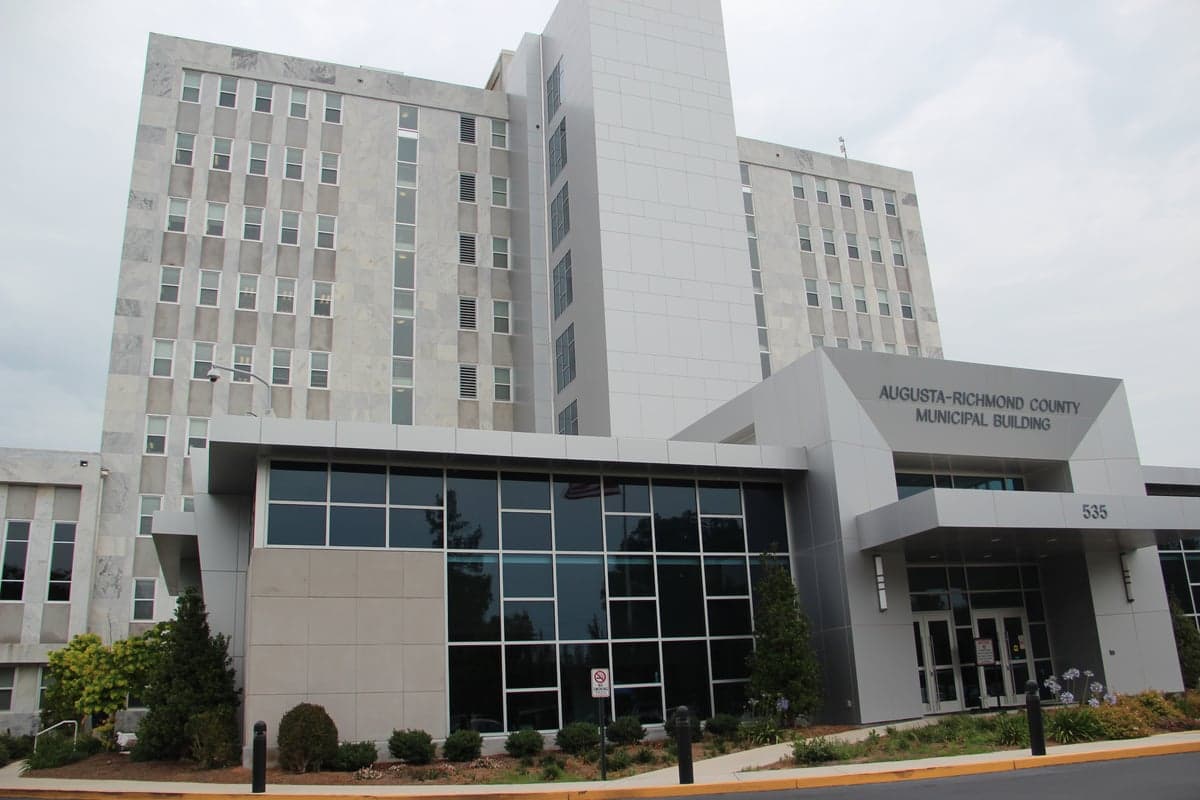
Photo: Wikipedia
Political ClimatePolitical Climate in Richmond County
Showing district-level results — no local-only data available.
Local Political AnalysisPolitical Analysis of Richmond County
Richmond County, anchored by Augusta, has long been a Democratic stronghold in Georgia, but its trajectory is more complex than a simple blue-dot-in-a-red-state story. The county's Cook PVI of R+7 might seem contradictory, but that number reflects the conservative lean of the entire congressional district, which stretches well into rural areas. Inside the county itself, the political reality is a tale of two cities: a reliably blue urban core that has trended even more Democratic in recent cycles, and a surrounding mix of suburbs and exurbs that have shifted rightward, mirroring national suburban shifts. You can see this split most clearly when you compare precincts in Augusta's historic districts, like Summerville, which have grown more liberal, with the rapidly developing areas around Evans and Martinez in neighboring Columbia County, which are deeply Republican and pull the district's overall PVI red.
How it compares
Compared to Georgia as a whole, Richmond County is more intensely Democratic than the state average, but its influence is checked by the fast-growing, heavily Republican suburbs outside its borders. While Georgia's statewide Cook PVI is effectively a toss-up (often cited as R+3 in recent years), Richmond County consistently delivers 55-60% of its vote for Democratic presidential candidates. The difference is stark: a precinct like Harrisburg might go 80% Democrat, while a rural precinct in the county's southern end, near the former town of Blythe, can swing 60-70% Republican. State-level races often break differently here than in the rest of Georgia; for instance, Richmond County typically backs Democratic Senate candidates by wider margins than the Atlanta suburbs do, but its votes are more concentrated. The county's trajectory is also distinct: while Georgia's rural areas are bleeding Democratic votes, Richmond County's urban core has held steady, and in some cases, grown bluer due to an influx of younger professionals in the medical and tech sectors tied to the Georgia Cyber Center.
What this means for residents
For a conservative resident of Richmond County, especially in the southern or western fringes, the practical effect is that you're often voting against the local tide but aligning with the broader congressional district. Local elections in Augusta, however, are where the Democratic lean is most felt—school board and city council races are often decided in the Democratic primary. For a liberal resident, especially in the core neighborhoods like Laney-Walker or the revitalizing downtown around Broad Street, the political environment is more affirming than in much of Georgia. The county's Democratic machine, built around the local party and historically Black churches, still holds considerable sway. However, the growing conservative suburbs mean that any county-wide referendum or tax issue can be a nail-biter, depending on turnout. The political climate also means that services like public transit and affordable housing tend to get more public funding and attention than in surrounding red counties, where such initiatives often stall.
In terms of cultural and policy distinctions, Richmond County stands out for its more progressive stances on local governance. The Augusta Commission, which also serves as the county commission under the city's consolidated government, has passed anti-discrimination ordinances and consistently funds the arts at higher levels than neighboring counties. The city's reliance on the Savannah River and its historic ties to the medical community (with Augusta University's Health System) create a political culture that values infrastructure and public health investment—issues that don't always align with the anti-tax conservatism of the district's rural portions. For newcomers, the biggest surprise is usually how the county manages its police and fire services: a dedicated sales tax (SPLOST) overwhelmingly approved by voters funds public safety, a sign of a pragmatic political center that still exists, even amid the partisan divides. Locals will tell you that while the national noise is loud, day-to-day politics here is more about potholes and hospital funding than any culture war.

State Political ClimatePolitical Climate in Georgia
State Political AnalysisPolitical Environment in the State
Georgia has transformed from a reliably Republican stronghold into the nation’s most competitive swing state, with a partisan lean that now sits essentially dead even. The 2020 presidential election saw Joe Biden win the state by just 11,779 votes—a margin of 0.23%—and the 2024 race is expected to be equally tight. This shift has been driven by a decade-long demographic transformation: explosive growth in the Atlanta metro, particularly in Cobb, Gwinnett, and Henry counties, has added hundreds of thousands of younger, more diverse, and more college-educated voters who lean Democratic, while rural and exurban areas have hardened their Republican allegiance. The result is a state where both parties hold real power, and where the political climate is defined by constant tension and negotiation.
Urban vs. rural divide
The political map of Georgia is a classic story of urban islands surrounded by a red sea. The Atlanta metro—including Fulton, DeKalb, Cobb, Gwinnett, and Clayton counties—accounts for roughly 60% of the state’s population and votes overwhelmingly Democratic. In 2020, Biden won Fulton County by 73 points and DeKalb by 82 points. Meanwhile, rural south Georgia and the exurban north are deeply Republican: counties like Murray, Gilmer, and Union in the north routinely vote 80%+ Republican, and the “Wiregrass” region around Tifton and Valdosta is similarly red. The swing counties are the fast-growing suburbs and exurbs: Henry County flipped from +17 R in 2012 to +14 D in 2020, Forsyth County went from +66 R to +44 R, and Columbia County (Augusta’s bedroom community) remains solidly red but is drifting leftward as Atlanta commuters move in. The cities of Savannah, Augusta, Macon, and Columbus are Democratic-leaning but surrounded by conservative rural areas, making them competitive at the local level.
Policy environment
Georgia’s policy environment is a mix of conservative governance and pragmatic moderation. The state has a flat income tax rate of 5.49% (set to drop to 4.99% by 2029 under HB 1437), and no estate or inheritance tax. Property taxes are relatively low, with a median effective rate of 0.87% of home value. The state is a “right-to-work” state with a Republican-controlled legislature that has consistently passed business-friendly tort reform and regulatory streamlining. Education policy is a flashpoint: Georgia has a robust charter school system and a school voucher program (the Georgia Promise Scholarship Act, passed in 2024) that provides $6,500 per student for private school tuition, but public school funding remains a perennial issue, with teacher pay raises of $2,000-$5,000 in recent years. Healthcare is a major divide: the state has not expanded Medicaid under the ACA, leaving roughly 300,000 low-income adults in a coverage gap. Election laws have been contentious: SB 202 (2021) added voter ID requirements for absentee ballots, limited drop boxes, and restricted third-party ballot collection, while also expanding early voting hours in most counties. Gun laws are permissive: permitless carry was enacted in 2022 (HB 218), and the state has a “stand your ground” law. Abortion is banned after six weeks under the 2019 “Heartbeat Bill” (HB 481), which took effect after the Dobbs decision in 2022.
Recent policy direction
The last five years have seen Georgia lurch rightward on social issues while maintaining a pro-business posture. On gun rights, HB 218 (2022) eliminated the requirement for a permit to carry a concealed firearm, making Georgia one of 25 permitless carry states. On education, the Georgia Promise Scholarship Act (2024) created a universal school voucher program, though it’s capped at $140 million annually. On parental rights, SB 88 (2022) allows parents to opt their children out of any school assignment they find objectionable, and HB 1084 (2022) restricts classroom discussion of “divisive concepts” related to race. On medical autonomy, the six-week abortion ban (HB 481) has no exceptions for rape or incest, only for medical emergencies. On privacy and surveillance, the state has no comprehensive data privacy law, but a 2023 law (SB 36) restricts local governments from collecting certain biometric data. On property rights, Georgia is a “Dillon’s Rule” state, meaning local governments have only the powers explicitly granted by the state—this has been used to preempt local ordinances on short-term rentals, tree protections, and minimum wage. On voting, SB 202 (2021) remains the most consequential law: it reduced the time to request an absentee ballot, banned mobile voting buses, and made it a crime to give food or water to voters waiting in line (though that provision was later clarified). The overall direction is toward more conservative social policy, but with enough moderation to keep the business community and suburban moderates from fleeing.
Civil unrest & political movements
Georgia has been a focal point for political activism on both sides. The 2020 election saw massive protests in Atlanta after the killing of George Floyd, with the city becoming a hub for the Black Lives Matter movement. The “Stop the Steal” movement was also active, with a large rally at the state capitol in November 2020 and ongoing election integrity activism led by groups like the Georgia Republican Assembly. Immigration politics are less visible than in border states, but the 2024 passage of SB 452 (which requires local law enforcement to cooperate with ICE) has sparked protests from immigrant rights groups. There is no sanctuary city in Georgia; in fact, a 2009 law (HB 2) prohibits sanctuary policies, and several counties—including Gwinnett and Cobb—have faced lawsuits over alleged non-compliance. The “Cop City” controversy in DeKalb County (the proposed Atlanta Public Safety Training Center) has been a major flashpoint since 2021, with violent protests, arson attacks, and a state law (SB 44, 2023) that classifies the facility as “critical infrastructure” with enhanced penalties for trespassing. Election integrity remains a live issue: the 2022 gubernatorial race saw Stacey Abrams lose by 7.5 points, and while she conceded, many activists on the left continue to question the fairness of the state’s election system. On the right, the 2024 presidential primary saw Donald Trump win Georgia easily, but the state’s Republican establishment—led by Governor Brian Kemp and Secretary of State Brad Raffensperger—has maintained distance from Trump’s election fraud claims, creating a persistent intraparty tension.
Projection
Over the next 5-10 years, Georgia is likely to remain a swing state, but with a slight Democratic lean in presidential elections and continued Republican control of the state legislature. The key demographic driver is the Atlanta metro’s continued growth: the region is expected to add 1.5 million people by 2035, with most of that growth in the diverse, college-educated suburbs of Gwinnett, Cobb, and Henry counties. This will make it increasingly difficult for Republicans to win statewide without strong performance in the exurbs and rural areas. However, the state’s legislative maps are gerrymandered to favor Republicans, and the state’s voter ID laws and limited early voting in rural areas will continue to suppress Democratic turnout in some regions. The wild card is the 2026 gubernatorial election: if a Democrat wins, it could trigger a wave of policy changes on Medicaid expansion, voting access, and education funding. If a Republican wins, expect continued conservative social policy with incremental moderation on economic issues. For a new resident, the practical takeaway is that Georgia will remain a place where your vote matters—but where the political climate is also shaped by constant legal battles over election laws, abortion, and education. The state is not going to flip blue overnight, nor is it going to become a deep red Texas. It’s a purple state that will stay purple for the foreseeable future.
Bottom line for a new resident: If you’re conservative, you’ll find a state that generally aligns with your values on taxes, guns, and education, but you’ll need to accept that your vote will be contested and that the Atlanta metro will continue to push the state left. If you’re liberal, you’ll find a state where your vote can actually swing elections, but you’ll face a legislature that is hostile to your priorities on abortion, voting, and labor rights. Either way, Georgia is a state where politics is a contact sport—and where the outcome of every election feels like it matters more than in almost any other state.
* Values derived from national, state, county, city and local statistics and may differ in a specific area. Last updated: 2026-06-25T10:45:44.000Z
Narrative content on this page is AI-generated and may contain mistakes. Verify any details that matter before acting on them.
ReloMaps may earn a commission from affiliate links at no extra cost to you.

