
Photo: Wikipedia
Personal Sovereignty in Richmond County
Viable for self-reliance. Generally workable, though some barriers may limit total independence.
What does Personal Sovereignty tell us?
Personal Sovereignty measures your capacity for self-reliance and independence with minimal government friction. Higher scores mean fewer barriers between you and the way you want to live... but it assumes you have the space you need and good neighbors.
What does this tell us?
Personal Sovereignty measures your capacity for self-reliance and independence with minimal government friction. Higher scores mean fewer barriers between you and the way you want to live... but it assumes you have the space you need and good neighbors.
State Policy
Energy independence: Importer (12% of energy produced in-state)
Personal Liberty
Homesteading

Personal Liberty Analysis
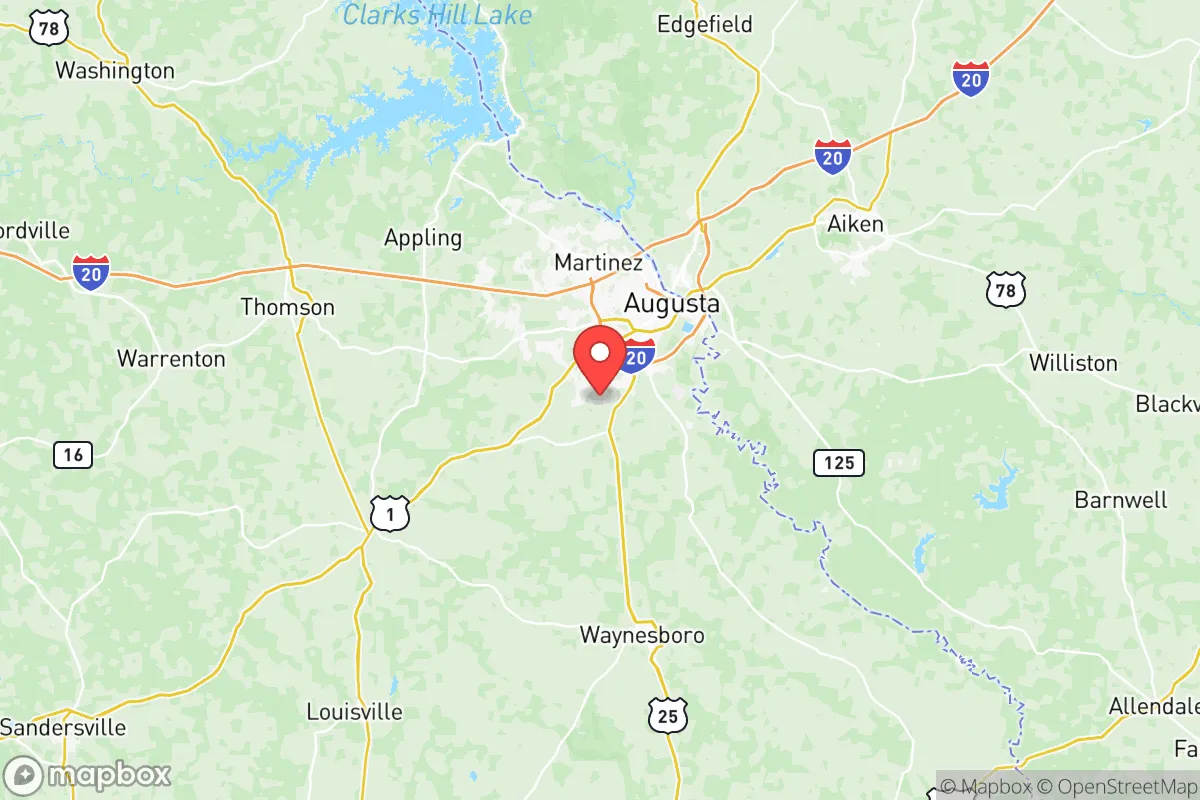
Richmond County, anchored by Augusta, presents a mixed picture of personal sovereignty that balances Georgia’s generally pro-freedom state framework against stricter local ordinances, particularly in the urban core. While Georgia tilts conservative on self-defense, taxation, and parental rights, Augusta’s city-county consolidated government imposes a heavier regulatory hand than much of the surrounding area, especially in unincorporated pockets like Hephzibah, Blythe, and northeastern tracts near the Savannah River. For families and individuals seeking maximum autonomy—whether through gun rights, low taxes, or off-grid living—the county’s eastern and southern fringes offer more breathing room than the downtown Augusta or its bedroom suburbs.
Tax burden and regulatory posture
Georgia is a moderate-tax state with a flat income tax rate of 5.49% (with ongoing rate reduction legislation) and a state sales tax of 4%, but Richmond County adds a local option sales tax of 2%, bringing the total to 7% in Augusta proper. The county’s property tax millage rate, at roughly 20.5 mills for the Augusta-Richmond consolidated government, is nearly double the Georgia median of ~10 mills, thanks to a heavy local school tax and overlapping municipal levies. This creates a noticeable split: in unincorporated Hephzibah, property tax bills can be 30–40% lower than in Augusta’s urban core due to lower millage rates and reduced service demands. Regulatory posture is mixed—Richmond County enforces a minimum 1-acre lot size for new single-family homes outside the urban service boundary, but inside Augusta city limits, zoning is tighter, with strict setbacks, noise ordinances, and business licensing fees that can run $200–$500 annually for a home-based enterprise. For homesteaders or small farmers, the county’s preferential agricultural assessment (CUVA) can cut property taxes by up to 50% on land actively used for forestry or crops, but only parcels over 10 acres qualify in practice, limiting options for suburban mini-farms.
Self-defense and gun law specifics
Georgia is a constitutional carry state—since 2022, no permit is required to carry a concealed handgun for anyone 21 or older who can legally possess a firearm. Richmond County fully honors this state preemption, meaning no local ordinances ban open or concealed carry in public spaces except for statutorily restricted areas like schools, courthouses, and government buildings. The sheriff’s office in Augusta issues concealed carry permits for reciprocity purposes, with a processing time averaging 30–45 days as of 2026. Local gun culture leans markedly practical: the Augusta Gun Club and multiple outdoor ranges operate without controversy, and stand-your-ground laws apply statewide, with no duty to retreat in any place you are lawfully present. However, do note that Richmond County has a higher-than-average violent crime rate—about 550 violent crimes per 100,000 residents (2024) vs. the Georgia average of 380—which drives many residents in Blythe and rural McBean to maintain home defense weapons as a matter of routine, while Augusta’s urban neighborhoods see more restrictive homeowners' association rules that sometimes prohibit firearms in common areas. The minimal bureaucratic friction here is a strong plus for sovereignty-minded relocators.
Self-reliance and homesteading viability
For those seeking true off-grid or semi-self-sufficient living, Richmond County offers stark contrasts. In Hephzibah, unincorporated areas allow chickens, goats, and up to two horses per acre without a special permit, and well water is legally accessible as long as the parcel is at least 1 acre. In Blythe, in the county’s far northeast, zoning is even lighter—no building permit is required for structures under 400 square feet used for agricultural storage, and rainwater collection is unrestricted by local code (Georgia itself only limits it for potable use). Solar panel installation is straightforward under Georgia’s net metering policy, though Richmond County requires a $75 permit fee for residential solar and an electrical inspection. The county’s average lot size for new subdivisions is 0.5 acres in Augusta, but open agricultural land in McBean and along River Road regularly sells in 5–20 acre parcels, often at $5,000–$8,000 per acre—affordable by national standards. Off-grid feasibility is higher than 70% of U.S. counties, but note that Richmond County does not recognize composting toilets as primary sewage; you must connect to public sewer or install a septic system, a $5,000–$10,000 upfront cost. The biggest barrier to full self-reliance is the county health department’s requirement that dwellings must have a permanent water source (well or public) to get a certificate of occupancy—no "dry camping" on your own land unless it is zoned recreational or agricultural with a 5-acre minimum.
Personal liberties
Georgia law provides robust parental rights through HB 1178 (the Parental Bill of Rights, 2022), which gives parents the explicit right to direct their child’s education, medical care, and religious upbringing without state interference. Richmond County schools, operated by the consolidated Richmond County School System, do not mandate masking or vaccination for attendance as of 2026, and school board meetings have seen active parental oversight on curriculum choices. Medical autonomy is generally supported: Georgia is a tort-reform state with no vaccine passport requirement, and telehealth for mental health or primary care is widely available without cost-prohibitive licensure hurdles. Speech protections are strong—Augusta does not impose noise ordinances that restrict political signage or public gatherings, and the county’s public comment period at commission meetings is 3 minutes per person, uncensored. Property rights are reinforced by Georgia’s private property protection act, which requires just compensation for any regulatory taking; Richmond County’s planning commission rarely engages in spot zoning or eminent domain beyond infrastructure projects. However, historic preservation rules in Augusta’s Summerville district can limit exterior modifications to homes over 50 years old, a friction point for DIY renovators. Overall, personal liberties here are near the top of Georgia’s metro counties, falling short only of truly rural counties like Glascock or Lincoln.
Relative to other Georgia areas, Richmond County’s sovereignty profile is tiered: taxes and zoning are heavier than outlying counties like Columbia or Jefferson, but self-defense freedoms, homesteading options in the fringes (especially Hephzibah and Blythe), and strong state-level protections for parental and medical autonomy make it a solid mid-tier choice for those valuing independence. The key trade-off is proximity to Augusta’s jobs and healthcare versus the lighter government footprint in McBean’s 10-acre homesteads or Hephzibah’s small-acreage farms. For a conservative-leaning family that wants city amenities without surrendering core freedoms, Richmond County works well—provided you buy outside the urban core.

* Values derived from national, state, county, city and local statistics and may differ in a specific area. Last updated: 2026-06-25T10:45:44.000Z
Narrative content on this page is AI-generated and may contain mistakes. Verify any details that matter before acting on them.
ReloMaps may earn a commission from affiliate links at no extra cost to you.

